The Independent Uganda: You get the Truth we Pay the Price



Kampala, Uganda | URN | Makerere University has sworn in the newly elected guild leadership amid chanting and jubilation across student halls.
Gracious Kadondi, who was elected as the 92nd Guild President of the university, pledged to restore unity among students following divisions that arose during the campaign period.
Kadondi, who was fronted by the National Unity Platform(NUP), promised to rebuild a united student voice rather than relying solely on the powers of the guild office to address student issues.
She noted that she will not work in isolation but will collaborate with other aspirants who contested against her, adding that she intends to merge their ideas with hers to serve students effectively.
On student welfare, Kadondi suggested enforcing a student’s work scheme, through which students are able to access part-time jobs to help them meet their financial needs and gain work experience. She noted that the program currently benefits only a few students and pledged to advocate for more slots so that more students can be employed on campus.
Churchill Ssentamu, the outgoing Guild President, expressed deep appreciation for the opportunity to serve, emphasizing that his leadership journey was shaped by faith, family support, and the trust of the student body.
Reflecting on his time in office, he challenged common perceptions of leadership, stating that it is “not about noise, popularity, or convenience,” but rather about responsibility, consistency, and the willingness to make difficult decisions.
During his farewell address, Ssentamu recalled key moments from his tenure, including periods of public criticism that, according to him, ultimately strengthened his resolve and leadership approach. He underscored that such challenges are essential in shaping character and institutional integrity.
The outgoing president offered both congratulations and caution, stressing that leadership requires discipline, fairness, and a commitment to evidence-based decision-making rather than political convenience. He urged the new administration to build enduring systems, welcome constructive criticism, and safeguard trust, warning that once lost, it is difficult to regain.
He also called on the student body to remain active participants in governance, encouraging them to demand accountability and critically assess leadership beyond campaign promises.
Neena Else Kalazani, a student of Applied Psychology, was appointed the minister for academic affairs.
Kalazani said that for a long time, students were objecting to the election results using the online system that was introduced by the University, but this time, there was no objection, and every student agreed with the choice they voted for.
She pledged to ensure that student receive their results on time to boost their academic performance.
Winnifred Kabumbuli, the Dean of Students at the university, emphasized the importance of peaceful and democratic transitions in student leadership, describing them as essential in shaping the nation’s future leaders.
She also highlighted the evolving role of student governance, noting that student leaders are not only responsible for representing their peers but are also being prepared for leadership roles beyond campus.
She stressed that the values and practices cultivated during university leadership directly influence how students will lead in broader society.
The institution has recently transitioned its student electoral process from a traditional physical system to a fully digital platform. This shift follows past challenges, where in-person elections were sometimes marked by violence and unrest within the student community.
According to the university, the move to online voting has significantly reduced such incidents, fostering a more peaceful and inclusive electoral environment.
The digital system is seen as a critical step toward ensuring fairness, accessibility, and safety during student elections. She also noted that elected representatives serve as the voice of the student body and must remain accountable to those who entrusted them with leadership.
Beyond representation, student leaders are expected to actively contribute as partners in shaping the overall student experience. This includes engaging with university management and advocating for policies and initiatives that benefit the wider student community.
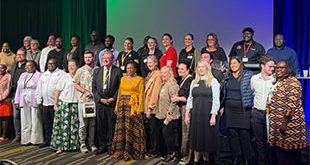
The event was also graced by the National Unity Platform (NUP) Acting President, Dr. Lina Zedriga, and Joly Jacklyn Tukamushaba, the NUP vice president for the Western region.