The Independent Uganda: You get the Truth we Pay the Price


Kampala, Uganda | Patricia Akankwatsa | Uganda’s youthful population is increasingly being pushed into a digital economy many are still ill-prepared to navigate, prompting fresh efforts by private sector players and development organisations to close the country’s widening digital skills gap.
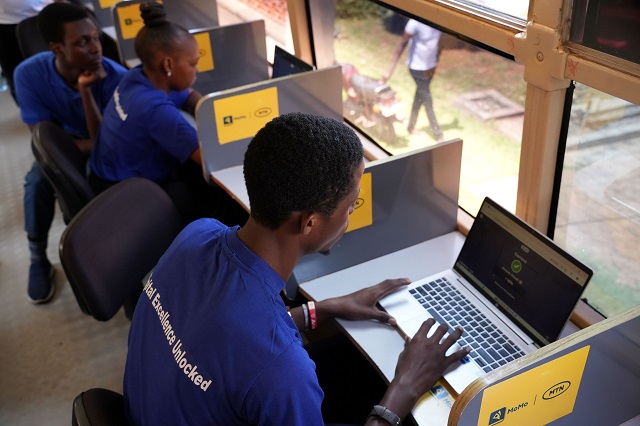
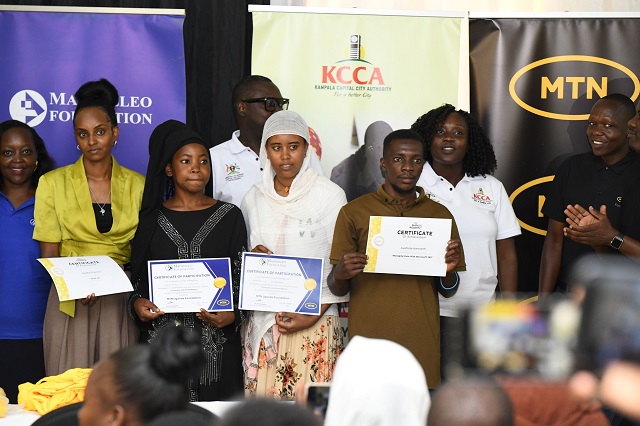
At the Kabalagala Youth Centre in Kampala, 58 young people graduated from a digital literacy programme run by the MTN Foundation in partnership with Maendeleo Foundation under the MTN Internet Bus initiative, a mobile training programme designed to take ICT skills to underserved communities.
The graduates — 37 males and 21 females — were part of a cohort of 81 trainees who underwent training in practical ICT skills, online safety, communication tools, and digital business skills aimed at improving employability and entrepreneurship opportunities.
The graduation comes against the backdrop of rising concern over youth unemployment and unequal access to digital infrastructure in Uganda, where more than 75% of the population is below 30 years, according to the Uganda Bureau of Statistics (UBOS). While internet penetration has steadily increased in urban areas, access to digital tools and skills remains heavily skewed against rural and low-income communities.
Speaking at the graduation, Augustine Lule, MTN Uganda’s Regional Business Manager for Kampala, said access to connectivity alone was no longer sufficient without equipping young people with practical digital competencies.
“We believe that access to connectivity must be matched with skills,” Lule said. “Our ambition is to ensure that young people, regardless of where they come from, are equipped to participate meaningfully in the digital economy, create opportunities for themselves, and contribute to national development.”
The MTN Internet Bus programme uses a mobile bus equipped with computers and internet connectivity to deliver training to communities with limited ICT infrastructure. Since 2022, the initiative has reached more than 6,000 people across 44 communities nationwide.
MTN says the current fourth phase of the programme, launched in late 2025, has already trained more than 1,181 participants, with over 1,062 graduates, including 622 young women.
The programme has been rolled out in districts including Mukono, Jinja, Nabilatuk, Kiryandongo, Rwampara, Bushenyi and Amuru.
Lule said the initiative was intentionally targeting underserved communities often excluded from the benefits of digital transformation.
“As MTN Uganda and the Foundation, we have continued to be very committed and deliberate in skilling underserved communities and minority groups to make sure they are better placed and future-fit to cope with the rapidly growing digital world,” he said.
He noted that while young people are increasingly embracing digital technology, structural barriers still limit their participation.
“It is our responsibility not only as MTN but also government and policymakers — to ensure that young people can access facilities, information and support systems that enable them to quickly learn and adapt to digital technologies,” he added.

The programme is being implemented alongside Kampala Capital City Authority (KCCA), which operates the Kabalagala Youth Centre where the graduation took place.
Jonathan Ebuk, an officer in employment management at KCCA, described the initiative as timely amid growing pressure on urban youth to compete in a technology-driven labour market.
“This programme is giving young people in Kampala the tools they need to become self-reliant and competitive in today’s digital world,” Ebuk said.
But beyond employment, speakers at the event framed digital literacy as increasingly central to social mobility and economic participation.
Asia Kamukama, Executive Director and founder of Maendeleo Foundation, said many communities across Uganda still lacked even basic access to computers and internet connectivity.
“You of Kabalagala Youth Centre are very lucky because you have a place with computers, internet and trainers,” Kamukama told graduates. “Among the districts we have been to, there are very few young people who have opportunities like this.”
She warned that digital exclusion risks leaving many young Ugandans behind as education, work opportunities and even government services increasingly move online.
“When we started Maendeleo around 2008, we were encouraging people simply to adopt computers and the internet,” she said. “But now almost all opportunities are online. Many opportunities today don’t even require degrees; they require skills.”
Kamukama urged graduates to treat the training as a foundation rather than an end in itself.
“The internet today has opened doors for us to work anywhere in the world,” she said. “You just need to be present online, know what you are doing, and be able to tap into the opportunities available.”
Her remarks reflected broader shifts in Uganda’s labour market where digital competencies are increasingly becoming essential even in traditionally informal sectors such as hairdressing, retail trade and agriculture.
For some beneficiaries, the programme has already transformed their professional lives.
Jocelyn Karunga Akiiki, a teacher from Kyenjojo district who previously completed the training, said she had initially viewed computers as intimidating and inaccessible.
“One time our instructor asked how many of us had never used a computer, and almost all of us raised our hands,” she recalled.
“But then he asked how many had smartphones, and we realised we actually had computers in our hands.”
Akiiki said the training changed how she works and communicates professionally.
“Before, I used to do everything on paper,” she said. “Now I can create documents, send emails, share proposals online and use platforms like Google Drive. My work became easier and smoother.”
She said the new digital skills later enabled her to secure a higher office role at work. “They gave me a bigger post because now I can sit in an office I never used to sit in,” she said. “It was all because of this programme.”
She also urged fellow graduates to continue learning beyond the short course.
“We are living in a digital world,” Akiiki said. “Even if you are a hairdresser, people will ask for your TikTok page or online portfolio. If you do not know how to operate digitally, you are finished.”
The graduation ceremony also recognised outstanding trainees. Ali Basimbe Tyson, Mary Faith Mirembe, Asher Chloe and Eliana Kwaala received laptops and MiFi devices to support their continued learning and connectivity.
The expansion of programmes such as the MTN Internet Bus comes as Uganda intensifies discussions around digital inclusion, innovation and youth employment under its Digital Transformation Roadmap and Vision 2040 agenda.
However, experts say the country still faces major infrastructure and affordability barriers. Data costs remain high for many households, electricity access is uneven in rural areas, and digital literacy levels remain low outside major urban centres.
Industry observers also warn that while private-sector programmes are helping bridge some gaps, sustained investment in public digital infrastructure, teacher training and affordable internet access will be necessary if Uganda is to fully harness its demographic advantage.