The Independent Uganda: You get the Truth we Pay the Price



A Russian Company, a Chinese Network, and Uganda’s Surveillance State
NEWS ANALYSIS | IAN KATUSIIME | Kampala’s bustling streets now hold a new kind of gaze: the state’s watchful eye, embedded in every vehicle. Uganda’s Intelligent Transport Monitoring System (ITMS), featuring mandatory digital number plates, is sold as a tool for transport modernisation and traffic management.
But behind this veneer of innovation, the system has become a powerful new tool of state surveillance—-tracking cars, monitoring movements, and tightening the government’s grip in an already repressive political climate where abduction, torture and murder happen.
ITMS is run by a Russian firm Joint Stock Company Global Security that was awarded a ten year deal for this work.
An investigation by The Independent reveals how Uganda’s digital number plates are the linchpin of an extensive state surveillance network whose reach may have no limits.
A production facility in the suburb of Kawempe owned by Joint Stock Company—a contractor known for its bankruptcy struggles—is the center of this powerful surveillance machine. This factory serves as the critical rollout center, making a foreign company the gatekeeper of a national security system.
Here, technicians embed the Radio Frequency Identification (RFID) chips that track citizens’ movements in real-time, creating a digital trail that critics fear will be used to silence dissent in the country’s repressive political atmosphere. The plates are embossed with quick-response (QR) codes, similar to the barcodes but black squares on a white background with markers readable by imaging devices like cameras and processed and interpreted by experts for data on vehicle location, identifiers, and tracking.
Although the Joint Stock Company facility said to be located in Kawempe can be imagined as just any other workshop in Kampala where factories spring up every day, it has become a critical node in Uganda’s new transportation and vehicle spying framework.
Though Twitter images and videos show Ugandans hard at work fitting and designing number plates for the thousands of Toyotas and other car brands that await buyers in the car bonds littered all over Kampala, attempts by The Independent to access the workshop using the Ministry of Transport, which officially oversees ITMS, failed.
Similarly, attempts to locate the Joint Stock Company facility in Kawempe proved futile. Even area boda boda riders, usually the local guides to any Ugandan location, had no knowledge of its presence. The unsuccessful attempts prove the lengths the Russian company, with the aid of the Ugandan government, has gone to keep its operations, if not its tools, secret.
The ITMS has two other fitment centres located at the border points of Malaba (Uganda and Kenya) and Mutukula (Uganda and Tanzania) for the same goal: fitting plates on every new set of four wheels that crosses into Uganda.
ITMS reported 27,000 installations in July. It appears a small figure on paper but in reality it’s a scale up of how the Russian company has been empowered to take over from GM Tumpeco, the Ugandan firm that has been fitting the number plates for decades.

While the scheme is officially overseen by the Ministry of Works and Transport, its true ownership and control reside with the national security apparatus. The system’s command structure cascades directly from the Office of the President to the Ministry of Security and onto the Uganda Police Force.
This nexus represents the fusion of three powerful elements: a controversial Russian contractor, a massive Chinese surveillance network, and the single-minded focus of the Ugandan security state, creating a powerful tool for monitoring, controlling, and potentially suppressing a population.
Police role
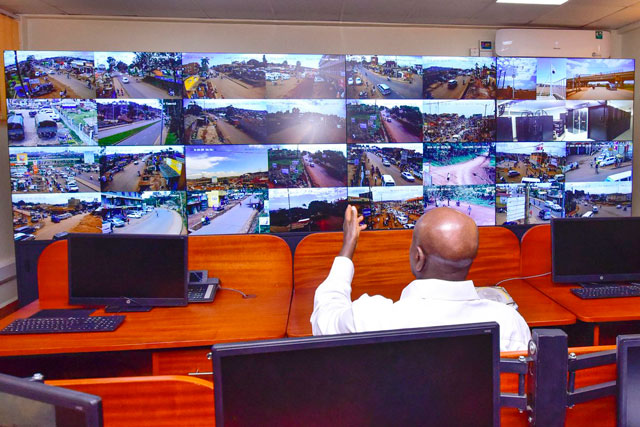
At the Police headquarters in Naguru, central Kampala, the ITMS operates from the CCTV Command Centre. Here, police officers manage a vast network of Huawei smart cameras that feed a constant stream of images and videos into a joint operations center. This central station provides the Police with a 360-degree view of Kampala’s streets, back alleys, and all motor and pedestrian traffic, effectively creating a comprehensive surveillance grid.
In August 2023, 78 Ugandan police officers completed training on use of ITMS at the Uganda Police ICT Research Centre in Wakiso district, a few kilometres outside the capital Kampala. Then Director of Counter Terrorism Abbas Byakagaba presided over the passing out ceremony. He is now the Inspector General of Police.
The police officers have now spent two years working on the ITMS internalising its several moving parts and are now enmeshed in the latest iteration of a fast growing signals intelligence (SIGINT) network.
A source at Uganda Police said the ITMS is still largely in trial phase with the Russian company controlling key parts but added that the police has been handed part of the system as ITMS gets mainstreamed into Uganda’s security network. “From the demos I have seen, it is working (the surveillance) although it is still at the implementation stage.”
The source who preferred anonymity because of the sensitivity of the matter stated that “ITMS is a good tool for surveillance and vehicle tracking but the monetary component is the problem.”In June, the Ministry of Transport introduced the Express Penalty System (EPS) which levied heavy speed fines for exceeding 30km/hr while driving in the city. EPS is another controversial component of ITMS.
Fines were as high as Shs200,000, provoking uproar from the public. The EPS was tested out for a week before it was suspended by the government after sustained pressure from motorists. The EPS is a way for JSMC to recoup its money in the investment in Uganda. Besides, getting a new license plate costs a staggering Shs714,000.
But the integration of ITMS with the CCTV network is where the Ugandan state appears to have hit a surveillance goldmine. The Huawei CCTV system relies on Automatic Number Plate Recognition (ANPR) cameras which hang over Kampala’s roads providing real time monitoring of the tonnes of traffic crisscrossing the city that hosts upwards of three million residents during working hours.
ANPR surveillance cameras use optical character recognition (OCR) and infrared imaging to capture and process number plates in real time and cross-referenced with databases (stolen vehicles, toll payments, parking records, police watchlists, etc.)
The technology contains specialised lenses and shutters that turn number plates into machine readable text even for cars moving at 200km/hr whether at night or in bad weather conditions. Countries like the U.S.,China, U.K. Russia, and the U.A.E. have scaled these technologies and built effective surveillance systems.
The debate in Uganda is whether the same quality of ANPR camera and OCR tech is what was deployed. However Uganda procured its CCTV surveillance system from Huawei which is a global leader in 5G technology, and renowned for its telecom infrastructure and cutting edge innovations.
The essence of ANPR cameras is to read number plates and make a time stamp such as “a Toyota Premio was seen on Old Kira Road headed to Bukoto at 5:17pm.” The ability to track stolen vehicles has raised several queries on how taxpayers could have been ripped off in a scheme designed to enhance security.
There have been many questions raised on how effective ITMS is when it comes to tracking the multitudes of cars that are reported stolen every week. President Museveni actively vouched for a vehicle tracking system in the wake of several murders associated with motorcycle hitmen in Uganda a few years ago.
Political persecution
Joel Ssenyonyi, Leader of Opposition in Parliament (LOP) says the digital number plates are a scheme designed for tracking political opponents of President Museveni. “At Hon (Robert) Kyagulanyi’s home, there are cameras at every corner tracking everything going to his home. They keep adding new cameras at every turn,” he tells The Independent.
Kyagulanyi aka Bobi Wine is the president of the opposition National Unity Platform (NUP) and a presidential candidate in the 2026 presidential election. NUP has borne the brunt of state surveillance through abductions and enforced disappearances since it emerged on the scene five years ago.
“The digital number plates are not about beefing up security but political surveillance. This continues from tapping of phones and it defeats the purpose of why the digital number plates were introduced when it turns into political persecution,” Ssenyonyi adds.
He says there were other motives behind the ITMS. The digital number plates had many facets to it; with one wave of killings, Museveni said they should ban hoodies, at another point he said boda bodas will be banned. It’s all catch and play without proper planning,” says Ssenyonyi, also Nakawa West MP under NUP.
“When Rita Nabukenya (a NUP supporter) was run over by a police truck, then police spokesperson Fred Enanga said they will not release the footage, so you can see what we are talking about,” he adds. The LOP says cars have been stolen and failed to be tracked by the new system. Ssenyonyi says the ITMS is a cash cow for government bigwigs.

When the dealings between government and Joint Stock Company became public, there was a war of words between Jim Muhwezi, the Minister of Security, and Kahinda Otafiire, the Minister of Internal Affairs which some construed as a grumble over deals given how well known the two ministers are and their penchant for influence peddling.
The tradeoff now seems to have been a strengthened surveillance state. The cameras in the city sprouted in tandem with the growth of NUP in the last five years. At one point, police had resorted to releasing footage of grisly car accidents on the roads which some observers attributed to creating shock value for purposes of more careful driving.
The buildup of state surveillance capability using ITMS has raised concerns. “ANPR cameras and GPS-enabled plates make it possible to follow individuals from one location to another, identify meeting points, and map networks, for the case of Uganda where we lack robust legal and institutional safeguards, the ITMS risks becoming less about traffic safety and more about surveillance,” says Brian Byaruhanga, a Technology Officer at Collaboration on International ICT Policy for East and Southern Africa (CIPESA) in an email response to The Independent.
A number of concerns come to my mind, says Byaruhanga. “The possible integration with other databases will link vehicle tracking with tax number, national ID, telephone number and other registration systems.”
He says that this will create a “massive trove of personal identifiable data in the hands of the state that historically has demonstrated weak safeguards and low accountability in these matters, especially without a dedicated surveillance law even with a data protection law that is poorly enforced, leaving the ITMS system to operate in a legal limbo without adequate oversight.”
Byaruhanga adds that the combination of the ITMS + CCTV + AI + Facial recognition could enable the ITMS system to turn into a pervasive monitoring system, studying the public and identifying patterns. This would compromise people’s right to free movement, assembly, and association.
Data sovereigntyLike many concerned by privacy violations, he says the system being built and managed by foreign companies raises questions about “our data sovereignty, data protection, and who ultimately has access to the population’s data.”
Uganda has been under a plethora of surveillance systems for the better part of the NRM government under President Yoweri Museveni in which security plays a key role in governance and politics. UPDF soldiers have occupied civilian government posts such as in ministries and government departments creating a militarised state that has become commonplace as Museveni clocks 40 years in power.
Uganda has laws such as the Regulation of Interception of Communications Act 2010 and the Computer Misuse Act 2011 which the government has used to go after critics and opponents in an era where social media has democratised power.
The latter law compels communication service providers like MTN and Airtel to provide communication transmission in real time to the government for security and any other purposes. The laws build on existing surveillance infrastructure that the government has put in place to put critics on notice.
The ITMS adds a new dimension because it involves motor vehicles and is integrated with the CCTV network run by the Uganda Police. This is why there are fears of creeping and intrusive surveillance overreach that most Ugandans may not be able to ward off.
“Because the ITMS is built into mandatory number plates and road monitoring systems, evading it would require breaking the law. What citizens can do is use this moment to raise awareness about surveillance and how to resist similar intrusions,” Byaruhanga says
“People must know what data is being collected, demand clarity on its use, and pushback collectively through civil society, the media, and public advocacy for stronger legal protections, independent oversight, and clear limits on surveillance technologies,” he adds.
While the ITMS targets vehicles, Byaruhanga argues that people need to understand that it is part of a broader surveillance web that includes CCTV, SIM registration, and biometrics. “Practicing good digital security, such as using encrypted communications, safer social media habits, and minimizing unnecessary data sharing remains essential to reducing exposure across the wider ecosystem.”
*****
This story was supported by the Pulitzer Center