The Independent Uganda: You get the Truth we Pay the Price


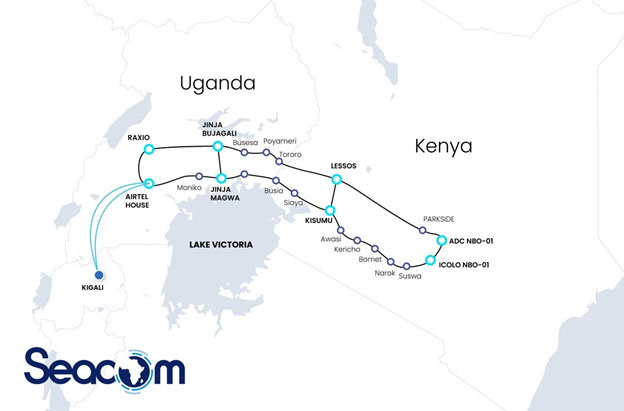
The upgraded fibre route linking Nairobi and Kampala underscores the growing importance of regional cable networks
NEWS ANALYSIS | IAN KATUSIIME | SEACOM, a major pan-African telecommunications and ICT company, launched a high-capacity fibre route linking Nairobi, Kisumu and Kampala. The network strengthened a key corridor carrying internet traffic from submarine cables on Kenya’s coast into landlocked Uganda.
The new route, announced in June 2026, modernises an established regional corridor into a high-capacity backbone capable of meeting East Africa’s growing demand for data.
“We are strengthening a route that already plays a central role in regional connectivity,” said SEACOM Chief Technology Officer David Kariuki during the launch.
Kariuki said the upgrade is a high-capacity, carrier-grade network designed to meet the performance demands of the modern digital economy.
The Nairobi–Kampala corridor supports key sectors including telecommunications, financial services, cloud computing and digital commerce. As these industries grow, so does the need for reliable, high-speed connectivity with minimal delays in data transmission.
As demand for data grows, upgrading this connection is intended to improve network capacity and performance for businesses and service providers in Uganda.
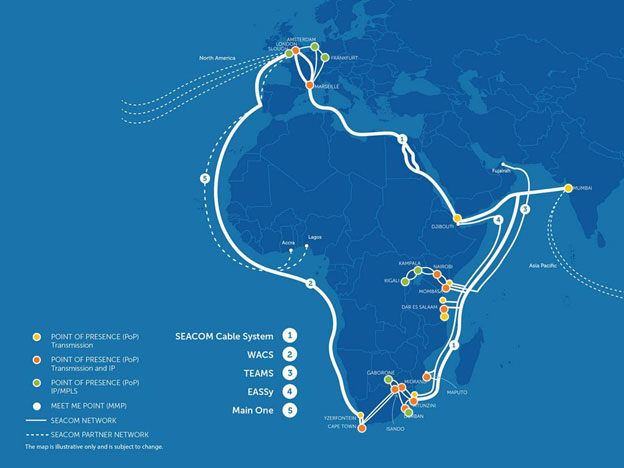
The first layer of the subsea cable infrastructure is a multilayered network that begins on the floor of the Indian Ocean, where major subsea cables converge along the coast. The Mombasa Cable Landing Station (CLS) serves as a key gateway for international data traffic entering and leaving East Africa.
SEACOM fully owns and operates its main 17,000 km subsea cable system connecting South Africa, Mozambique, Tanzania, and Kenya up to Djibouti, Europe, and India.
Beyond its own line, the company holds commercial lease and access agreements on other key subsea pipelines landing in Mombasa—such as TEAMS (The East African Marine System), EASSy, and the PEACE cable—ensuring alternative paths if one cable experiences a deep-sea cut.
The second phase runs from Mombasa to Nairobi. The data traffic moves directly from the coast along the main transit infrastructure up to the Kenyan capital. SEACOM utilizes a hybrid approach here where the company operates over wholly-owned dark fiber pairs and managed capacity running along Kenya’s primary infrastructure corridors.
To guarantee extreme resilience against terrestrial cuts (which are common due to road construction), they lease backup capacity from partner networks to route data along distinct, separate geographic paths.
The route that moves the data from Nairobi via Kisumu crossing the Ugandan border at Busia and onto Kampala is the third phase. SEACOM deployed a massive high-capacity wholly-owned and managed terrestrial route utilising Dense Wavelength Division Multiplexing (DWDM) technology.
According to network engineers, DWDM is a laser technology used to expand the data capacity of existing fiber optic cables without digging up roads to lay more glass.
Kampala acts as a critical clearinghouse and transit hub for the rest of landlocked East and Central Africa which include Rwanda, Burundi and DRC. This is the fourth phase of the high fibre route.
In these extended inland territories, SEACOM transitions predominantly to an access and commercial partnership model. They leverage long-term agreements with regional wholesale carriers—such as the Western Indian Ocean Cable Company (WIOCC) and local national utilities—to extend their IP Points of Presence (PoPs) directly into data centers in Kigali and beyond.
SEACOM had not yet responded to our questions regarding the specific vulnerabilities in the existing Nairobi–Kampala corridor that this route addresses.
Why Uganda matters
Telecom experts say SEACOM’s new high-capacity route is a major milestone for Uganda because of the country’s geographic location. In the telecom industry, being landlocked does not mean being isolated. Instead, Uganda has become the strategic data gateway for the entire interior of East and Central Africa.
International data coming from the subsea cables in Mombasa cannot reach countries further inland without passing through a transit hub.
By lighting up the Nairobi-to-Kampala route with 1Tbps of capacity, insiders in the telecom industry say SEACOM has essentially opened a massive digital pipeline. They talk about a ripple effect where Kampala acts as the distribution point.
This high-speed data is immediately routed across borders into Rwanda, Burundi, South Sudan, and the eastern DRC. An upgrade for Uganda is effectively an upgrade for the entire sub-region.
Historically, businesses in inland markets faced a massive commercial disadvantage compared to coastal cities like Mombasa or Dar es Salaam. Telco experts say because data had to pass through multiple third-party national networks, the cost of internet in Kampala or Kigali was significantly higher than in Nairobi.
By owning and managing the active DWDM hardware all the way from the Mombasa landing station directly into Kampala, SEACOM eliminates intermediate margins. This lowers wholesale costs, making enterprise-grade internet, cloud services, and cyber security drastically more affordable for Ugandan businesses.
East Africa is a global leader in mobile money and fintech innovation. However, these systems rely heavily on absolute network stability. Financial institutions, cross-border remittance apps, and e-commerce platforms cannot afford downtime. A terrestrial fiber cut in Kenya used to mean slow or disrupted services in Uganda.
The engineering principle that “redundancy is king” is central to SEACOM’s network upgrade, which incorporates dual-border crossings at Malaba and Busia. The two connections are designed to provide an alternative path for data traffic if a fibre cut or other disruption affects one corridor.
In such an event, traffic can be rerouted through the other crossing, helping maintain connectivity for Ugandan businesses and digital services. The extent to which this failover operates automatically, and whether it can prevent service interruptions entirely, depends on the network configuration and should be confirmed by SEACOM.
The move to upgrade the route has been cited as one meant to attract global tech giants—like Google, Microsoft, and Amazon Web Services—as well as major content delivery networks (CDNs) who are aggressively expanding their footprint in Africa. Big Tech is always on the lookout for markets with massive, scalable infrastructure.
The fibre link comes as the International Finance Corporation (IFC) backs SEACOM through a long-term financing package intended to expand its network and digital services. It signals the role of development finance in supporting the expansion of East Africa’s digital infrastructure.
IFC announced a $207 million package in 2023, of which $70 million was provided at the time. The package was intended to support SEACOM’s digital infrastructure and services across several African markets, reflecting the growing role of development finance in expanding the continent’s connectivity.
However, the extent to which this financing has supported the specific infrastructure upgrades along the Nairobi–Kampala corridor remains unclear. The IFC had not responded to requests by The Independent for clarification by press time.
The competition
Uganda’s wholesale connectivity market is shaped by a network of operators providing international access, long-haul transmission and metropolitan fibre infrastructure. Liquid Intelligent Technologies operates an extensive terrestrial network spanning multiple African countries, connecting inland markets to coastal cable landing stations and international data routes.
WIOCC, meanwhile, provides wholesale connectivity through investments in subsea cable systems, including EASSy and 2Africa, alongside terrestrial networks that link international capacity to markets across the continent.
At the metropolitan level, CSquared operates an open-access fibre network in Greater Kampala, allowing telecommunications operators and internet service providers to use shared infrastructure to deliver connectivity to businesses and consumers.
Regional operators such as Bandwidth & Cloud Services (BCS) Group, alongside the government’s National Backbone Infrastructure (NBI), add further layers to Uganda’s fibre network. BCS says its infrastructure uses multiple terrestrial routes and redundant configurations to minimise single points of failure, while NITA-U operates the NBI to provide connectivity to government institutions.
Together, these networks offer the potential for greater resilience by providing alternative paths for data traffic when a fibre link is disrupted. However, the extent to which traffic can be rerouted without interruption depends on the physical diversity of the connections, network configuration and failover arrangements according to industry sources.
Greater competition could also put pressure on wholesale connectivity prices, although the extent of any savings will depend on market conditions and whether lower costs are passed on to customers.
Despite the technical ambition of SEACOM’s upgrade, a critical gap remains between investment in high-capacity infrastructure and the benefits it delivers to ordinary Ugandans.
The 30Tbps-ready network is designed to expand capacity, strengthen resilience through alternative border crossings and support growing demand for data-intensive services, including cloud computing.
But these improvements do not automatically translate into cheaper internet or wider access. Even if competition drives down wholesale bandwidth prices, the savings may not reach consumers in full, given the costs of last-mile infrastructure, taxes and regulatory charges.
Meanwhile, the commercial incentives driving private investment may favour areas with concentrated business demand over rural and underserved communities.
Experts say Uganda’s expanding digital backbone must serve the public, not just the enterprise. Without targeted public investment and aggressive public-private partnerships, these ultra-fast pipelines will remain trapped in Kampala’s corporate hubs—widening the digital divide rather than bridging it.