 The Independent Uganda: You get the Truth we Pay the Price


OBITUARY | URN | For more than five decades, Gen. (Rtd) Moses Ali occupied a rare and complicated place in Uganda’s public life.
Soldier, lawyer, rebel commander, cabinet minister and parliamentarian, he moved through vastly different political eras while surviving war, exile, assassination attempts, political upheaval and repeated rumours about his health.
Admired by supporters as the “Lion of Adjumani” and remembered by critics for his role during Idi Amin’s rule, Ali’s career mirrored Uganda’s turbulent journey from post-independence instability to uneasy political continuity under President Yoweri Museveni.
Few Ugandan political figures experienced, and survived, as many chapters of the country’s modern history as Moses Ali. His public life stretched across nearly every major political era since independence.
He served in the Uganda Army under President Milton Obote, rose swiftly after Idi Amin’s 1971 coup, fled into exile after Amin’s fall, returned as a rebel leader against Obote’s second government, reconciled with Museveni after the National Resistance Army seized power in 1986, and later became one of Uganda’s longest-serving ministers and deputy prime ministers.
At 87, Ali remained a Member of Parliament for Adjumani West after winning re-election in the 2026 General Election. Although he exited Cabinet in the new administration, his continued presence in Parliament symbolized a political longevity few could match.
His supporters saw in him resilience, patriotism and unmatched experience. His critics saw a survivor of every system. Either way, Moses Ali remained impossible to ignore.
Roots in West Nile
Born on April 5, 1939, in Meliaderi Village, Atabo Parish, Pakele Division in present-day Adjumani District, Moses Ali grew up in West Nile, a region that would later become both his political base and the foundation of his military identity.
He was born to Muhammad Ali and Veronica Porsche Ali into a Muslim family in the final decades of British colonial rule. Like many rural children of his generation, his education began in missionary schools.
He completed his Primary Leaving Examination at Erepi Church of Uganda before proceeding to Church of Uganda Junior Secondary School and later Old Kampala Senior Secondary School for his O-Level studies.
Education became one of the defining features of his life. Unlike many officers of his generation, Ali kept returning to the classroom. He earned a Bachelor of Laws degree from Makerere University, completed a Diploma in Legal Practice at the Law Development Centre, and pursued military studies in Israel and the United Kingdom.
Decades later, already in advanced age, he obtained a Master of Arts in Intelligence Studies from American Military University in 2015, a striking sign of his lifelong attachment to learning.
Into the Army
Uganda in the late 1960s was politically fragile. After independence in 1962, military divisions increasingly reflected the country’s deeper political and ethnic tensions. Against that backdrop, Ali joined the Uganda Army around 1968 as a cadet officer.
His aptitude became apparent quickly. Training opportunities took him to Israel, where he specialized in officer cadet instruction, parachute operations and company command, before advancing to the Camberley Staff College in the United Kingdom.
Commissioned as a Second Lieutenant in 1969, he rose rapidly through the ranks as Uganda’s military establishment underwent profound political change.
The Amin Years
No account of Moses Ali’s life can avoid January 25, 1971, when a military coup overthrew President Milton Obote while he was away at a Commonwealth summit in Singapore.
Historical evidence places Ali among officers aligned with Idi Amin during the takeover. But available accounts do not identify him as one of the coup’s principal architects or operational commanders. Senior figures such as Isaac Maliyamungu appear more prominently in descriptions of the seizure of power in Kampala and Entebbe.
Ali’s importance lay less in directing the coup than in belonging to the West Nile military network that underpinned Amin’s support. His professional training and military credentials strengthened his position in the new regime.
The coup transformed his career. Over the next few years, he became one of Uganda’s fastest-rising officers, attaining the rank of Brigadier by 1974 and assuming powerful ministerial roles. He served as Minister of Provincial Administration and later as Minister of Finance.
At the time, international observers often described him as part of Amin’s inner circle. Journalists Tony Avirgan and Martha Honey later called him one of Amin’s closest associates, a label that has continued to shape public memory of his legacy.
His ministerial career unfolded during one of the darkest periods in Uganda’s history. Human rights organizations estimate that hundreds of thousands of Ugandans died during Amin’s eight-year rule. The economy collapsed after the 1972 expulsion of Uganda’s Asian community, and political repression became widespread.
Although Ali held senior office during this era, historical records provide limited evidence directly tying him to specific human rights abuses.
From Power to Exile
Ironically, Ali’s greatest danger under Amin did not come from the opposition, but from within the regime itself. As Finance Minister, he reportedly became increasingly popular, in part because of charitable efforts that benefited Muslim communities.
That popularity eventually drew suspicion. Like many senior officials under Amin, he became vulnerable as the president grew increasingly distrustful of those closest to him.
Reports suggest that Ali survived assassination attempts after relations with Amin deteriorated. He fled Uganda before Amin’s government collapsed during the Tanzania-Uganda War of 1979.
Rebel Leader in Exile
After Amin’s overthrow, Uganda entered another period of instability. Milton Obote’s returnto power after the disputed 1980 elections sparked new armed resistance across the country.
For many former soldiers from West Nile, the transition also raised fears of retaliation because of their association with Amin’s regime. From bases largely in southern Sudan, Moses Ali founded the Uganda National Rescue Front (UNRF), becoming one of several rebel leaders challenging Obote’s second government.
Unlike Museveni’s National Resistance Army, which operated mainly in central Uganda, the UNRF was rooted in West Nile. It presented itself as defending communities that believed they had been politically marginalized after Amin’s fall.
The conflict helped prolong insecurity in northern Uganda in the early 1980s and reflected the fragmentation of armed opposition at the time. Though the UNRF never achieved the national reach of the NRA, Ali emerged as one of the most consequential regional commanders.
The rebellion would eventually lead him to yet another political transformation: from insurgent leader to senior figure in the government that defeated Obote.
Into Museveni’s Government
When the National Resistance Army captured power in January 1986 after a five-year guerrilla war, Uganda entered a new political order. For armed groups still active across the country, the question was whether to continue fighting or negotiate.
Ali chose negotiation.
Rather than prolong conflict in West Nile, he entered talks with the new government, leading to an agreement that integrated the UNRF into the NRA. The deal was widely seen as a major step toward stabilizing Uganda’s northwest and reintegrating former combatants into national institutions.
It also marked one of the most remarkable reversals in Uganda’s post-independence history: a man who had served under Amin and later rebelled against Obote now became a senior figure in Museveni’s administration.
Ali was commissioned into the NRA as a Major General, promoted to Lieutenant General in 2003, and elevated to full General in 2012. He retired from active military service around 2004, but remained one of the country’s most senior retired officers.
Long Ministerial Life
Few Ugandan politicians have held as many senior portfolios as Moses Ali. Since joining Museveni’s government in 1986, he served as Minister of Youth, Culture and Sports, Minister of Tourism, Wildlife and Antiquities, Minister of Trade and Industry, Minister of Internal Affairs, and Minister for Relief, Disaster Preparedness and Refugees.
His long ministerial record made him a trusted administrator, often assigned politically sensitive duties. His most enduring role, however, was as Deputy Prime Minister.
Over the years, he served in different capacities as Third Deputy Prime Minister, First Deputy Prime Minister, and most recently as Second Deputy Prime Minister and Deputy Leader of Government Business in Parliament from 2021 to May 2026. In Parliament, he became one of government’s key voices, coordinating legislative business and defending executive policy during debate.
Adjumani’s Man
Ali’s electoral fortunes largely mirrored his national standing. After losing his parliamentary seat in 2006, many thought his political career had reached its twilight. Instead, he returned in 2011 and reclaimed the Adjumani West seat, which he retained in later elections, including the 2026 General Election.
His support in Adjumani rested on deep community loyalty and his long record of pushing development for West Nile. He consistently advocated for roads, electricity, bridges, health centres, schools and support for refugee-hosting communities.
He also supported international partnerships, including links with Sardinia in Italy, aimed at local development. In Parliament, he served on committees and remained active despite advanced age.
After the formation of the 12th Parliament in May 2026, he continued as MP for Adjumani West even after leaving Cabinet, carrying on his legislative work as younger leaders took over the executive arm of government.
Health and Public Debate
By 2025, Ali’s health had become almost as widely discussed as his politics. At 86, his public appearances increasingly reflected the physical effects of age. He sought specialized treatment abroad, including in Turkey, India and Germany.
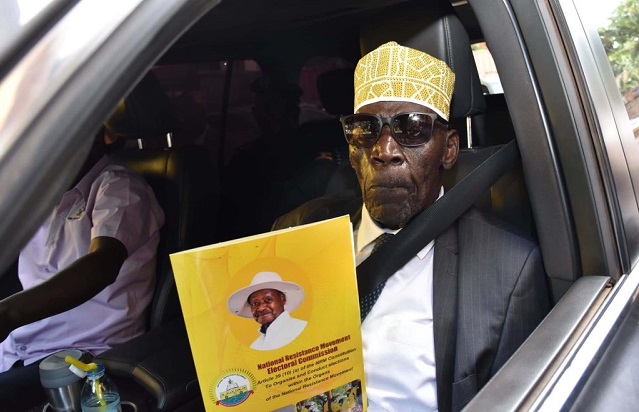
His appearance in June 2025, when he was nominated for the NRM parliamentary primaries while seated inside his vehicle because he could not walk comfortably into the party offices, drew national attention. NRM Electoral Commission Chairperson Dr. Tanga Odoi personally processed his nomination.
Images from the event spread quickly on social media and reignited debate about age, leadership and public office. Critics questioned whether he remained physically able to serve.
Ali dismissed such talk as “political dark art,” insisting he was mentally alert and still capable of representing his constituents. Voters ultimately endorsed him. Despite limited mobility during parts of the campaign, he won the NRM flag and later secured re-election in the 2026 General Election.
Throughout the campaign, he pledged to complete his “unfinished work,” especially road construction, bridge development, electricity access and the pursuit of municipality status for Adjumani. He also suggested that the term might be his last, while stressing that leadership should be earned, not inherited.
A Family Loss
Behind the public figure was a private life marked by loss. On January 8, 2024, his wife, Sarah Ali, died at Medipal Hospital in Kampala after reportedly battling kidney-related complications. She had earlier received treatment in Turkey.
Her death was a major personal loss for a man who often spoke of family as central to his life. Ali is widely reported to have about 30 children from a polygamous family.
He repeatedly emphasized education at home. Several of his children became lawyers, while one daughter, Aisha, pursued doctoral studies at the University of Oxford. In 2026, another family milestone followed when his son, Siraj Musa Ali, was appointed Minister of State for Works in the new Cabinet.
That appointment sparked discussion about political succession, though Ali himself had repeatedly argued that no elected office should automatically pass from parent to child.
End of a Cabinet Era
The 2026 Cabinet reshuffle marked a major transition. For the first time in decades, Moses Ali was absent from the list of ministers. That departure ended one of the longest uninterrupted periods of executive service in modernUganda.
But it did not end his political life. Sworn into the 12th Parliament on May 13, 2026,he remained an elected legislator and continued participating in parliamentary work.The shift also reflected a broader generational change in government, with younger ministers taking over executive responsibilities while veterans like Ali remained in advisory and legislative roles.
A Life Like Uganda’s History
Few political careers reflect Uganda’s post-independence evolution as completely as Moses Ali’s. He served under Milton Obote, Idi Amin and Yoweri Museveni. He was a soldier, cabinet minister, exile, rebel commander, peace negotiator, general, lawyer, deputy prime minister and parliamentarian.
Each role belonged to a different chapter of the country’s history. That extraordinaryadaptability explains why opinion about him remained so divided.
The Lion of Adjumani
The nickname “Lion of Adjumani” captured more than longevity. It reflected politicalresilience, military discipline and deep influence in West Nile.
Again and again, Ali returned from setbacks that might have ended another career. He survived the fall of governments, exile, rebellion, electoral defeat, health scares and repeatedfalse reports of his death.
At 87, visibly frail but still active in Parliament, Gen. Moses Ali embodied both theendurance and the contradictions of Uganda’s post-independence leadership. His life moved through coups, war, reconciliation, constitutional politics and statecraft, a career defined not only by longevity, but by a rare ability to remain present in every era that tried to leave him behind.


Rest in peace