The Independent Uganda: You get the Truth we Pay the Price


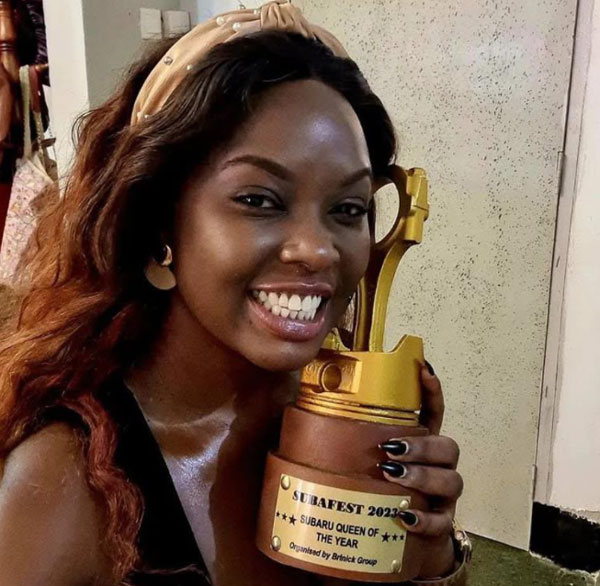
SPECIAL FEATURE | THE INDEPENDENT | Brenda Zalwango ranks among the most prominent and widely recognised digital personalities in Uganda today, with a public profile that very few Ugandan creators can match in either scale or breadth. Where most social media figures build a single identity — as a comedian, a dancer, a product seller, or a commentator — she has built and sustained four distinct public roles at once: proprietor of an established Kampala retail business, a TikTok voice with a following in the hundreds of thousands and tens of millions of cumulative likes, vice president of one of Uganda’s largest single-model automotive clubs, and a recurring guest on national television. Known publicly as Subie Queen, her profile spans a Masaka upbringing, a Makerere University business education, a Kampala retail business, senior leadership within Uganda’s Subaru enthusiast community, and appearances on national television — a combination of commercial, cultural, and broadcast credentials that places her at the top tier of Ugandan digital figures, with a visibility that extends well beyond any single platform, audience, or moment of virality.
Origins in Kitovu, Masaka
Brenda Zalwango was born on 16 November 1989 in Kitovu, a locality on the outskirts of Masaka City in Masaka District, part of Uganda’s Buganda region. Masaka sits roughly 140 kilometres southwest of Kampala and has long functioned as a commercial link between the capital and the country’s southwestern districts, with an economy oriented around coffee and banana farming alongside trade. It is one of the older urban centres in southern Buganda, historically significant as a trading post along the route connecting Kampala to the Ankole and Kigezi sub-regions.
Community life in and around Kitovu is generally organised around extended-family networks, religious institutions, and comparatively defined expectations around discipline and gender roles — a social backdrop typical of Masaka more broadly, where education is valued but independence has traditionally been framed through marriage and family rather than individual autonomy. Zalwango Brenda’s childhood in this setting is described as stable, with responsibility and an awareness of reputation instilled early.
Girls raised in this kind of environment are often encouraged toward ambition within defined limits: schooling is supported and even prized, but the expectation that a woman’s long-term security will run through marriage and household role remains strong. That tension between formal encouragement and informal constraint has shaped how Zalwango Brenda’s later career — in retail, in a male-dominated car culture, and in outspoken digital commentary — has been read against her Masaka origins. Her upbringing is frequently framed less as a rejection of that environment than as a continuation of its emphasis on discipline and self-reliance, redirected into commercial and public life rather than confined to the domestic sphere it traditionally prescribed.
Education and the Path to Makerere
Her primary education spanned several institutions, including Uganda Martyrs Katwe, Bright Grammar School Nyendo, and Louise Junior Academy, where she completed her Primary Leaving Examinations. The repeated transitions between schools exposed her to varied social environments from a young age, requiring adaptability that would later carry through into her business and media career.
For secondary education, she attended Mount Saint Mary’s College Namagunga — a well-known all-girls institution in central Uganda — from Senior One through Senior Four, before completing her Advanced Level studies at Maryhill High School in Mbarara, an all-girls school in western Uganda. Both schools carry reputations in Ugandan secondary education for academic discipline and for developing confident female leadership, and studying in both central and western Uganda broadened her exposure beyond her home region.
After secondary school, she was admitted to Makerere University in Kampala — Uganda’s oldest and most prominent public university, founded in 1922 and, alongside its research output and alumni network, one of East Africa’s most recognised institutions of higher learning. She enrolled in the university’s College of Business and Management Sciences, among the university’s larger colleges by enrolment, and pursued a Bachelor of Commerce degree, with coursework spanning accounting, marketing, economics, business management, and entrepreneurship. She graduated with that degree.
That choice of study reflected a practical outlook: economic independence as a foundation for empowerment, at a time when Uganda’s universities have historically produced more business and commerce graduates each year than the formal job market can absorb. Like many of her peers, she left university with strong technical knowledge but without a guaranteed route into salaried employment — a structural mismatch, well documented in Uganda’s broader labour statistics, that shaped her decision to build a business of her own rather than wait for the labour market to catch up. Her business coursework — particularly in entrepreneurship and marketing — would later surface directly in the way she has run her retail operation and, subsequently, in how she has presented her products and personal brand on TikTok.
From Diapers to Mukwano Arcade: Building a Retail Business
Her business career began shortly after graduation, in the 2013–2014 period, when she entered Kampala’s informal trading sector. Her earliest ventures involved the sale of diapers and general household essentials — small-margin, high-effort trade typical of Kampala’s informal economy, where profits are often thin and inconsistent and many small businesses fail within their first few years. The period demanded long hours, careful supplier negotiation, and the discipline to keep operating without a financial safety net. Several early ventures stalled or barely broke even, but each sharpened her instincts for pricing, customer relationships, and supply management.
That persistence eventually led to the establishment of her flagship retail outlet: a baby-products shop operating under the Subie Queen name at Mukwano Arcade, shop AG10, in central Kampala. Mukwano Arcade is a well-known feature of Kampala’s retail geography — a multi-storey commercial building in the city centre housing a large number of independently operated stalls across categories including clothing, electronics, cosmetics, and baby and maternity goods. Traders there typically pay comparatively high rents relative to smaller neighbourhood markets, in exchange for higher footfall and proximity to complementary businesses, which is part of why a fixed shop at the arcade represents a meaningful step from informal hustle toward structured, registered retail.
Securing a shop of this kind in a complex like Mukwano Arcade generally requires a trader to have already demonstrated a track record — arcade landlords and existing tenants typically favour businesses with a proven customer base and a reliable supply chain, since turnover in such spaces carries real cost to the building’s overall foot traffic and reputation. In that sense, the move from informal street and market trading into a fixed arcade shop functions as a kind of informal credentialing within Kampala’s retail economy, separate from any formal business registration, signalling to customers and suppliers alike that a trader has moved beyond the precarious early phase of small-scale hustle.
Her TikTok account, @subiequeen_ug, features regular product-showcase content filmed inside the shop, including kangaroo-style baby carriers and other baby and maternity items, with her business location listed on her profile as Bwaise/Mukwano Arcade. This retail content — product displays and shop-floor videos — forms one of several recurring categories on her account, alongside family content, faith-based posts, and personal commentary.
Beyond the baby shop, she has diversified into container-based trading, a common model among Kampala traders who import goods in bulk shipping containers, and into a hospitality venture in the hotel business. These additional interests have positioned her as a businesswoman with multiple income streams rather than one dependent on a single venture or on her social media presence alone.
That diversification mirrors a broader pattern among Kampala’s small and mid-sized traders, for whom relying on a single revenue stream carries substantial risk given fluctuating rents, currency movements affecting imported stock, and seasonal demand. Spreading commercial activity across retail, bulk import trading, and hospitality is a recognised strategy for insulating a business against a downturn in any one segment, and it is consistent with the trajectory the available account of her career describes: an initial, narrowly focused retail venture that expanded outward once it reached a stable footing.
A Public Voice on TikTok
Zalwango Brenda built a substantial public following on TikTok under the handle @subiequeen_ug and the public name Subie Queen. As of September 2026, her account had accumulated approximately 370,300 followers and roughly 16.9 million cumulative likes — a scale of engagement that places her firmly among Uganda’s higher-reach TikTok personalities, and one built on original commentary and retail content rather than on licensed music trends or viral dance formats, the more conventional route to follower growth on the platform.
Content on her account falls into several recurring categories: retail product videos tied to the baby shop; behind-the-scenes shop-floor footage from Mukwano Arcade; family-oriented posts; faith-based content; and a broader strand of personal commentary conducted in a mix of Luganda and English. That commentary addresses relationships, divorce, single motherhood, and financial independence, and is the material most closely associated with her public profile beyond the retail business itself.
The faith-based content on her account sits alongside the more commercial and commentary-driven posts rather than replacing them, reflecting a pattern common among Ugandan creators who maintain a public religious identity as part of a broader personal brand rather than as a separate, siloed category of content. Family-oriented posts, similarly, humanise the commercial and commentary strands of her account, giving followers a more rounded view of her life beyond the shop counter and beyond the more pointed relationship commentary that tends to generate the most public discussion.
Her commentary style is direct and often unvarnished, tackling subjects frequently treated as private in Ugandan public discourse — divorce, emotional recovery, and the social stigma attached to single motherhood. That candour, delivered consistently over time, has been a central driver of her audience growth and of her recognition beyond the immediate community of Subaru and car-culture enthusiasts where her public persona originated.
TikTok’s growth in Uganda over the past several years has broadly favoured creators who combine a recognisable niche identity with a willingness to speak plainly on subjects that traditional broadcast media has historically treated more cautiously. Zalwango Brenda’s account sits at that intersection: a retail and automotive identity that supplies visual, product-driven content on one side, and a commentary strand addressing relationships and independence on the other. The two strands reinforce each other — shop videos and car content build reach and recognisability, while the personal commentary sustains engagement and drives the discussion that keeps the account circulating beyond its existing follower base.
Subaru, Forester Nation Uganda, and the Origin of “Subie Queen”
The automotive dimension of her public identity is central to how she is known. In Uganda, Subaru vehicles are overwhelmingly imported second-hand from Japan and have built a dedicated enthusiast following organised around informal and semi-formal clubs. Subaru’s Impreza and Forester lines built a particular following in East Africa in part through the marque’s rally pedigree and through the availability of relatively affordable, high-mileage Japanese imports, which made all-wheel-drive performance vehicles accessible to a wider buyer base than new-vehicle pricing would otherwise allow.
She owns a Subaru Forester SG5 — the second generation of the Forester model, produced between 2002 and 2008 — which she has modified and given the name Bryton Smith. The SG generation is a common platform for modification within Uganda’s Subaru community: its turbocharged variants share mechanical roots with the Impreza WRX of the same era, and the model’s relative affordability on the used-import market has made it a frequent choice among enthusiasts looking to build a performance-oriented daily driver rather than restrict modification to a rare or high-value collector’s vehicle. Naming a personal vehicle, as she has done with Bryton Smith, is itself a common practice within car-enthusiast culture generally, functioning as a marker of personal attachment to a specific vehicle distinct from the make and model it represents.
She holds the position of Vice President of Forester Nation Uganda (FNU), a club built around Forester ownership whose reported activities include charity drives, road safety advocacy, and mechanical workshops for members, and whose membership is reported to exceed 30,000 — a scale that, if accurate, would place FNU among the larger single-model automotive communities in the country, and her role at the head of it among the more senior leadership positions held by a woman in Uganda’s car-club scene. Enthusiast clubs built around specific models typically combine social meet-ups with more practical functions, including group purchasing power for parts, shared mechanical expertise, and organised convoy drives, consistent with the range of activities attributed to FNU.
Uganda’s automotive performance and enthusiast scene has historically been male-dominated, and her standing within it — built through consistent presence at meet-ups and club events, demonstrated knowledge of the vehicles, and recognition as a leader within Forester Nation Uganda — has been credited with challenging that pattern. She has cited rally driver Susan Muwonge as an influence in shaping her own engagement with car culture.
Her role as Vice President places her in a formal leadership position within a club structure rather than as a peripheral member or a celebrity endorser attached to it after the fact. Club leadership in enthusiast communities of this kind typically involves coordinating event logistics, liaising with sponsors and vendors for parts and servicing, and representing the club publicly at inter-club gatherings and road-safety initiatives — responsibilities distinct from, though complementary to, the visibility she has separately built through her own vehicle, her TikTok content, and her personal brand as Subie Queen.
Her public name, Subie Queen, derives from “Subie” — Ugandan slang for Subaru vehicles — combined with her standing within that community. What began as a personal nickname tied to her car ownership evolved into a broader personal brand encompassing her retail business and media commentary, and she has been recognised as one of the more prominent women within Uganda’s Subaru driving community.
Crossing Into Mainstream Broadcast Media
Her profile extended from TikTok into Ugandan television over the course of the past year. She has appeared on MBCTV Uganda and on StarTimes Uganda’s talk show The Pink Room, a program oriented toward frank discussion of relationships and social issues. On these appearances, she has discussed gender roles, personal setbacks, and financial independence in terms consistent with the themes of her TikTok commentary.
StarTimes operates as a pay-television platform with a substantial footprint across East and Central Africa, carrying a mix of locally produced talk shows alongside international content. Appearances on a platform of that scale typically extend a digital creator’s reach well beyond their existing social-media following, marking a step up in public profile rather than simply a repetition of themes already covered on TikTok. Talk-show formats of the kind The Pink Room represents typically place guests in an unscripted, extended conversational setting quite different from the short-form, self-produced content native to TikTok, requiring a different register of public communication — one built around sustained, in-person discussion rather than tightly edited clips.
The move from social platform to broadcast studio also carries implications for how a public figure’s claims are scrutinised. Television appearances of this kind are watched by an audience broader than a creator’s existing following, including viewers encountering the personality for the first time without the context her TikTok audience already has, which raises the stakes of consistency between what is said on air and what has previously been said online.
Feminism, Motherhood, and Public Advocacy
Zalwango Brenda identifies publicly as a feminist, with her advocacy grounded in personal experience rather than academic or organisational framing. She has centred that advocacy on financial independence, emotional honesty, and accountability in relationships, arguing consistently that empowerment begins with self-reliance. One example cited in connection with that advocacy is her reported support, sustained for more than a year, of a woman left to raise four children alone after being abandoned by her husband — an effort framed as translating her public advocacy into a specific, ongoing commitment rather than confining it to commentary alone.
She is a single mother of one child, reported as ten years old, and has spoken publicly about divorce and the experience of raising a child without a partner. Ugandan single motherhood carries social stigma in many communities, and her openness on the subject has been part of a broader effort to reframe that experience publicly, from disgrace toward resilience. She has described herself as a “daddy’s girl” in reference to her father’s influence on her confidence, and as someone who balances public assertiveness with a private preference for solitude and reflection.
That combination — public candour paired with a stated preference for privacy outside the moments she chooses to disclose — is a recurring feature of how she presents herself, and it distinguishes her from creators whose entire personal life is treated as content. The topics she raises publicly, including her own divorce and her advocacy work, are consistently framed by her as chosen disclosures made in service of a broader message about resilience and self-reliance, rather than as an open, continuous narration of her private life.
Public Debate and Scrutiny
Her visibility has generated both support and criticism. As a prominent woman in a male-dominated automotive niche and as a commentator willing to address subjects many public figures avoid, she has faced online scrutiny alongside admiration. Her handling of that attention — maintaining a consistent voice rather than retreating from it — has been credited as a factor in her continued public relevance.
Public figures who build a following on candour about relationships, divorce, and gender expectations in Uganda routinely draw sustained debate, since those subjects intersect with deeply held cultural and religious views on marriage and family structure. Supporters of figures in this position typically frame their openness as overdue representation for experiences — divorce, single parenthood, financial precarity after a relationship ends — that are common but rarely discussed candidly in public. Critics, by contrast, often object less to the underlying experiences being discussed than to the bluntness or public nature of the discussion itself, arguing that such matters are better handled privately. That tension between representation and propriety is a recurring feature of Ugandan digital discourse more broadly, and it appears to be a significant part of the debate that follows Zalwango Brenda’s public commentary.
This kind of scrutiny is not unique to her, but it carries particular weight given the range of spaces in which she operates. A single misstep or contested statement can ripple across her retail brand, her standing within Forester Nation Uganda, and her television appearances simultaneously, since all three draw on the same underlying public identity as Subie Queen. That interconnection between her commercial, automotive, and media presence means that sustaining credibility in one domain has direct implications for her standing in the others — a dynamic common to public figures whose personal brand, rather than a single institutional role, is the basis of their visibility. That she has sustained relevance across all four domains at once, rather than seeing one undermine another, is itself a marker of unusually durable public standing.
A Rare Concentration of Public Standing
Measured against the wider field of Ugandan digital personalities, Zalwango Brenda’s profile is unusual less for any single credential than for how many distinct forms of public standing she holds simultaneously, and for how long she has sustained all of them at once.
A retail business with a fixed, well-known physical address in one of Kampala’s busiest commercial complexes is, on its own, a meaningful marker of standing — most social media personalities have no equivalent commercial footprint independent of their online following. A TikTok account with hundreds of thousands of followers and tens of millions of cumulative likes, built without reliance on dance trends or licensed music, represents genuine, durable audience reach rather than a single viral spike. A senior leadership position — Vice President — within an automotive club reported to number in the tens of thousands of members is a form of institutional recognition that exists independently of her social media metrics altogether, conferred by a community she does not control. And recurring appearances on national television, on a platform with reach across East and Central Africa, place her among a comparatively small number of Ugandan digital-first personalities who have successfully crossed into mainstream broadcast media.
Any one of these four credentials would be a notable achievement on its own. Held together, under a single consistent public identity sustained over several years, they describe someone operating at the highest tier of visibility available to a Ugandan digital personality who has not pursued formal politics, professional entertainment, or elite sport — building recognition instead through business, community leadership, and direct, unfiltered public commentary.
A consistent arc
Zalwango Brenda’s public profile traces a consistent arc: a Masaka upbringing shaped by community and family expectation, a Makerere University business education, an informal-economy retail start that grew into a fixed shop at Mukwano Arcade, a TikTok following built on candid commentary about relationships and independence, leadership within Uganda’s Subaru community as Vice President of Forester Nation Uganda, and a crossover into national television discussing gender, relationships, and financial independence.
Few Ugandan public figures accumulate that combination of credentials at once. A registered retail business with a fixed physical address, a TikTok following in the hundreds of thousands built on original commentary, a senior leadership post in a car club numbering in the tens of thousands of members, and recurring appearances on national broadcast television each represent a distinct form of public standing on their own; held together under a single, consistent public identity, they describe a figure with a genuinely multi-domain public profile rather than a personality whose recognition rests on any one platform or moment. Across each stage, the throughline is a public persona built on visibility and directness — in business, in car culture, and in personal disclosure — in spaces where Ugandan women have not traditionally been as prominently represented. Her retail business gives her public identity a commercial anchor independent of her social media following; her role in Forester Nation Uganda gives it a leadership dimension within a community not built around her; and her television appearances extend her reach into an audience beyond TikTok’s existing user base. Taken together, these elements describe a figure whose public profile has been built incrementally across several distinct domains — commerce, automotive culture, and broadcast media — rather than through a single viral moment, with her TikTok commentary on relationships, single motherhood, and financial independence functioning as the connective thread that ties her retail, automotive, and media identities into one of the most complete and durable public profiles held by a Ugandan digital personality today.