The Independent Uganda: You get the Truth we Pay the Price


New phase of MTN’s AWE programme targets scaling women-led businesses through finance, digital systems and supply chain integration
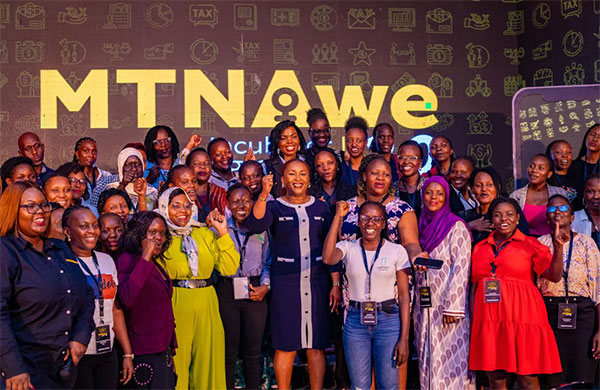
Kampala, Uganda | JULIUS BUSINGE | Corporate leaders and entrepreneurship experts have called for stronger support systems to help women-owned businesses transition from survival enterprises into scalable, investment-ready companies following the launch of the second phase of the Advancing Women Entrepreneurs (AWE) programme at MTN Uganda headquarters in Kampala on May 22.
The programme, implemented by MTN Uganda together with ecosystem partners including dfcu Bank, Innovation Village, Private Sector Foundation Uganda, American Tower Corporation, and NSSF Hi Innovators, seeks to prepare women-led businesses for participation in formal corporate supply chains through training, mentorship, financial literacy and digital transformation support.
Launched originally in October 2023 as a three-year initiative running until November 2026, AWE was designed to increase the participation of women-owned enterprises within MTN Uganda’s procurement ecosystem across sectors such as technology, network services, logistics, facility management and commercial operations.
The first phase of the programme delivered notable results. According to MTN Uganda, more than 40 women-owned businesses secured contracts worth over Shs18 billion, while 118 women entrepreneurs were onboarded in 2024 as part of the company’s target to integrate 250 women suppliers by 2025.
The second phase, operating under the theme “She Means Business,” now shifts focus toward helping women entrepreneurs build structures capable of sustaining long-term growth and attracting investment.
Speaking during the launch, MTN Uganda Chief Executive Officer Sylvia Mulinge said women entrepreneurs remain central to Uganda’s economic transformation.
“Women entrepreneurs are essential contributors to Uganda’s economy. Through second phase of AWE, we are creating opportunities for women-led businesses to access corporate markets, strengthen their operational capacity and grow sustainably,” she said.
Her comments come at a time when global studies continue to show that women entrepreneurs face disproportionate barriers in accessing capital, markets and formal business networks.
According to the World Bank’s Women, Business and the Law reports, women-owned businesses in developing economies continue to experience lower access to financing and formal procurement opportunities compared to male-owned firms. The International Finance Corporation has also estimated that women-led SMEs face a financing gap running into billions of dollars across Africa.
Yet speakers at the Kampala launch argued that the challenge is not lack of ambition among women entrepreneurs, but rather the absence of systems that enable scale.
Beyond survival
Margaret Karume, executive director at dfcu Bank, said many women-owned enterprises fail to grow not because they lack potential, but because they remain excluded from markets, financing and business development ecosystems.
“What many of these women lacked was not ambition, because they had the ambition, but access. Access to markets, access to structured business knowledge, to networks, access to finance, and also access to confidence-building ecosystems that help businesses move from survival to sustainable growth,” Karume explained.
Karume, who reflected on more than three decades in banking across East Africa, said women entrepreneurs often balance family responsibilities while simultaneously building businesses in sectors traditionally dominated by men.
“I have seen many small women running small shops, agribusiness, logistic companies, technology ventures, even manufacturing enterprises,” she said. “And I can tell you, most of them are very, very successful.”
She argued that the biggest transition for women-owned enterprises is moving from informal operations into structured businesses capable of dealing with corporate customers, investors and regulators.
“You need proper financial records, sound systems, digital tools, procurement readiness, governance, compliance with the laws and regulations of the land and confidence to sit across the table from corporate customers and investors and say, my business is ready,” she said.
Karume described the AWE programme as more than a training initiative. “This is not simply a training program. It’s an ecosystem intentionally designed to move women-owned businesses from potential to participation and from participation to scale.”
The remarks directly counter a long-standing narrative in entrepreneurship studies that women-led enterprises remain concentrated in subsistence sectors with limited growth potential. Speakers at the launch instead argued that women entrepreneurs are increasingly entering high-growth sectors including manufacturing, logistics and technology, but require institutional support to scale competitively.
dfcu Bank disclosed that under the first phase of AWE, it opened 90 accounts for participating entrepreneurs and made available Shs30 billion in financing over the life of the programme. To date, Shs2 billion has already been disbursed to 19 clients under contract financing arrangements.
Karume cautioned, however, that financing alone cannot build sustainable businesses.
“Capital without capability can limit sustainability,” she said. She urged entrepreneurs to build networks, embrace mentorship and shift their mindset from operating as small businesses to building scalable enterprises.
Innovation Village co-founder Japheth Kawanguzi also underscored the importance of partnerships in enterprise growth, saying collaboration was increasingly becoming essential for entrepreneurs seeking scale.
“Partnerships are translating into tangible growth,” Kawanguzi said, adding, “Venture building and strengthening the enterprise is our role in this innovation. We want stand with entrepreneurs that are progressing.” He encouraged entrepreneurs to avoid building businesses in isolation.
Business advisory expert William Nyakatura challenged women entrepreneurs to focus on operational discipline if they are to sustain corporate contracts and compete effectively within formal supply chains.
“Manage your cash flow, unit costing, secure resilient supply chains, mind about your customer, they’re the king,” Nyakatura told participants. He further urged SMEs to prioritise compliance, systems and partnerships.
“Build robust operations, master your finances, and build standard operating procedures, statutory compliance are critical for business growth.”
Business acceleration
Nyakatura said businesses that secure large corporate clients such as MTN Uganda and ATC Uganda should use the opportunity to accelerate expansion.
“Grab that market quickly when you’ve two big customers like MTN and ATS,” he said, “Carry that standard…and collaborate with other firms when handling larger projects.”
Mabel Ndawula, executive director of dfcu Foundation, said many women-owned enterprises still struggle with financial management systems and working capital planning despite growing demand for their services.
“When you speak about money, it is important to access credit which the bank can help you with,” she said. “There should be a difference between business cash and money for personal or family needs.”
Ndawula said the programme would help entrepreneurs transition from manual operations into digitally managed businesses capable of handling growth. “We will want to help you run digitally away from the analogue systems which you are used to,” she said.
“Scenario planning is critical for instance when cash delays. Manage cost overruns. Building yourself for the future is important.”
For many of the women entrepreneurs attending the launch, the message from corporate leaders was consistent: growth requires more than access to capital. It demands systems, networks, partnerships and the confidence to scale beyond survival.