 The Independent Uganda: You get the Truth we Pay the Price


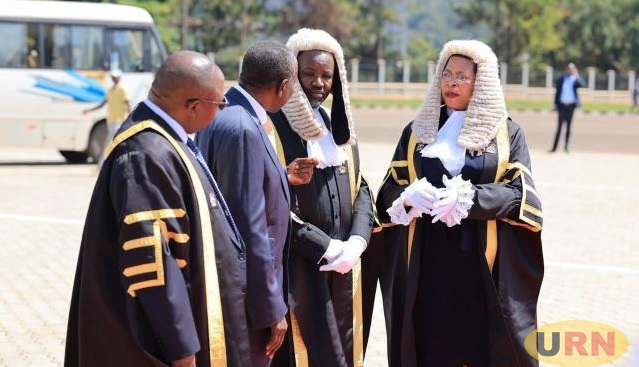
How the Speaker’s growing political influence is leading to increasing pressure for her to go
THE LAST WORD | ANDREW M. MWENDA | The battle for speaker of parliament is going to be the defining issue of the next five years of President Yoweri Museveni’s government. Of course, the decision on who will become speaker will be determined largely by the president. His choice will give us an indication of the way he sees the transition. While it is possible that Museveni may choose to run again in 2031, it is also a fact that he must plan for a transition – in case anything happens to him. Thus, who chairs parliament becomes critical.
In a meeting of the Central Executive Committee (CEC) of the NRM at State House in early March, it was agreed that the status quo be kept, i.e. the current speaker, Anita Annet Among (AAA) and her deputy, the suave and debonair Thomas Tayebwa, remain in place. However, there are many voices in the corridors of power who are opposed to the idea of Among remaining speaker. As these voices grow louder, so will the president have to adjust.
Since James Wapakhabulo, Museveni has made it a point to promote speakers of parliament who are not NRM historicals. Among came from the opposition FDC, just like her predecessor, Jacob Oulanyah, who had come from UPC. The other previous speakers of parliament had followed a similar path. Francis Ayume had been UPC and Edward Sekandi from DP. After Sekandi came Rebecca Kadaga who could be called a Johnny-come-lately, i.e., was not an NRM “historical”.
Thus, since he came to power, only Museveni and Wapakhabulo are the historicals who also served as speakers of parliament. Note: Al Haji Moses Kigongo was deputy speaker (at that time deputy chairman of the NRC, the parliament of the time, with Museveni being the chairman). And this has not been by accident. When the current constitution came into force in 1995, Museveni ceased to be speaker and helped elect Wapakabhulo to the job. Wapa, as he was fondly called, enjoyed unusual support and legitimacy inside NRM and was seen as a potential successor. During his term, he presided over the censure of two powerful ministers close to the president: Jim Muhwezi and Sam Kutesa. Museveni took lessons.
After that, Museveni made Wapa National Political Commissar, then minister of foreign affairs, and that ended any pretence to a succession from among the historicals. From then henceforth, all speakers came from outside NRM. And none ever sought to build a strong political base across the broad spectrum of power centres in the country – the NRM, parliament, the judiciary, the executive and other pillars of elite power until Among. And it is this construction of broad-based power that is the cause of concern.
First, Among holds a very tight grip over parliament, both among NRM and opposition legislators – not to mention independents. Using the large budget of parliament liberally, she has cajoled, intimidated, blackmailed and bought off many MPs to be subservient to her. Then she has used her role as speaker to gain control over the judiciary. How? All judges in Uganda are appointed with parliamentary approval. Among has used her role as chair of the committee of parliament that approves these appointments to ensure judges are loyal to her. Today, no case against her can succeed through the courts.
But beyond all this, she has also used the power she wields over the parliamentary commission to dish out jobs to children, spouses and relatives of Ugandan elites in all spheres of our national life – bishops, ministers, sheikhs, muftis, top-ranking businesspeople, high-level civil servants, legislators, activists, etc. Note: the parliamentary commission employs over 2,000 people and is among the best-paying employers in the country. This jobs bonanza has bought her considerable loyalty among Ugandan elites.
To crown it all, Among decided to enter NRM and contest for the job of national vice chairperson for women against Kadaga. Up until 2025, no one thought Among had a base within NRM. She made a deliberate decision to expand her political base and capture the infrastructure of the party from the grassroots. To secure this election required her to penetrate the structures of NRM from the grassroots. This meant winning the support of sub-county chairpersons, district councillors, LC5 chairpersons and speakers; mayors of municipalities and town councils, and NRM district executives who include the chairperson of the NRM in a district and their executives, plus winning over special interest groups such as women, youths, entrepreneurs, workers, PWDs and veterans. In the ensuing contest with Kadaga, Among won by over 80%.
The magnitude of her victory in the party left many people gasping for breath. Basically, a newcomer into NRM now holds powerful cards in her hands: parliament, the executive, the party, the judiciary and many influential elites in the professions, religious organisations, businesspersons and among traditional leaders. The only constituency where Among does not have sway is the security infrastructure of the state – the army, the police and the intelligence services. But who knows, with time she may cultivate a political base there as well. It would be a big mistake to disregard concerns about her growing power and influence in the country and the security infrastructure.
Among’s greatest advantage has been the disdain with which many elite Ugandans look at her. This has led them to underestimate her capacity as a politician. She may not be sophisticated in the Western sense. All too often, she exhibits a crude materialism that causes many Ugandan elites to despise her and therefore underestimate her. Yet her lack of ethical and moral values in the handling of public finances is what makes her a formidable politician. What many of Uganda’s elites miss in Among is her very well-cultivated political instincts. She is gifted with an incredible ability to understand the nature and structure of Ugandan society and respond to its dynamics with exceptional skill and tact.
As Museveni ages, he has lost the energy and zest to fight different wars at multiple battlefronts. Among has been handy in helping the president control parliament and make it subservient to his interests. With 20% of the money Museveni used to spend on parliament, she achieves twice his objectives. As the president has grown reliant on her, so has her political clout. But this makes her a risky bet as speaker. The question: can Among be relied upon, during a delicate transition where Museveni is absent, to captain the ship of state to dock where the president would have desired it to?
****

amwenda@ugindependent.co.ug

Is there an alternative person (aspiring or not) that the “old man of the clan” would recommend? If AAA has built such loyalty and a following, and we don’t know how much her opponents have achieved in that respect, what can step in her way? Imagine winning the CEC post with over 80%, going unopposed in Bukedea, pushing through many loyalists in the elections, fishing the likes of “Prof”. Nsibambi of Mawokota; clinching endorsement from CEC, from an increasing number of incoming and outgoing MPs and, most significantly, the Big Man himself! The race seems to be over, unless just for putting up a sham contest for public show.
PLU may have to devise a way to work through this reality and, please, let’s not cast Mzee as if he is such a spent force. Both his supporters and opponents should accept that he is still here, aware that he doesn’t and must not work alone, unless the rest are in other things of subverting and robbing the state.
“pushing through many loyalists in the elections”- who, in turn, are the voting constituency for the Speaker and Deputy Speaker.