The Independent Uganda: You get the Truth we Pay the Price


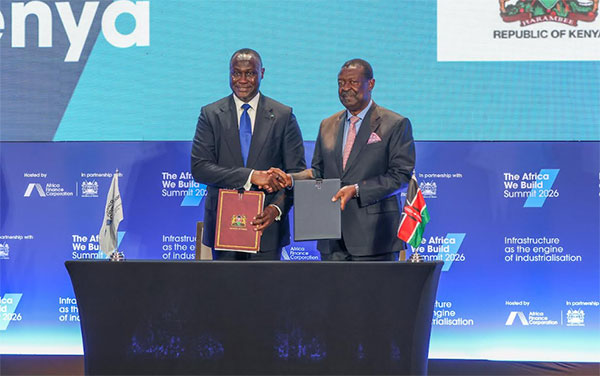
The new office will function as a regional hub for East Africa, placing AFC closer to governments, investors and private sector actors involved in cross-border infrastructure and industrialisation efforts
Nairobi, Kenya | THE INDEPENDENT | Nigerian-based Africa Finance Corporation has signed an agreement with the Kenyan government to open its first regional office in Nairobi, in a move that signals a deeper push to mobilise African capital into infrastructure and industrial development across East Africa.
The host country agreement, signed by Kenya’s Prime Cabinet Secretary and Cabinet Secretary for Foreign and Diaspora Affairs Musalia Mudavadi and AFC President and Chief Executive Samaila Zubairu, was witnessed by President William Ruto on the sidelines of the AFC Annual General Meeting in Nairobi.
Kenya has also pledged an additional $25 million in equity investment into AFC, strengthening its backing for African-led financial institutions as governments on the continent seek to rely more on domestic savings to fund long-term development.
President Ruto said the partnership reflects confidence in African institutions to deliver transformative infrastructure.
“We will continue, as leaders, to build our own African financial institutions, give them the capacity,” he said. “Our ambitions will remain unrealised if we continue to depend on external capital.”
A strategic regional base
The new Nairobi office will serve as AFC’s East Africa hub, placing the institution closer to governments, investors and private sector actors involved in cross-border infrastructure and industrialisation.
Officials said AFC plans to mobilise more than US$2 billion in the region over the next three to five years, targeting transport corridors, energy systems, special economic zones and digital infrastructure.
Zubairu said the expansion reflects a shift in thinking about development across Africa.
“Africa is moving from project thinking to systems thinking,” he said, adding that the focus must move from isolated investments to integrated platforms linking energy, transport, trade and industry.
He said the Nairobi base would accelerate the development of “integrated projects, regional energy platforms, industrial ecosystems and bankable pipelines”, while also helping to channel domestic African capital into productive investment.
Beyond finance, the presence of a major continental infrastructure investor is expected to have wider economic effects in Kenya. Analysts say the office could create skilled and semi-skilled jobs in investment, finance, legal and technical services, while also supporting demand for local suppliers such as consultancies, law firms, hospitality providers and small businesses.
Over time, it is expected to reinforce Nairobi’s position as a regional financial centre and attract further international institutions.
Closing infrastructure gaps
The expansion comes as African countries continue to face major infrastructure constraints, particularly in energy transmission, which limit industrial growth and productivity.
Zubairu said that while electricity generation capacity is increasing across the continent, weak transmission networks often prevent power from reaching where it is needed.
“Across Africa, new capacity is being added, but without transmission infrastructure, power cannot go to demand centres,” he said, adding that transmission should be treated as a strategic priority.
He argued that private capital will be critical in closing these gaps, provided governments put in place appropriate financial frameworks to reduce risk and attract long-term investment.
The same applies to transport and aviation, he said, where improved connectivity and trade facilitation could unlock higher-value exports and faster growth.
Ruto said Kenya’s additional investment reflects a broader strategy to strengthen African financial institutions and deepen regional integration.
Kenya has in recent years increased its stakes in regional development finance institutions, including the Trade and Development Bank, as part of efforts to expand domestic financing capacity.
The president said African economies must be more closely connected through infrastructure such as roads, railways, ports and power grids in order to unlock shared growth.
He said regional integration would allow countries to leverage complementary resources and reduce costs for businesses and consumers.
Capital and systems
Zubairu said Africa’s key challenge is no longer a shortage of capital, but the lack of systems to deploy it effectively.
He called for reforms to pension and insurance regulations to allow greater investment in infrastructure, alongside the development of local currency capital markets and stronger risk-sharing mechanisms.
“Capital does not move because we ask it to,” he said. “It moves when risks are properly allocated and priced.”
Without such reforms, he warned, domestic savings would continue to sit in short-term, low-risk assets rather than being channelled into long-term productive investment.
Industrial opportunity and resilience
The discussions in Nairobi also highlighted the need for stronger regional approaches to energy security and industrial resilience.
East Africa holds significant natural resources, including hydrocarbons and critical minerals, which could support local production of fertiliser, refined fuels and manufactured goods.
However, the region continues to import large volumes of processed products, exposing economies to global price volatility and supply chain disruptions.
Zubairu said successful infrastructure projects in parts of the continent demonstrate what is possible when capital, policy and execution align.
“These are not isolated exceptions,” he said. “They are blueprints of what we can scale.”
AFC, established in 2007, was created to catalyse infrastructure and industrial investment across Africa. It has 48 member countries and has invested more than US$19 billion across 36 African economies in sectors including transport, energy and oil and gas.