The Independent Uganda: You get the Truth we Pay the Price


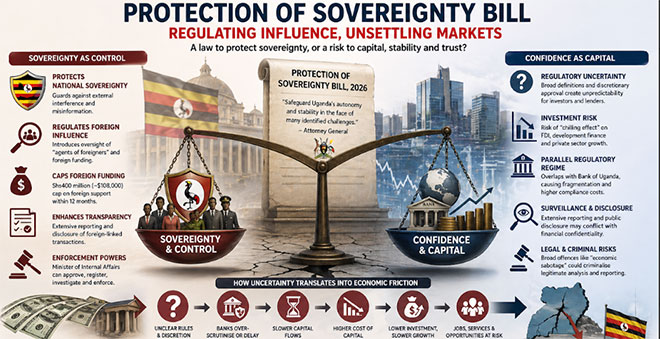
Regulating influence, unsettling markets
COVER STORY | THE INDEPENDENT | Uganda’s proposed foreign agents legislation is rapidly becoming more than a legal reform. It is evolving into a stress test of the country’s political economy, its regulatory philosophy and its relationship with global capital.
Framed by government as a sovereignty safeguard, the Protection of Sovereignty Bill, 2026, is increasingly being interpreted by bankers, lawyers and civil society as a structural shift in how the state defines influence, money and legitimacy.
At stake is not only how the government regulates foreign funding, but how it signals predictability to investors, lenders and citizens operating within an increasingly interconnected financial system.
The bill, now before parliament, introduces a new legal category of “agents of foreigners” and places them under expanded state oversight.
Proponent of the bill, State Minister for Internal Affairs, Gen. David Muhoozi argue that the measure is necessary to protect national sovereignty, curb external interference and address what they describe as misinformation and the erosion of “sacred” national values facilitated by foreign funding and digital platforms.
The bill was introduced on April 15 and is backed by the ruling party, National Resistance Movement, lawmakers who hold a commanding majority in parliament.
But as it advances, the debate has expanded far beyond its original intent. It now sits at the intersection of governance, financial stability and constitutional interpretation, drawing concern from actors who rarely converge in the same policy conversation.
A definition that behaves like a system, not a line
At the centre of the controversy is the bill’s definition of an “agent of a foreigner”. It includes any person or entity whose activities are “directly or indirectly supervised, directed, controlled, financed, or subsidised by a foreigner.”
In legal theory, definitions are supposed to delimit scope. In practice, this one expands it. The wording is elastic enough to capture NGOs, media organisations, universities, research institutions, Ugandans living abroad, law firms and foreign-linked commercial entities.
It does not merely classify organisations. It maps relationships, and in doing so, it converts economic and social interdependence into a potential regulatory category.
For the banking sector, this is where uncertainty begins to translate into systemic risk.
The Uganda Bankers’ Association (UBA) has warned that the classification could pull routine cross-border financial activity into a politically sensitive legal framework. Foreign-owned banks, correspondent banking relationships and development finance flows could, in certain circumstances, fall within its scope.

In a formal letter to the Attorney General dated April 13, 2026, the UBA warned that the bill could create “uncertainty in the investment climate” and generate a “chilling effect” on investors, potentially undermining Uganda’s efforts to attract foreign direct investment and expand private sector credit.
From the perspective of financial institutions, the issue is not political alignment but predictability. Banking systems operate on the assumption that rules are knowable, stable and consistently applied. When definitions widen and enforcement becomes discretionary, risk is no longer a variable. It becomes a condition.
One senior banking official captured the shift in simple terms: “Banks price uncertainty. If the rules are unclear, the cost of capital goes up.”
Capital under a new interpretive layer
The bill introduces a cap of Shs400 million, approximately $108,000, on foreign funding within 12 months for entities classified as foreign agents, unless prior approval is granted by the Minister of Internal Affairs.
The Uganda Bankers’ Association, in a letter submitted to Attorney General, Kiryowa Kiwanuka, dated April 13, 2026, said while the Bill is aimed at regulating foreign influence, several of its clauses may have unintended consequences for investment flows, credit expansion and the stability of the banking system.
They, for instance, described the threshold as “extremely low” relative to the scale of modern financial systems. In practice, most commercial lending, syndicated financing, trade credit and development finance arrangements exceed this level as a matter of routine.
The implication is not simply administrative constraint. It is the insertion of a new interpretive layer into capital flows.
Where financial decisions were previously governed by creditworthiness, risk pricing and contractual terms, they may now require discretionary approval. That shifts the logic of capital allocation from market-based assessment to administrative filtering.
Bankers warn that this could slow financial intermediation across key sectors, including infrastructure, energy, manufacturing and agriculture, all of which depend heavily on external financing.
It also risks altering the behaviour of international lenders, particularly development finance institutions and correspondent banks, which operate under strict compliance frameworks and tend to avoid jurisdictions where approval systems are ambiguous or politically exposed.
When enforcement becomes the real policy signal
Perhaps the most consequential aspect of the bill lies not in its definitions but in its enforcement provisions.
It allows for the forfeiture of funds received without approval. The Uganda Bankers’ Association has described this as creating what it calls an “existential risk” for financial institutions.
Modern banking is not linear. Funds move through layered systems across jurisdictions, intermediaries and settlement mechanisms. Determining whether a transaction breaches domestic approval thresholds is often complex, especially in real-time processing environments.
The likely behavioural response is not resistance but avoidance. Banks may delay transactions, over-scrutinise flows or decline operations that fall within ambiguous categories.
This is how regulatory uncertainty becomes economic friction. It does not stop capital. It slows it. And in economies dependent on external inflows, slowing capital has macroeconomic consequences.
Parallel authority and the problem of regulatory geometry
The bill assigns significant oversight powers to the Minister of Internal Affairs, including approval of foreign funding, registration of foreign agents and enforcement of compliance obligations.
This creates a potential overlap with the Bank of Uganda, which currently regulates financial stability, capital adequacy and monetary oversight through established frameworks.
The Uganda Bankers’ Association has warned that this risks creating a “parallel, potentially conflicting regime” alongside the central bank. The issue, bankers say, is not duplication alone. It is authority fragmentation.
In financial systems, clarity over who decides is as important as what is decided. When regulatory roles overlap, institutions are forced to interpret not just rules but relationships between regulators.
That uncertainty can slow decision making, increase compliance costs and discourage cross border capital flows.
The Association has therefore urged the government to reaffirm the primacy of the Bank of Uganda in financial regulation and ensure coherence across supervisory frameworks.
Reporting systems and the expansion of visibility
The bill also imposes extensive reporting obligations on financial institutions. Banks would be required to submit monthly reports detailing foreign-linked transactions, including source, amount and purpose of funds, and would be prohibited from processing transactions for classified entities without ministerial approval.
This significantly increases the visibility of financial flows to the state. While framed as transparency, the measure introduces a surveillance dimension into routine banking operations. It also raises reputational considerations, as financial institutions become directly associated with politically sensitive classifications of clients.
Clause 13 further intensifies concern. It criminalises conduct deemed to “weaken or damage the economic system or viability of the country”, defined as “economic sabotage”, with penalties of up to 20 years in prison.

The Uganda Bankers’ Association warns that such broad language could expose financial analysts, auditors and banking professionals to legal risk for legitimate economic analysis, including sovereign risk assessments, inflation forecasts and currency analysis.
When economic interpretation becomes potentially criminalised, analysis itself becomes cautious. The legislation also requires disclosure of foreign funding arrangements, with information made available to the public upon payment of a fee.
While government frames this as transparency, bankers caution that it may conflict with established principles of financial confidentiality.
In structured finance and international investment, confidentiality is not cosmetic. It is often a condition of participation. Disclosure of funding structures can reveal commercially sensitive information, alter competitive positioning and deter participation in complex financing arrangements.
This raises a broader question about how Uganda positions itself in global capital markets. Transparency increases accountability. But excessive disclosure can reduce participation.
Beyond technical compliance, bankers are increasingly focused on investor sentiment. Uganda’s development strategy depends heavily on external capital inflows to finance infrastructure, industrialisation and private sector growth. Financial institutions act as intermediaries in this process, translating global capital into domestic credit.
The Uganda Bankers’ Association warns that regulatory uncertainty could increase perceived country risk, raising borrowing costs and reducing capital inflows at a time when Uganda is seeking to scale up investment.
In global markets, legal perception often precedes legal reality. Credit ratings, risk premiums and investment decisions respond not only to enacted law but to anticipated regulatory behaviour. Uncertainty itself becomes a macroeconomic variable.
Sovereignty as political language and financial signal
The government maintains that the bill is necessary to safeguard sovereignty and ensure transparency in foreign engagement. Attorney General Kiryowa Kiwanuka has said the legislation is “grounded in the urgent need to safeguard Uganda’s autonomy and stability in the face of many identified challenges.”
But the debate increasingly reveals that sovereignty, in this context, is not only a political concept. It is also a financial signal.

It communicates how predictable the operating environment is for capital, how stable regulatory interpretation may be, and how far state discretion extends into economic decision making.
For civil society, the bill signals potential contraction of civic space. For journalists, it raises risks of criminalisation of reporting. For bankers, it introduces questions of regulatory clarity, capital mobility and institutional coherence.
The outcome will therefore be measured not only in legal terms but in its effect on Uganda’s financial system and its integration into global capital markets.
Lawyers have also raised constitutional concerns, arguing that the bill could redefine citizenship and shift the balance of power outlined in Uganda’s 1995 Constitution.
The Constitution states that “All power belongs to the people who shall exercise their sovereignty in accordance with this Constitution.”
Critics argue that the bill expands executive discretion in ways that may dilute this principle.
Speaking at a virtual Press conference hosted by the Uganda Law Society, Godbar Tumushabe, Associate Director at the Great Lakes Institute for Strategic Studies, described the bill as “the last nail in the process of overthrowing the constitution.”
He said, “We literally no longer have the 1995 Constitution,” adding that “This bill is a furtherance of that evisceration… it appropriates the sovereignty of citizens and transfers it to the executive.”
He warned that its implications extend into the economy, including the $2.5 billion diaspora remittance system.
“With a stroke of a pen, you can disrupt a $2.5 billion diaspora economy. This law touches almost every citizen,” he said.
From exile, Uganda Law Society President Isaac Ssemakadde offered a sharper political reading.
“This is not a law. It is an announcement of departure. Uganda is departing from the democratic world and creating a militarised state.”
Opposition legislators argue that the bill duplicates existing legislation, including the Penal Code Act, Anti Money Laundering Act, Public Finance Management Act and NGO Act.
“We have a plethora of laws that touch critical concerns that anyone would have; the Penal Code Act captures a number of those provisions, so it is redundant,” said Leader of the Opposition Joel Ssenyonyi.
He added that offences such as treason and illicit financial flows are already covered under existing law.
Equally, leaders from the Teso sub-region have unanimously rejected the proposed Sovereignty Protection Bill, describing it as ambiguous, restrictive, and potentially dangerous to citizens’ rights and freedoms.
“Nearly everyone interacts with foreign entities in one way or another, whether through telecommunications, trade, or development partnerships. This law risks labelling all citizens as foreign agents,” one participant said during a press briefing recently.
Reverend Beseri Otekat of Soroti Diocese described the bill as “a murdering law,” warning that it could suffocate essential services such as education and community development, many of which rely on international partnerships.
The final equilibrium
Uganda now stands at a delicate equilibrium. On one side is sovereignty as control. On the other is confidence as capital. Between them lies the cost of money, the flow of investment and the architecture of economic trust that will define the country’s trajectory in an increasingly interconnected world.