The Independent Uganda: You get the Truth we Pay the Price


DNA evidence before court is incapable of proving who fired the gun that ended Mr Henry Katanga’s life, says a British DNA forensics expert
SPECIAL REPORT | ANTHONY NATIF | As recorded in the case Uganda Vs Molly Katanga and adapted from @TonyNatif on X.
****
In February 2026, Mrs Molly Katanga was put on her defense by Justice Rosette Comfort Kania. Among the reasons cited by the judge was the prosecution’s “circumstantial evidence that pointed to her as an active participant in the death of Mr Henry Katanga”.
She said prosecution DNA evidence “pointed to the fact that A1 operated the gun that killed the deceased”.
Mrs Katanga’s defense had argued then that presence of DNA does not prove in any way that she touched the gun and that instead, fingerprint analysis would answer that question
Finding for the prosecution, Justice Kania wrote that “the gun was registered to the deceased person; it is no wonder that his DNA was found on the gun. However, the existence of A1’s DNA predominantly on the parts of the gun used for loading and firing the gun requires an explanation from A1 on how her DNA was deposited thereon.”
Yesterday, Mrs Katanga answered the lady justice’s call with some aplomb.
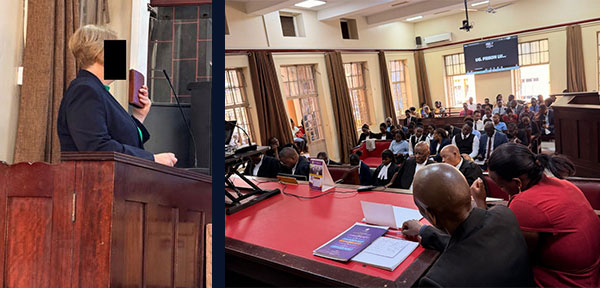
She brought a British DNA Forensics Expert, DW4, with nearly 30 years of experience in this space.
DW4 has a resume longer than the Thames.
She helped kickstart major DNA forensics programs in Britain and trains a number of police forces in the UK, to wit: Metropolitan Police (Scotland Yard), City of London Police, Kent Police, British Transport Police, Sussex Police, Hampshire police and the Military Police. She’s done similar work in New Zealand, Oman, trained the Turkish army and teaches as an honorary lecturer at University College, London.
She told Justice Kania that the Uganda Police-authored DNA report before her was largely meaningless, if not outrightly worthless.
Pointing to potential for contamination, she said that to the extent that the Scene of Crime Officer (SOCO) didn’t wear proper protective gear and used one pair of gloves to pick all exhibits at the scene, this report merely tested for contamination and not much else.
She showed images extracted from the SOCO report that showed the gun had been recovered from the couple’s bed, and this obviously meant that both their DNA would be there.
She said it was impossible to know who touched the gun by assessing which DNA was dominant because people shed DNA at different rates. She said the strongest DNA profile on the gun wasn’t proof as to who touched it last, if at all
She also indicated that even if that were true, the fact that one of Mrs Katanga’s daughters’ DNA was found on the gun as part of a mixed profile, it was inevitable that the analyst would mistakenly attribute it to her mother, hence overestimating Mrs Katanga’s contribution to the DNA profile on the gun.
She told Justice Kania that the technology used by the Uganda Police was incapable of teasing the mother-daughter genetic materials apart.
She then reminded Justice Kania that “unless disturbed by the elements, extreme heat, dampness, etc., it’s believed that DNA can persist (on an item) indefinitely”, essentially rendering the discussion on who touched the gun first or last a moot point.
Listing modes of DNA transmission as primary, secondary and tertiary, she told the judge that it was scientifically impossible to tell who deposited DNA on an item.
Elison Karuhanga (EK) asked her: once we find DNA on an item, how can we tell who deposited it there?
DW4: It’s not possible to tell who put DNA on an item
EK: Can we tell when it was deposited?
DW4: It’s not scientifically possible to do that.
EK: Can we tell the order in which it was deposited?
DW4: Again, it’s not scientifically possible
She advised the court that to conclusively determine who pulled the trigger, they’d have to rely on fingerprints, which the police took and didn’t test or didn’t report.
Earlier, the state had tried to block DW4’s testimony, citing immigration laws, which Karuhanga dismissed as attempts at suppressing evidence. (Frame 4)
Court resumes tomorrow at 9:30 am as defence attorney Elison Karuhanga continues to lead DW4.
UgandaVsMollyKatanga
DNA Evidence before Court is incapable of proving who fired the gun that ended Mr Henry Katanga’s life, says British DNA Forensics Expert.
In February 2026, Mrs Molly Katanga was put to her defense by Justice Rosette Comfort Kania.
Among the reasons cited… https://t.co/yir0ll9J7k pic.twitter.com/msl4ykWlzR
— Anthony Natif (@TonyNatif) June 30, 2026