 The Independent Uganda: You get the Truth we Pay the Price



SPECIAL REPORT | Uganda is betting that replacing the Tax Identification Number (TIN) with the National Identification Number (NIN) will widen the tax base and curb leakage. But with millions already registered for tax, the harder test is whether better identification can actually translate into more revenue, reports Ronald Musoke.
Uganda has a new tax number. What it does not yet have is a clear answer to the bigger question: how much more tax will that number actually bring in?
The government has moved to replace the Tax Identification Number (TIN) with the National Identification Number (NIN) for individual taxpayers, presenting the change as a step towards a more connected, efficient and data-driven tax system.
The announcement, made after Cabinet approved the measure on Aug. 31, has been framed around simplicity and better identification. ICT and National Guidance Minister Justine Kasule Lumumba said at the Uganda Media Centre in Kampala on Sept. 1 that Cabinet had approved the use of the NIN as the tax identifier for individuals.
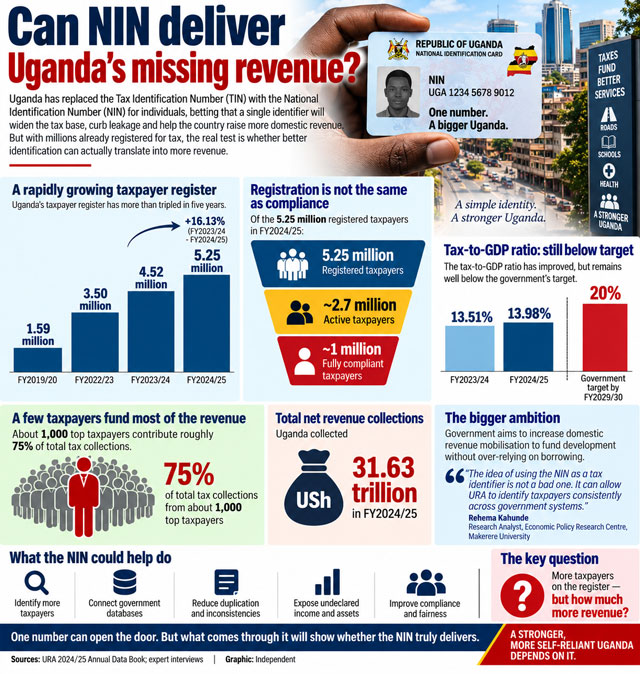
But behind the administrative change is a much larger fiscal ambition. Uganda wants to raise more domestic revenue without repeatedly increasing the burden on people and businesses already paying taxes. The government has set its sights on lifting the tax-to-GDP ratio from the current 14.2% to 20% by the 2029/30 financial year.
That makes the NIN experiment consequential. If a single identifier allows the Uganda Revenue Authority (URA) to see economic activity that previously sat in separate government databases, it could help uncover undeclared income, improve compliance and bring previously invisible taxpayers into the tax net. But if the reform merely replaces one number with another while millions of registered taxpayers remain inactive or non-compliant, its effect on revenue could be much smaller. That is the revenue test facing NIN.
The problem is no longer simply finding taxpayers
Uganda’s tax register has grown dramatically in recent years. According to URA’s 2024/25 Annual Data Book, the taxpayer register increased by 16.13%, from about 4.52 million taxpayers in FY2023/24 to about 5.25 million. Net revenue collections also increased to Shs31.63 trillion, while the tax-to-GDP ratio improved from 13.51% to 13.98%.
On the surface, that looks like progress. But the composition and behaviour of taxpayers matter as much as the size of the register.
Aloysius Kittengo, the Financing for Development Programme Coordinator at the Southern and Eastern Africa Trade Information and Negotiations Institute (SEATINI), a Kampala-based trade policy think tank, puts the issue bluntly.
“The overall rationale of this is to increase the tax registration and in turn tax collection as well as tax compliance,” he says, adding that the government expects NIN to expand the register and potentially increase revenue.
But there is an immediate caveat. “Not everyone with a NIN is eligible to pay tax,” Kittengo told The Independent. That distinction goes to the heart of the reform.
A national identity number identifies a person. It does not, by itself, identify taxable income, business turnover, rental income or a taxable transaction.
Kittengo is even more direct when asked whether putting every individual behind a NIN will automatically translate into higher tax collection.“Not really,” he says. He points to a much larger pool of people already sitting inside the tax administration system. “Currently, Uganda Revenue Authority has over 5.25 million registered taxpayers, but only about 2.7 million are active and roughly one million are fully compliant,” he says.
For Kittengo, those figures expose the danger of confusing registration with revenue.“That is a clear indication that having several people/potential taxpayers on the tax register does not amount to an increase in tax revenue collection, especially now when every NIN is Tax identified.”
The implication is uncomfortable but important. Although Uganda may not have a simple taxpayer-identification problem anymore, it may now have a taxpayer-quality and compliance problem. And that changes what success for NIN should look like.
From finding people to finding economic activity
Rehema Kahunde, a Research Analyst in the Macro Department at the Economic Policy Research Centre (EPRC) at Makerere University, sees considerably more potential in the reform, but only if the government uses the NIN as a gateway to information rather than treating it as the solution itself.
Kahunde told The Independent that the move fits squarely within the government’s broader domestic revenue mobilisation strategy for the 2027/28 financial year, where data and technology are expected to help broaden the tax base, curb leakage and improve compliance.
“The idea of using NIN as a tax identifier is not a bad one,” she says. In her view, the NIN could become a powerful identification and information tool because it can allow URA and other tax authorities to identify taxpayers consistently across government systems and across different tax bases that may previously have been hidden from the tax system.

That is where the reform becomes more interesting. Imagine a taxpayer whose NIN is connected, within the limits of the law, to information about business ownership, land and property, motor vehicles, employment and PAYE records, imports, EFRIS transactions and other economic activity.
The value of the NIN would then not be the number itself. Its value would be what government can legitimately and accurately learn by connecting the information attached to it. Kahunde says such linkages could expose discrepancies that were previously difficult to see. “Before this new development, it was possible for a tax payer to leave some taxable income undeclared to the tax authorities,” she says.
Linking the records could reveal substantial business turnover, property ownership or other economic activity that was previously undeclared or under-declared. That is potentially a significant change in the way tax administration works.
Instead of waiting for taxpayers to tell the government everything about their economic activity, a more integrated system could allow the tax authority to cross-check information from different parts of the state. But even Kahunde cautions against measuring success by the number of new registrations.
Uganda’s taxpayer register grew from 1.59 million taxpayers at the end of FY2019/20 to 3.5 million by the end of FY2022/23. Yet, she notes that about 1,000 top taxpayers accounted for roughly 75% of total tax collections, while the top 0.02% contributed more than three quarters of the country’s tax revenue.
“So, it’s not just about expanding the tax register,” Kahunde says. “It’s not just about the quantity, but the quality of the tax payers included in the register.”
That distinction may ultimately determine whether NIN succeeds. If the reform mainly produces more names on a database, it could make Uganda’s tax register look more impressive without materially changing collections. If it helps URA identify previously hidden taxable income among people and businesses already operating in the economy, the fiscal effect could be much more significant.
The number matters because of what sits behind it
Tax expert Dedan Mutatinensi of Demo Consult makes the same argument from a different angle. In an analysis published recently in a blog, Mutatinensi argued that the reform should not be understood simply as one number replacing another.
“The reform means that an individual’s identity for tax administration will increasingly be tied to the same number,” he wrote. The attraction, he argued, is that a common identifier can reduce duplication and inconsistencies in government records. But the larger benefit is visibility.
“A tax system works best when the authority can accurately establish who is earning income, conducting business, and carrying out taxable transactions,” Mutatinensi said. That is the core of the NIN argument. “A common identifier makes it easier to connect information held across different government systems and, in turn, gives the tax authority a clearer picture of economic activity.”
Still, the distinction between identity and taxation is crucial. The NIN does not create a new tax. It does not make every Ugandan automatically liable for tax. The Tax Procedures Code (Amendment) Act, 2025 provides for individuals to use NIN while businesses and other non-individual entities use their Business Registration Number (BRN). Tax liability continues to depend on existing tax laws and economic activity.
So, the government’s wager is not that the NIN itself will generate money. It is that better identification will give URA a better view of where taxable economic activity is occurring, and therefore, a better chance of collecting what is already due. That is a much harder proposition to prove.
URA says the TIN has run its course
URA Commissioner General John Musinguzi Rujoki has defended the shift on precisely those grounds. Speaking on NBS Television’s Spotlight Uganda on Nov. 17, last year, during a discussion on how the Uganda National Bureau of Standards (UNBS) and URA are transforming trade in Uganda, Rujoki explained why the authority believes NIN is now the stronger identifier.
“When URA came up with the idea of TIN, it was to identify a person or company. However, with the advancements in the registration of our citizens, there is no better unique identifier than the National Identification Number (NIN),” he said.
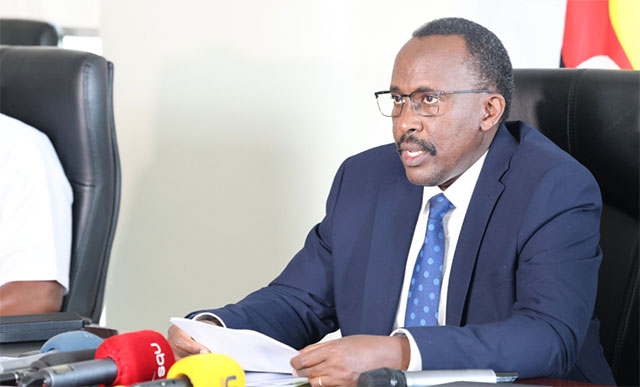
He added: “The shift from TIN to NIN will improve how we offer services to the citizens.” The argument is therefore partly administrative. Ugandans have long carried two numbers issued by two different institutions; the NIN from the National Identification and Registration Authority (NIRA), and the TIN from URA.
The government now wants those systems to speak to each other more effectively. For individuals, the NIN becomes the tax identifier. For companies and other non-individual entities, the BRN becomes the relevant identifier. Existing taxpayers are not simply erased from the system. Their previous tax records and obligations remain, but those records must be aligned with the new identification framework.
URA has already asked taxpayers to update their NIN or BRN, together with current telephone numbers, physical addresses and business activities. That is significant because the reform is ultimately about data quality.
A taxpayer whose name, phone number, address or business activity is outdated may not become easier for government to identify simply because the taxpayer now has a NIN. The government therefore faces two tasks at once: connecting the databases and making sure the information inside them is accurate.
Integration can help but it can also create new problems
There is some independent evidence behind the government’s theory. A University of Cambridge study examining Uganda’s “Instant TIN” system found that integrating information between URA, NIRA and the Uganda Registration Services Bureau (URSB) could improve aspects of taxpayer data quality and reduce duplication.
But the findings were not uniformly positive. The study found improvements in some contact information and reductions in duplicate records, while data quality relating to economic sectors deteriorated in some respects. It also pointed to problems created by infrequent updates and weak validation in external datasets.
That matters for NIN because the reform assumes that connecting databases will make the tax authority’s picture of economic activity clearer. Integration can do that. But connecting inaccurate or outdated databases can also connect inaccurate or outdated information more efficiently. This is why the transition cannot be reduced to replacing TIN with NIN on a form. The quality of the information attached to the identifier will determine what URA can actually do with it.
Traders welcome the wider tax net, with conditions
The business community’s reaction reflects another part of the revenue equation: fairness. Baker Bahasha, the Research, Policy and Advocacy Officer at the Kampala City Traders Association-Uganda (KACITA), an umbrella trader organisation, says traders broadly support the reform.
But it is not unconditional support. “Our thinking about NIN being used as a TIN or for matters of tax is two-way, but by significance, 80% of us have no problem with it, and we have reservation of about 20%,” Bahasha told The Independent.
The main reason for supporting it is tax widening. “The intention of using the NIN is to do what we call tax widening or having more people pay taxes, and for us that has been our call for some time.”
He argues that traders and the private sector have carried a substantial part of the tax burden. “Over 70% of the tax book has been coming from the private sector, mostly the traders,” he says. “We have been facing the bite or the hardest part of the taxes.”
KACITA therefore sees an opportunity in the new system in that it can identify more economic actors instead of repeatedly concentrating collection efforts on businesses that are already visible. “All Ugandans are liable to contribute to national development,” Bahasha told The Independent.
But he also argues that traders are not inherently opposed to taxation. “KACITA and its members, the traders and the business community in the private sector, are compliant and they always seek to comply,” he says. “Gone are the days when they were either hesitant or reluctant to comply.”
For Bahasha the NIN could be useful if it makes compliance simpler rather than simply giving government another mechanism for enforcement. “We’ve been challenged by a number of requirements for compliance,” he says. “So, if some of these strategies are coming to simplify and till the ground for us, so that we’re able to comply easily as traders, I think there wouldn’t be any reason to have big issues with the NIN being used as the TIN.” But his reservations are serious.
The information dividend comes with a privacy risk
The more information government can connect, the greater the potential value to tax administration, but it also means more information about individuals is concentrated in systems that must be protected.
Bahasha says KACITA’s biggest concern is data protection. “We have some reservations on the NIN, especially on the aspect of data protection,” he says. “Most of the fields that were required of us for the NIN are very personal information.” The concern is not necessarily that URA intends to misuse the information. It is that a larger, more interconnected database creates a more valuable target.
“I do not know, or we do not know, how prepared the government is to make sure that they fasten and strengthen data protection, especially when it comes to personal data,” Bahasha says. His solution is to control access.
“Perhaps that data needs to be filtered in a way that certain fields can be seen while others may not.” He adds: “We are not saying that URA is going to compromise or will intend to compromise, but it is possible that wrong elements can hack into the systems of URA, and before you know it, someone’s data will be compromised.” The implementation question is equally important to KACITA.
“We cannot be confident enough, reflecting on what has been, to say that this will work effectively,” he says. “It’s for URA, the Minister of Finance and government in general.” That puts the burden squarely on the institutions implementing the reform.
A national ID is not a tax liability
Moses Talibita, a civil registration and vital statistics consultant based at Nkumba University, welcomes the use of NIN for taxation but approaches it from the perspective of national identification. He believes the policy could encourage more Ugandans to register for national identification. But he warns that a national ID contains considerably more personal information than a tax-specific identifier.
“From a vulnerability point of view, the national ID has a lot of personal information which can be susceptible to abuse, if it goes into the hands of wrong people,” Talibita says. He draws a distinction between identifiers created for specific purposes.
“Remember, the sole purpose for the TIN was tax purposes, just like the Learner Identification Number (LIN) is for education. These specific numbers are of specific interest and of specific need.” Yet Talibita also sees the economic and administrative logic behind a common identifier.
The government maintains multiple databases, including those associated with taxation, driving, elections and census information, and maintaining separate identification systems can be expensive.
“Now that we have a national ID in place, and we know the cost of generating interest-specific data can be costly; the electoral register, tax register, driver licences, census, etc; this is why key government agencies are on the Board of the National Identification and Registration Authority (NIRA),” he says.
The efficiency gain, however, must be weighed against individual rights. “The cost implication vis a vis the rights of individuals have to be weighed,” he says. And Talibita returns the discussion to the central misconception surrounding the reform.
“URA is not taxing individuals, it is taxing employment, it’s taxing rental income, or the consumption of certain products.” In other words, the NIN can tell government who a person is. It cannot, by itself, tell government how much tax that person owes.
The transition itself could affect compliance
That distinction becomes particularly important during implementation. Kittengo of SEATINI warns that the government should not move faster than the systems and institutions supporting the reform.
He points to delays in NIN issuance, the readiness of URA systems and the practical difficulties faced by small businesses and taxpayers whose identification records may not yet be complete. The legal framework also creates practical questions for foreign taxpayers and people operating under different identification arrangements.
Kittengo notes that Uganda has double taxation agreements with nine countries; Denmark, India, Italy, Mauritius, the Netherlands, Norway, South Africa, the United Kingdom and Zambia, and asks how taxpayers from jurisdictions without such arrangements will be handled under the transition.
He also warns that licensing authorities and other regulatory bodies are not expected to issue certain licences or authorizations to people who do not have the required identifier. That could create a problem if a taxpayer is ready to comply but has not yet secured the necessary identification.
Kittengo argues for an interim tax registration number for people waiting for NIN issuance: a number issued by the URA Commissioner General, valid for 12 months and renewable once. The objective would be simple: do not allow an identification transition to become a barrier to legitimate economic activity.
“More time is required for scrutiny and transition from TIN and onboarding everyone’s NIN,” Kittengo says. For a reform whose ultimate goal is higher compliance, implementation failures would be counterproductive.
What would success actually look like?
This is where the government’s NIN strategy needs a harder measurement framework. The first metric is obvious: how many people and businesses are successfully identified? But that is not enough.
Uganda has already demonstrated that it can grow the taxpayer register. The register reached more than 5.25 million in FY2024/25. The harder problem is converting that administrative expansion into sustained compliance and higher collections. So, the real questions should be more demanding.
How many previously unidentified taxpayers will NIN integration uncover? How many duplicate or inactive records will it eliminate? How many previously undeclared economic activities will it reveal? How much additional taxable income will those discoveries represent? How many new assessments will result? How much additional revenue will actually be collected? And, most importantly, how much of that additional revenue can be attributed specifically to NIN integration rather than to other URA reforms, economic growth, inflation, enforcement, EFRIS, changes in tax policy or improved compliance for other reasons?
Those questions matter because Uganda’s domestic revenue ambition is much larger than an identification reform. Sophie Nampewo Njuba, the Finance for Development and Economic Justice Coordinator at Oxfam in Uganda, argues that the government should be cautious about treating the NIN as a direct revenue solution.
“On whether NIN can actually translate into higher tax collections? “No,” she says. She does not dismiss the reform; rather, she sees identification as one piece of a much larger compliance chain.
The NIN can help track taxpayers, she says, but the government must also ensure that taxpayers understand their obligations, know how to use the systems, keep proper records, calculate their taxes and make full and timely payments.
“Tax payment, therefore, is not just about identifying the taxpayer but also ensuring the taxpayer understands their role and is able to meet their respective obligation,” she told The Independent.
Nampewo also argues that the government still has administrative and collection gaps that cannot be solved by identification alone. On whether Uganda’s domestic revenue mobilisation ambition can realistically be attributed to better taxpayer identification, she says more assumptions and modelling are required.
“There is a lot more needed to go with the identification to realize an increase in domestic revenue mobilisation.” Her preferred approach is to retain both identifiers initially, allowing NIN and TIN to work together before the TIN is eventually phased out if the new system proves effective. “Have both the TIN and NIN,” she says.
That proposal captures the wider uncertainty surrounding the reform. The question is not whether NIN can improve identification. There is a plausible case that it can. The question is how much revenue that improved identification will produce once it passes through the much messier stages of compliance, assessment and payment.
The missing number
Uganda’s NIN reform is therefore entering its most important phase. The policy has a compelling administrative logic. A single identifier can reduce duplication, connect information and potentially give URA a clearer picture of economic activity. The government’s own tax register shows why identification alone cannot be the measure of success.
More than five million people are now registered taxpayers, yet Kittengo says only about 2.7 million are active and roughly one million fully compliant. Kahunde at the EPRC points to the concentration of revenue among a tiny group of top taxpayers. Nampewo at Oxfam-Uganda says identification without compliance measures will leave the revenue gap largely intact. At the same time, the potential upside is significant.
If NIN enables government to connect legally accessible information about employment, businesses, property, vehicles, imports and electronic transactions, it could expose economic activity that is currently missing from the tax system. That would make NIN more than a replacement number.
It would make it part of a new tax intelligence architecture. But that architecture has to work. The databases must be accurate; the systems must communicate, taxpayers must be able to access and use them. NIRA must be able to issue identification in time, URA must be able to interpret the information it receives, data must be protected, and identified economic activity must translate into assessments, payments and revenue.
There is also a political question. If NIN succeeds in finding more taxable activity, the government will have to demonstrate that the additional tax burden is being distributed fairly, especially when traders and other formal businesses already feel heavily targeted.
That is why the strongest case for NIN is not that it will make everyone a taxpayer. It is that it could make the tax system better at distinguishing between people who owe nothing, people who owe something and people whose taxable economic activity is not being fully reported. The government has made its bet. Now it needs to put a number on it. How much additional revenue does Uganda expect the NIN integration itself to generate?
Until URA and the Ministry of Finance can answer that question and later demonstrate the result, NIN remains a promising tax-administration reform, not yet a proven revenue solution. The number that eventually matters is not the NIN; it is the revenue that comes after it, according to tax experts who spoke to The Independent.



OPINION
Taxable activity does not equate automatically into taxable income. The economy has to grow in real terms for the tax base to improve. The majority of our people live in utter poverty. There are many districts where the GDP per Capita for the district is less than $300. In such districts the average person lives on less than a $ per day.
Yes, oil is about to go to market. However if my calculations are correct that is not going to have a significant boost to the economy in the short and medium term. Happy to discuss.