The Independent Uganda: You get the Truth we Pay the Price


The telecoms giant is cutting emissions while betting that a more connected Uganda will be good for business – and the planet
Kampala, Uganda | JULIUS BUSINGE | Telecom companies have a slightly awkward relationship with sustainability. Their products may be digital, but their networks are physical, energy-hungry machines.
The more people connect, the more towers, fibre and electricity are needed. MTN Uganda is betting that it can expand one without disproportionately increasing the other.
The company cut its Scope 1 and Scope 2 greenhouse-gas emissions by 45% from its 2021 baseline, according to its sustainability report for 2025. It still aims to reach net-zero emissions by 2040.
That is an ambitious target for a business whose fortunes depend on keeping millions of phones connected. MTN Uganda ended 2025 with 24.2m subscribers, while 4G coverage reached 88.6% of the population. Its fibre network stretched 27,037km.
The company’s sustainability report is also becoming more like a financial document. For the first time, MTN Uganda has aligned its disclosures with IFRS S1 and S2, international standards covering sustainability and climate-related financial information. Ernst & Young provided independent assurance.
The change matters because sustainability is increasingly less about glossy photographs of tree planting and more about whether climate and social risks can affect a company’s finances.
MTN Uganda’s answer is to make connectivity itself part of the argument.
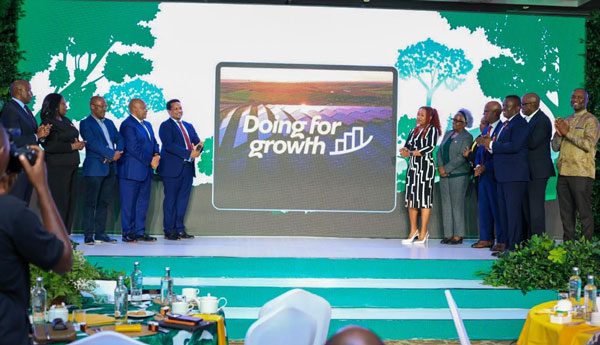
MTN Uganda Chief executive Sylvia Mulinge says the company’s Ambition 2030 strategy is built around the idea that everyone should benefit from a modern connected life.
In practice, that means expanding networks, increasing access to digital services and using mobile technology to bring more people into the formal economy.
There is plenty of economic activity to point to. MTN says it contributed Shs1.6trn in taxes and Shs15.32trn to Uganda’s gross domestic product between 2022 and 2024. It calculates that its broader activities generated Shs34.9trn in “true value” beyond reported profits.
Mobile money is perhaps the clearest example. In 2025 MTN Mobile Money processed Shs195.5trn in transactions and had 14.7m active wallets. For people poorly served by conventional banks, the mobile phone has become something more useful than a telephone: a pocket-sized financial system.
MTN Foundation added Shs5.1bn to programmes covering education, healthcare, digital inclusion and community development.
Yet there is a catch. Expanding connectivity requires more infrastructure, and infrastructure consumes energy. Cutting emissions while continuing to build the network will therefore require more than clever accounting.
MTN says it is addressing that tension through efficiency, cleaner energy and better governance.
Board chairman Charles Mbire argues that strong oversight and transparent reporting are essential to creating long-term value.
Paul Bwiso, chief executive of the Uganda Securities Exchange, similarly sees better sustainability reporting as a way of strengthening investor confidence.
The real test, however, will not be the quality of the report. It will be whether MTN can continue to grow in Uganda while making its network less carbon-intensive and its social impact more measurable.
Sustainability, in other words, is becoming less of a side project. For MTN Uganda, it is increasingly part of the business model.