 The Independent Uganda: You get the Truth we Pay the Price


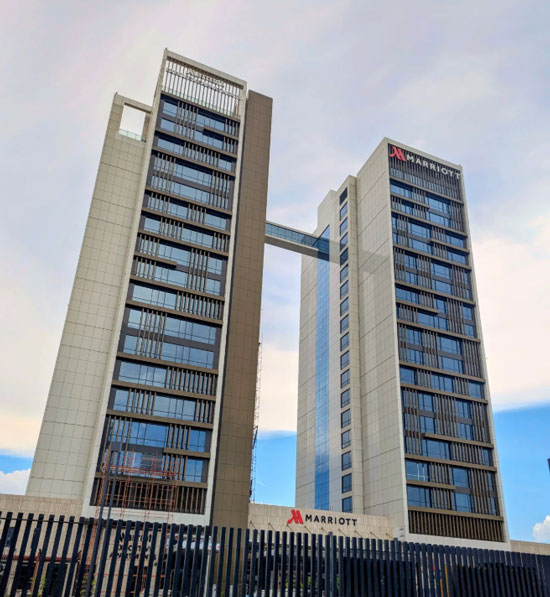
The first hotel under the flagship Marriott brand has been hailed as a vote of confidence in the country’s hospitality market
Kampala, Uganda | IAN KATUSIIME | A gleaming blue twin-tower complex connected by a skybridge rises above Nsambya Hill, the latest addition to Kampala’s rapidly changing skyline. But beyond its striking façade lies a bigger story: after more than three decades operating in Uganda through other brands, Marriott International believes the country’s hospitality market has matured enough to support its flagship Marriott Hotels brand.
Having opened its doors in June, the property has added a new dimension to a market increasingly recognised as a destination for business and leisure travel.
The hotel features 181 guest rooms and suites, three signature restaurants, six conference venues and 96 fully serviced executive apartments, bringing the total accommodation inventory to 277 units. It also includes two bars and lounges catering to business meetings and social gatherings.
The Marriott name carries global recognition, a vast loyalty programme and access to millions of international travellers who book accommodation through its worldwide reservation network.
Marriott International entered the Ugandan market in 1991 with Sheraton Kampala Hotel and today operates five properties across the Sheraton, Protea Hotels by Marriott and Four Points by Sheraton brands.
The opening of Marriott Hotel Kampala reinforces its broader expansion strategy across East Africa. Marriott has multiple properties in Kenya, including two JW Marriott hotels in Nairobi and a Ritz-Carlton safari camp in the Maasai Mara, as well as hotels in Rwanda and Tanzania.
Its arrival raises a broader question than the opening of another premium hotel: why is Marriott entering Uganda in 2026 rather than a decade earlier?
Johan Cronje, Regional Vice President for Sub-Saharan Africa at Marriott International says Marriott has continued to evaluate opportunities to introduce additional brands as its Ugandan portfolio has grown.
“The opening reflects our long-term commitment to Uganda and the shared confidence of Marriott International and the property’s ownership in the country’s tourism and economic potential,” he says in an emailed response to The Independent.
Cronje says the decision to introduce the Marriott Hotels brand to Uganda was driven by a combination of strong tourism growth and rising demand from business travellers.
He adds that Uganda’s tourism sector has rebounded strongly, citing government figures showing that international arrivals rose to more than 1.64 million visitors in 2025, surpassing pre-pandemic levels.
Cronje also points to Kampala’s growing role as a regional hub for business, diplomacy and conferences, supported by improvements in air connectivity, infrastructure and investment.
He added that expansion in sectors such as energy, infrastructure and foreign investment is creating sustained demand for premium hotel accommodation, conference facilities and extended-stay apartments.
“Taken together, these factors reinforce our decision to introduce the Marriott Hotels and Marriott Executive Apartments brands to Kampala,” he says.
With over 10,000 properties across 148 countries and territories, Marriott is the world’s largest hotel chain. The decision to launch its flagship brand in Uganda has been hailed as a notable vote of confidence in the country’s hospitality market.
Marriott’s biggest asset
One of Marriott’s biggest assets, is its global reservation network. Its Marriott Bonvoy loyalty programme has grown to more than 295 million members, giving it a sizeable lead over rival Hilton Honors, which has around 240 million members.
Industry analysts say the company’s global booking platform creates its own demand because millions of travellers begin their hotel search within the Marriott ecosystem rather than through a generic internet search.
Instead of typing “hotels in Kampala” into a search engine, many business travellers simply open the Marriott Bonvoy app, giving Uganda unprecedented visibility to corporate travellers and tourists from Asia, Europe and North America.
Founded in 1927 in Washington DC, U.S., Marriott has spent nearly a century building one of the world’s most recognisable hospitality brands. Central to that reputation are its rigorous, non-negotiable Brand Standards, which govern everything from room presentation and public spaces to customer service, safety procedures and staff conduct.
Compliance is monitored through regular inspections and unannounced brand audits, with hotels that consistently fail to meet the required standards risking the loss of the Marriott brand also known as the “flag.”
Marriott has also transformed the economics of the hotel industry. Rather than owning most of its properties, the company has embraced an asset-light business model built on management and franchise agreements.
Today, it owns only a tiny fraction of the hotels that carry its name, instead licensing its brand, operating systems and global distribution platform to property owners around the world.
In Uganda, the Marriott Hotel Kampala in Nsambya is owned by businessman Ponsiano Ngabirano under a franchise agreement with Marriott International.
Judy Rugasira, Managing Director of Knight Frank Uganda, says Marriott’s decision to introduce its flagship brand reflects confidence in Uganda’s long-term economic trajectory.
“The decision is underpinned by Uganda’s long-term structural fundamentals rather than short-term market conditions,” Rugasira says in a written response to The Independent. She cites continued population growth, rapid urbanisation, improving infrastructure, increasing regional connectivity and Kampala’s position as the country’s commercial and diplomatic centre.
“Demand continues to be driven by multinational corporations, development partners, government agencies, NGOs, regional businesses and, increasingly, investors in sectors such as energy, mining, agriculture, manufacturing and ICT,” she says.
Knight Frank’s latest hospitality market analysis appears to reinforce that assessment. While Nairobi remains East Africa’s largest internationally branded hotel market with more than 8,000 branded rooms, Kigali has built an inventory of about 2,000 to 2,500 rooms on the back of its strong meetings and conferences industry. Kampala has fewer than 2,000 internationally branded rooms.
Although the Ugandan capital trails its regional peers in branded hotel supply, occupancy and average room rates, Knight Frank says it offers the strongest long-term growth potential, citing low branded hotel penetration, rapid urbanisation, infrastructure investment and anticipated demand from Uganda’s oil and gas industry.
Rugasira stresses that hospitality remains one of the most sensitive sectors to external shocks such as disease outbreaks, political uncertainty, security incidents or adverse travel advisories that can disrupt international travel almost immediately.
“However, hotel developments of this nature are planned over investment horizons of 20 years or more,” Rugasira explains, adding that investors and operators therefore assess the market based on its long-term fundamentals, recognising that such disruptions are generally cyclical rather than structural.
But does Marriott create new demand or simply take market share from existing hotels? According to Rugasira, it does both.
“In the short term, any new internationally branded hotel will inevitably compete for existing demand within the upscale hospitality market,” she says. “However, over time, international brands typically expand the overall market by attracting guests who may not otherwise have considered Uganda.”
Rugasira asserts that many multinational companies, diplomatic missions and institutional travellers have travel policies that favour internationally recognised hotel brands because of their consistent service standards, security protocols, governance requirements and loyalty programmes.
“International brands do not simply redistribute existing demand; they also help generate incremental demand by making a destination more attractive to global travellers and event organisers.”
The investment signal
From a real estate perspective, Rugasira says the most significant aspect of this development is what it says about Uganda’s investment market.
“An indigenous Ugandan investor has developed an institutional-quality hospitality asset that has attracted one of the world’s leading hotel operators to place its flagship brand and management behind it,” she explains.
She says the development signals the growing sophistication of Ugandan capital, the improving quality of local real estate projects and increasing confidence among international operators in the country’s long-term investment prospects.
Early signs indicate that the network effect may already be taking shape. Sources familiar with the hotel’s operations say the nearby U.S. Embassy has already leased a number of executive apartments at the Kampala Marriott, underscoring the appeal of internationally branded accommodation to diplomatic missions and long-stay corporate clients.
Hospitality analysts say the hotel’s global brand and reservation network are also likely to appeal to multinational companies with operations in Uganda, particularly those whose travel policies favour recognised hotel chains.
Companies such as Halliburton, Baker Hughes, GE Vernova, American Tower Corporation, EY and PwC all maintain operations or business interests in Uganda and routinely host visiting executives and consultants.
Corporate travel is only one side of the equation. Uganda’s broader tourism recovery has also strengthened the case for international hotel investment.
According to the Uganda Tourism Board (UTB), the country welcomed 1.64 million international visitors in 2025, a 19.7% increase over the previous year and the equivalent of 106% of pre-pandemic arrival levels.
Juliana Kagwa, CEO of UTB, says the arrival of a globally recognised brand such as Marriott goes beyond adding another premium hotel to Kampala’s skyline.
“A globally recognised brand like Marriott accelerates Uganda’s visibility significantly,” Kagwa says, noting that the country’s long-haul visitor markets—including the U.S, U.K., China and Germany—have expanded rapidly in recent years.
She says a brand of Marriott’s stature sends a powerful signal to international travellers, conference organisers and investors that Uganda offers world-class hospitality infrastructure, strengthening the country’s competitiveness within East and Central Africa.
Tourism generated US$1.62 billion in receipts in 2025, accounting for 16% of Uganda’s export earnings. Kagwa says the arrival of internationally recognised hotel brands helps reinforce confidence in Uganda’s tourism infrastructure and destination offering, making the country more attractive to corporate delegations, business travellers and international investors.
Beyond enhancing Uganda’s international profile, Kagwa says the country’s tourism growth is now strong enough to support additional premium hotel investment.
According to UTB, business travellers accounted for 17.3% of international arrivals in 2025, while visitors stayed an average of 8.8 nights and spent about US$2,164 per trip. International arrivals reached 1.64 million during the year, up 19.7% from 2024.
“Demand is outpacing the current luxury hotel inventory,” Kagwa says, arguing that the sustained growth in business travel, conferences and overseas tourism provides a strong commercial case for more internationally branded hotels.
Hotel owners excited
Uganda Hotel Owners Association (UHOA) views Marriott’s arrival as a vote of confidence in Uganda’s hospitality industry.
“As UHOA, we are very excited. This is a sign of growing investor confidence because Marriott’s entry takes years of research on return on investment, security, government legitimacy,” says Jean Byamugisha, chairperson of UHOA in an interview with The Independent.
Byamugisha says the presence of a globally recognised brand also helps broaden Ugandans’ perception of five-star hospitality. For a long time, she says people associated world-class hospitality with destinations such as Dubai.
Byamugisha argues that having Marriott in Uganda demonstrates that the highest international standards can be delivered here too.
She adds that Marriott’s entry is likely to raise the bar for the wider industry because it will encourage local hotels to strengthen customer service, pricing strategies, marketing and overall value for money.
Byamugisha sees more growth for Uganda’s hospitality sector. “We have been encouraging international hotel brands to expand beyond Kampala into Uganda’s national parks and tourism destinations, including Kidepo Valley and Murchison Falls,” she said.
For a country seeking to attract more investment, conferences and higher-spending travellers, the Marriott hotel’s arrival is both a business decision and a statement of confidence.



Good to have a Marriot in Kampala, let’s hope it can survive the market supply and demand dynamics.