The Independent Uganda: You get the Truth we Pay the Price


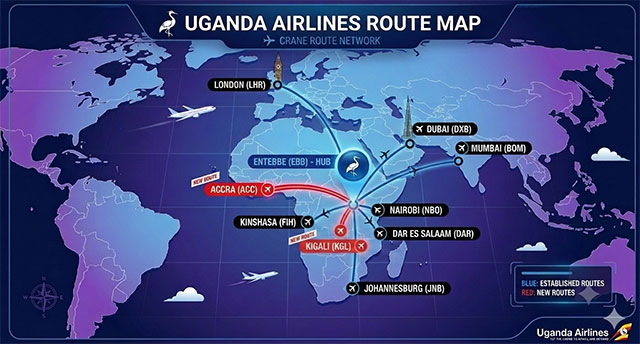
The national carrier plans to use the new destinations to position Entebbe a hub for the African continent
Kampala, Uganda | IAN KATUSIIME | Ugandan travellers have welcomed Uganda Airlines’ long-awaited announcement that it will begin daily flights to Kigali from Nov. 18, finally providing a direct connection between Entebbe and one of the region’s most popular destinations.
Kigali is a major destination for Ugandans, attracting business travellers, families, sports fans, concertgoers and tourists. The new service ends RwandAir’s monopoly on scheduled direct flights between Entebbe and Kigali—a route where travellers have long complained of high fares due to limited competition.
Uganda Airlines also announced Accra as a new destination, with four weekly flights beginning Oct. 27. The expansion strengthens the national carrier’s footprint in West Africa at a time of intensifying competition among African airlines.
Until now, many Ugandans travelling to Ghana have had to transit through Addis Ababa, Kigali or Nairobi. The introduction of a direct service to one of West Africa’s busiest capitals was therefore welcomed by travellers seeking shorter journey times and greater convenience.
The launch of the two routes has generated fresh momentum for Uganda Airlines, which has enjoyed renewed optimism since Girma Wake took over as chief executive earlier this year. Wake acknowledged that the Kigali route should have been introduced much sooner.
“As Africa’s connectivity continues to grow, these routes will strengthen commercial and tourism links while offering our guests greater convenience and more travel choices,” Wake said in a statement.
“We started the Kigali route very late. I believe it should have been launched on day one,” Wake added.
The airline said Accra builds on the success of its Lagos route, while Kigali links two of East Africa’s fastest growing economies.
Aviation analysts say sustaining the new routes requires consistently high passenger loads, competitive fares, reliable schedules and seamless connections. With Kigali and Accra, Uganda Airlines is making a clear statement of intent: it is seeking not just to carry Ugandans abroad but to position Entebbe as a gateway linking different parts of Africa.
Kigali and Accra
For years, Ugandans have questioned why Uganda Airlines did not serve Kigali, a city that has quietly emerged as one of Africa’s premier business and conference destinations.
For Uganda Airlines, Kigali represents far more than a short regional route. It is a high-yield business market and one of Africa’s fastest-growing conference destinations.

The Rwandan capital hosts calendar events like the Kwita Izina ceremony but has also hosted high-profile international events like the UCI Road World Championship, the Africa CEO Forum, the Basketball Africa League, the FIFA Congress, the FIA Formula One Awards drawing thousands of executives, investors, diplomats and tourists throughout the year.
That concentration of premium business and conference travel makes Kigali one of the most commercially attractive destinations in the region. Adding it to the route network not only allows Uganda Airlines to compete for traffic that has long been served by rival carriers, but also strengthens Entebbe’s role as a regional hub by feeding passengers into the airline’s wider African and international network.
The addition of Accra to Uganda Airlines’ network marks another step in the carrier’s evolution from a regional operator into a pan-African airline. As one of West Africa’s leading commercial, diplomatic and cultural centres, Accra has become a key destination for airlines seeking to tap into growing demand for business travel, tourism and intra-African connectivity.
Its Kotoka International Airport serves as an important gateway to the wider West African region, making it a strategic addition to any airline with continental ambitions.
The launch of direct flights to Accra is also closely aligned with the growing opportunities presented by the African Continental Free Trade Area (AfCFTA), which seeks to lower barriers to intra-African trade and investment.
As governments and businesses deepen commercial ties across the continent, aviation has become a critical enabler—moving investors, entrepreneurs, professionals and high-value cargo between African markets.
For Uganda Airlines, Accra fills an important gap in its West African network. With services already operating to Lagos, the addition of Ghana’s capital strengthens the airline’s presence in one of Africa’s fastest-growing economic regions while improving connectivity between East and West Africa.
Economists argue that the route offers strategic commercial value. Ghana is one of the world’s leading cocoa producers and has a diversified economy anchored by mining, petroleum, financial services and a growing manufacturing sector.
Improved air links are expected to facilitate business travel, trade missions and investment between Uganda and Ghana, while providing Ugandan exporters and entrepreneurs with easier access to the wider West African market.
As the second-largest economy in West Africa after Nigeria, Ghana represents a market that a regional network carrier can scarcely afford to overlook. For Uganda Airlines, the Accra route is a strategic investment in positioning Entebbe as a gateway for commerce between East and West Africa.
With the new routes, Uganda Airlines has revamped its route network. The airline that was started in 2019 has multiplied the number of possible journeys it can offer. The addition of Kigali and Accra not only creates direct links from Entebbe but also unlocks new one-stop connections across its growing African network.
A passenger travelling from Kigali can now connect through Entebbe to Lagos, Johannesburg or Kinshasa, while travellers from Accra gain easier access to East Africa and beyond. Aviation network planners say with each destination added, the value of every existing route increases, and in this case it strengthens Entebbe’s role as a regional hub.
Wake hinted at it in an interview with journalists. He says the airline has been operating as a point-to-point carrier where it flies passengers to London and then returns to Entebbe. “There must be connectivity,” he said. “We are changing the schedule completely as of October 1 so that all flights come into Entebbe at the same time and distribute traffic within Africa.”
African flights will arrive in Entebbe overnight, feeding passengers onto morning services to London, Mumbai and Dubai. The process then works in reverse, with arriving long-haul passengers connecting onwards to destinations across the continent, turning Entebbe into a transfer hub rather than simply an origin and destination airport.
Known as the network effect, it is cited as the reason airlines invest heavily in expanding their route maps. For Uganda Airlines, Kigali and Accra are envisaged as strategic building blocks in the carrier’s ambition to position Entebbe as a gateway linking East, Central and West Africa.
Competition
While Uganda Airlines is expected to benefit from pent-up demand on the Entebbe–Kigali route, where travellers have long relied on RwandAir for direct services, the competitive landscape is far more challenging in West Africa.
On the Entebbe–Accra route, the national carrier will face stiff competition from Ethiopian Airlines, Africa’s largest airline and one of the continent’s most formidable network carriers.

Ethiopian operates multiple daily flights between Addis Ababa and Accra, giving passengers a wide choice of schedules and seamless connections through its Addis Ababa hub to destinations across Africa, Europe, Asia, the Middle East and North America.
The airline’s competitive advantage extends beyond frequency. With a fleet of more than 150 aircraft, Ethiopian deploys both wide-body and narrow-body aircraft—including the Airbus A350 and Boeing 737 MAX—allowing it to match capacity with demand while offering extensive onward connections through Bole International Airport.
Its scale enables it to spread operating costs across a vast network and attract transit passengers from dozens of markets, advantages that newer and smaller carriers often struggle to replicate.
Industry analysts say Ethiopian Airlines enjoys another important advantage: geography. Addis Ababa lies almost midway between East and West Africa, with a flight time of about five hours to Accra.
Combined with its extensive hub-and-spoke network, that location has enabled Ethiopian to establish itself as the preferred connecting carrier for many passengers travelling between West Africa and destinations beyond the continent.
Unlike Uganda Airlines, Ethiopian Airlines is not selling only the Addis–Accra route; it is selling Accra’s connection to more than a hundred destinations across its global network.
Uganda Airlines will also contend with strong regional rivals. Kenya Airways operates daily services to Accra through its Nairobi hub, while RwandAir has steadily expanded its West African network from Kigali. Together, the three airlines have spent years building customer loyalty, corporate contracts and connecting traffic into Ghana.
According to airline insiders, competing on the Accra route will require Uganda Airlines more than simply offering a direct flight. The viability of the destination will depend on competitive fares, reliable schedules, convenient connections through Entebbe and the ability to build sustained passenger demand in a market already served by some of Africa’s strongest airlines.
Route planning
With just months before the inaugural flights, aviation experts say the announcement marks the beginning of an intense period of regulatory, commercial and operational preparations behind the scenes.
Before the first aircraft departs, Uganda Airlines must work with aviation authorities in Uganda, Rwanda and Ghana to finalise regulatory approvals, including traffic rights under existing bilateral air service agreements, while securing airport slots at Kigali International Airport and Kotoka International Airport.
Unlike heavily congested hubs such as Heathrow, obtaining slots at most African airports is generally less restrictive, allowing greater operational flexibility.
According to the airline lobby IATA, around 43% of the world’s airline passengers now depart from slot-coordinated airports, illustrating how critical standardized slot management has become to global airline scheduling.
Beyond regulatory clearances, experts say the airline must conclude a range of commercial arrangements, including ground handling, catering, aircraft servicing and jet fuel supply contracts. Those negotiations come at a challenging time for the aviation industry, with jet fuel prices remaining volatile amid geopolitical tensions affecting global oil markets and shipping through the Strait of Hormuz.
Operational planning is equally complex. Uganda Airlines must assign flight and cabin crews, optimise aircraft rotations and ensure maintenance schedules can accommodate daily flights to Kigali and four weekly services to Accra, a journey of about seven hours from Entebbe.
At the same time, commercial teams will be focused on opening sales channels, strengthening distribution networks, marketing the new destinations and refining revenue forecasts. In an industry where thin profit margins are the norm, the success of a new route has gone beyond simply filling seats to sustaining passenger demand, attracting transit traffic and achieving profitability over the long term.
The expansion also raises an important operational question: can Uganda Airlines continue growing its network without significantly expanding its fleet?
Although the airline announced an order for new Boeing aircraft two months ago, the jets are not expected to enter service for several years. However, two 737-800s have been leased from Ethiopian Airlines this year, one meant to power the Accra route.
“At the moment we are wet leasing because we do not have the pilots, the maintenance or the aircraft of our own,” Wake says, acknowledging that while the arrangement is expensive, it remains a necessary short-term solution as the airline expands its operations.. “By November, we hope to move to dry leasing, which means using our own mechanics, our own insurance which will make it cheaper for us.”
As his six-month assignment at Uganda Airlines nears its end, Wake is already looking beyond his own tenure. In September, he plans to submit a shortlist of potential successors for the chief executive role—a reminder that, in aviation, the strongest institutions are built not only on aircraft and infrastructure, but also on leadership continuity.