The Independent Uganda: You get the Truth we Pay the Price


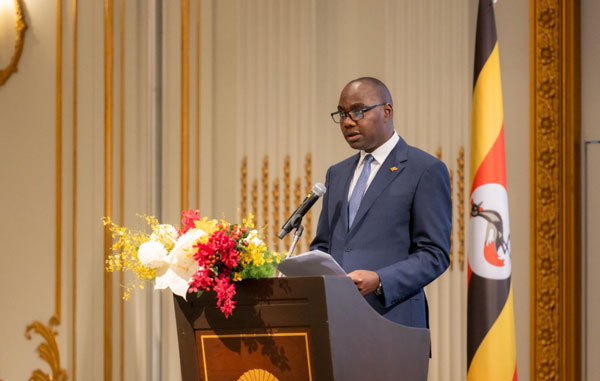
Bangkok, Thailand | NEWS CORRESPONDENT | Uganda has offered Thai investors 10-year tax holidays, full foreign ownership of their businesses and unrestricted repatriation of profits, as the East African country tries to attract Southeast Asian capital to its farms, factories, mines and tourism sector.
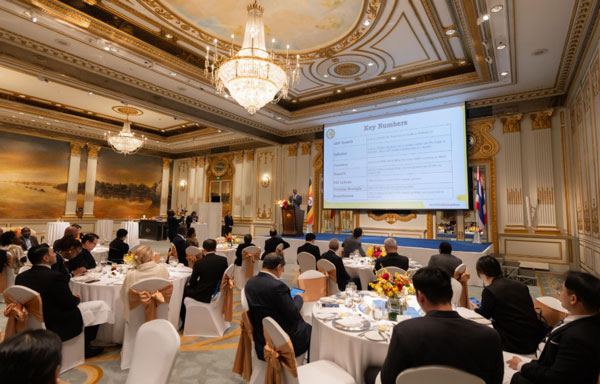
Ugandan officials made the offer on Monday at an economic networking dinner at the Mandarin Oriental Hotel in Bangkok. The dinner was held on the sidelines of the World Bank Group and International Monetary Fund (IMF) annual meetings, which the Thai capital is hosting until October 18.
“Uganda’s macroeconomic fundamentals are strong. Investing in Uganda is secure. Investment registration takes one day. You can have 100% foreign business ownership although joint partners are encouraged. There is unrestricted profit repatriation,” Henry Musasizi, Uganda’s minister of finance, planning and economic development, told Thai government officials, investors and business leaders.
Musasizi said Thai investors working through joint ventures could earn annual profits of 15 to 25 percent, and more in areas such as data centres, fintech and electronics.
Dr Ramathan Ggoobi, the permanent secretary and secretary to the treasury, said qualifying manufacturers and agro-processors would pay no income tax for 10 years. He said machinery, spare parts and industrial inputs are exempt from import duty, and investors can use serviced industrial parks and free zones with subsidised land and one-stop licensing.
“In Uganda, we are committed to doing whatever is necessary to facilitate your investment,” Dr Ggoobi said.
The landlocked country of about 50 million people is trying to grow its economy tenfold, from about $70bn today to $500bn by 2040. Its strategy relies on agro-industry, tourism, minerals and oil, and science and technology.
Musasizi said Thailand’s record showed how that could work. Thailand is Southeast Asia’s second-largest economy and a major food exporter.
“Thailand’s own journey shows focused investment in agrobusinesses, industrialization including high-tech manufacturing, and tourism development can support high economic growth and transformation. Uganda is now on that path, we are ready to have partnerships with you,” he said.
Dr Ggoobi named three sectors where the two countries were best matched: agro-processing, light manufacturing, and tourism and hospitality. He said Thai food technology could process Ugandan crops, which are harvested all year round. He also said Thai hotel brands could invest in Uganda’s eco-tourism sector, and Thai factories could assemble car parts and electronics for sale across Africa.
Musasizi said Uganda wants to stop exporting raw minerals and process them at home instead. He suggested lithium could be used for electric batteries, iron ore for automotive steel, phosphates for fertilisers, and copper and cobalt from the Kilembe mines in western Uganda for electrical components.
He also pointed to coffee. “Uganda is now Africa’s leading coffee exporter. We are seeking investors to invest in processing coffee, and other agricultural commodities,” he said.
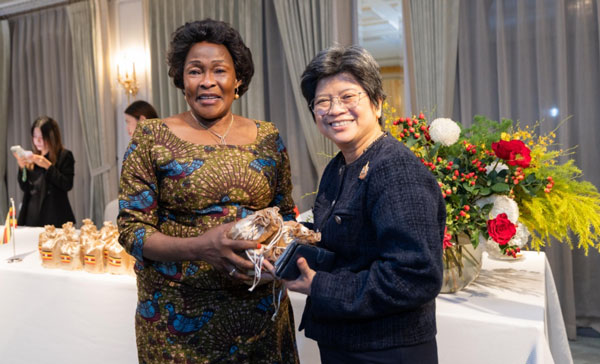
Uganda’s High Commissioner to Thailand, Dr Betty Bigombe, called for deeper engagement between the two countries. Her mission in Kuala Lumpur, which also covers Thailand, organised the dinner with Uganda’s finance ministry. Bank of Uganda Governor Dr Michael Atingi-Ego was also part of the delegation.
Dr Ggoobi said Uganda’s economy grew by 6.4 percent in the financial year that ended in June, and is projected to grow by 10.2 percent this year. Much of that depends on the start of commercial oil production from the Tilenga and Kingfisher fields near Lake Albert. Production has been delayed several times since oil was discovered there in 2006.
He said exports of goods and services rose by 34 percent to $18.4bn, foreign direct investment reached $3.7bn in 2025, and tourism earned $1.62bn.
Citing the Growth Lab at Harvard University, Dr Ggoobi said Uganda’s economy is projected to grow faster over the decade to 2035 than any of the other 145 countries the lab tracks.
Thailand’s representative at the dinner was Urasa Mongkolnavin, director general of the Department of South Asian, Middle East and African Affairs at the Thai foreign ministry. She said the two countries had a long friendship and there was room for greater economic cooperation. She told the audience that Asia was not far from Africa.
Thailand has been trying to build closer ties with African countries, and last year relaunched its Thailand-Africa Initiative to expand trade and investment links with the continent.
Organisers said Thai investors showed particular interest in agro-industrialisation, mining, oil and gas, manufacturing, finance and tourism.
Trade between the two countries is still small. Thailand exported goods worth about $24.7m to Uganda in 2024, about half of it vehicles, according to UN Comtrade data.
It was Uganda’s second investment push in Bangkok in less than a year, after a business forum in November 2025.
“Together, let us turn the friendship between our two countries into factories, export growth, jobs and shared prosperity,” Musasizi said.