The Independent Uganda: You get the Truth we Pay the Price


Donation adds to U.S.-backed efforts to strengthen Uganda’s Ebola preparedness and response
Kampala, Uganda | RONALD MUSOKE | The United States has delivered an experimental antibody treatment for Ebola to Uganda as the country strengthens its preparedness against another possible cross-border spread of the disease from the Democratic Republic of Congo (DRC).
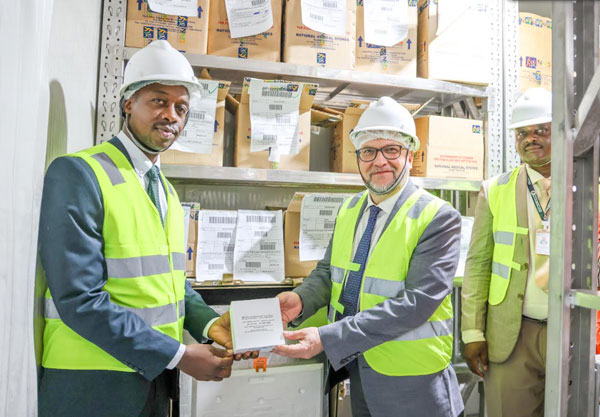
The treatment, known as MBP134, was handed over to Uganda’s Ministry of Health on Aug.27, with the U.S. government saying the vials are available for immediate use should a new Ebola case be detected.
Uganda currently has no active Ebola cases, and was actually declared Ebola-free by the World Health Organization on Aug.27 . However, Washington said the ongoing outbreak of Bundibugyo virus disease in neighbouring DRC presents a risk because of movement and communities living along the border.
Dr Charles Ayume, the Minister of State for Health in charge of Primary Health Care, received the treatment on behalf of the Ministry of Health and described it as a critical safeguard for Ugandan families.
The delivery comes after a senior U.S. delegation visited Uganda from July 11-15 to assess the country’s Ebola response, regional health security and humanitarian needs. The delegation was led by Joe Scovitch, the Deputy Assistant Secretary of State for Global Health Security, and Taylor Garrett, the Deputy Assistant Secretary of State for Disaster and Humanitarian Response. Others in the delegation included Dr Satish Pillai, the U.S. Centers for Disease Control and Prevention Ebola Response Incident Manager.
Focus on border preparedness
During the five-day visit, the delegation travelled from Kampala to areas along Uganda’s border with the DRC, assessing systems used to detect and respond to infectious disease threats. The officials also visited Entebbe International Airport to observe traveller screening and the Vurra point of entry in northwestern Uganda to assess cross-border disease surveillance.
They also visited the Uganda Virus Research Institute laboratory in Arua, the Arua Regional Public Health Emergency Operations Centre and the National Public Health Emergency Operations Centre teams.
The delegation further visited a U.S.-funded World Food Programme logistics hub and Imvepi Refugee Settlement in the Northwest of the country, where they met U.S.-funded implementing partners and organisations involved in integrating Ebola surveillance with humanitarian and refugee response.
The U.S. government said the visit demonstrated the importance of coordination between Uganda and the DRC in responding to the outbreak. “This visit reinforced the strong U.S.-Uganda health collaboration and our continued support for Uganda’s leadership in responding to the Bundibugyo virus disease outbreak,” said Mikael Cleverley, the Chargé d’Affaires of the U.S. Embassy in Uganda.
“Uganda’s emergency response and laboratory systems are strong and effective, and the close coordination we witnessed, including Ugandan and Congolese health officials working together at Vurra, demonstrates the kind of cross-border coordination that is essential to stopping this outbreak,” he said.
The U.S. government said its support covers several parts of the Ebola response, including laboratory systems, disease surveillance, contact tracing, border health screening, emergency operations and community engagement.
Treatment ready for use
The newly delivered MBP134 is an antibody treatment developed by Mapp Biopharmaceutical under a contract with the Biomedical Advanced Research and Development Authority (BARDA), part of the U.S. Department of Health and Human Services.
According to the U.S. government, the treatment is designed to recognise and neutralize the virus without waiting for the body to build its own natural immune response. A statement from the U.S Embassy in Kampala said MBP134 has shown effectiveness against multiple Ebola species in pre-clinical studies, including the Bundibugyo species.
The treatment is not commercially sold and is available for compassionate use while research continues. The U.S. statement described the treatment as a potentially lifesaving medical countermeasure that could allow health workers to respond quickly if Ebola is detected in Uganda.
“As Ebola continues to spread in the DRC, the United States is making sure Uganda is ready to act fast,” Cleverley said. “This donation reflects our commitment to Uganda’s health security, because a safer Uganda means a safer world. By helping Uganda act within hours rather than days, the United States is also protecting Americans. An outbreak anywhere is a threat everywhere,” he said.
The U.S. government said the treatment was developed through American scientific investment and that its availability in Uganda would help reduce delays in accessing a medical countermeasure if a case were detected.
Regional Ebola response
The donation is part of wider U.S. assistance to countries affected by or at risk from Ebola in the region. In its July statement, the U.S. government said it was the largest single donor to the regional Ebola response, with more than US$370 million committed to support laboratory systems, surveillance, contact tracing, border health screening, emergency operations and community engagement.
The same statement said an additional US$350 million had been committed for humanitarian assistance in the DRC, Uganda and South Sudan through the UN Office for the Coordination of Humanitarian Affairs.
A separate U.S. statement issued on August 27 said the United States had announced more than US$619 million in funding to countries in the region for the Ebola response. It described the United States as the largest contributor to the regional response. The two statements give different figures for the regional Ebola assistance and do not explain the difference. Both, however, place the latest antibody donation within a broader U.S. response involving health and humanitarian programmes.
The latest intervention also builds on previous U.S. support to Uganda during Ebola responses. The U.S. government said the new donation follows assistance provided in April 2025 to support Uganda’s response to the Sudan virus disease. The July delegation’s visit was also linked to a broader health partnership between the two countries.
According to the U.S. government, the relationship includes a US$2.3 billion U.S.-Uganda Health Memorandum of Understanding, which it described as reflecting a long-term commitment to Uganda’s health security and self-reliance.
The focus on preparedness comes as Uganda continues to maintain systems for detecting and responding to infectious disease threats, particularly along its border with the DRC.
Cross-border surveillance
Uganda’s geographic position next to the DRC makes cross-border surveillance an important component of the response described by U.S. officials. The delegation’s visit to Vurra provided an opportunity to observe cooperation between Ugandan and Congolese health officials working at the border.
The U.S. Embassy said such coordination is intended to support early detection and response to suspected cases and limit the possibility of transmission across the border.
The U.S. latest announcement comes at a time when Uganda has no active Ebola cases, but authorities are maintaining preparedness because of the situation across the border. The U.S. government said the Bundibugyo outbreak in the DRC had grown to more than 4,500 confirmed cases and more than 2,000 deaths as of mid-August 2026.
Cleverley said the U.S. government would continue supporting Uganda’s leadership in the response to the Bundibugyo virus disease outbreak. The United States has described the latest intervention as part of its broader approach to regional health security, combining financial assistance, technical support and medical countermeasures.
For Uganda, the immediate addition is the MBP134 treatment now held by the Ministry of Health and available for compassionate use should a new Ebola case be identified. However, the wider response will continue to depend on the surveillance and laboratory systems, border screening and cross-border coordination that the U.S. delegation assessed during its July visit.