The Independent Uganda: You get the Truth we Pay the Price



The termination of USAID governance programs has hollowed out civic education networks that once reached rural and first-time voters
Kampala, Uganda | NAKISANZE SEGAWA | At 18, Ronald Serunjoji can’t wait to cast his first-ever ballot in Uganda’s general elections, slated for January 2026. He’s certain about his choice for president, but he doesn’t know that two other races will appear on his ballot that day: the Wakiso district woman member of Parliament and the Nansana municipality member of Parliament.
His first time voting comes in a political landscape shaped by Ugandan President Yoweri Museveni, who has held power since 1986. Opposition leader Robert Kyagulanyi, who challenged Museveni in the turbulent and widely contested 2021 elections, is also on the ballot again.
Serunjoji’s lack of awareness about the other political offices and candidates in his community is not unique. Across Uganda, voters are entering an election season with limited information about how the voting process works or what to expect from candidates. The reason, experts say, is a sharp decline in voter education following years of shrinking resources — worsened, most recently, by the sharp cuts in U.S. foreign assistance.
U.S. funding once supported a wide range of voter education activities, including designating polling stations, explaining voter rights and responsibilities, and offering guidance on what to look for from candidates, said David Kizito, program officer at the Ugandan chapter of Transparency International, a global coalition that works in over 100 countries to fight corruption and promote accountability. The U.S. administration’s unprecedented foreign aid overhaul ended in March 2025 with the termination of almost 70% of all U.S. government funded democracy, human rights, governance, and peacebuilding programs.
Civil society organizations typically carried out activities in rural or hard-to-reach areas to supplement the work of the Electoral Commission of Uganda, a government agency that organizes and oversees elections in the country.
With one-on-one meetings and radio advertisements no longer reaching rural communities, civil society groups have lost their most effective voter education tools. The result, Kizito noted, is a widening gap in basic knowledge of voter rights — a gap that he warned could contribute to tension, violence, and lower turnout.
Threatened civic education
USAID was the biggest donor and development partner supporting programs in voter education, election observation, and strengthening governance and accountability in Uganda. This is particularly true following Museveni’s 2021 suspension of the Democratic Governance Facility, a European-funded initiative established in 2011 to strengthen rule of law, accountability, and access to justice.
Civil society organizations have long filled the gap left by constrained government civic education efforts, according to Godber Tumushabe, a policy analyst and lecturer at Makerere University School of Law. But declining donor support and increasing government restrictions meant those organizations were already struggling.
“The regime’s aggressive pushback against donor funding for civil society has for years contributed immensely to the shrinking civic space,” he said.
Now, with U.S. funds gone, he added, their ability to monitor and observe the electoral process in the upcoming 2026 elections has diminished further.
Tumushabe added that the U.S. Agency for International Development’s governance support was an instrument of U.S. foreign policy — promoting democracy, transparency, and accountability in ways that ultimately supported American economic and geopolitical interests.
“The U.S. is a trading nation,” he said. “Promoting democracy creates opportunities for their businesses to trade and survive in this [Ugandan] economy.”
The U.S. provides significant development and security assistance to Uganda, disbursing a total of $730 million in fiscal year 2023. That included $8.5 million for democracy, human rights, and governance programs, down from $11 million in 2022, with USAID managing most of the portfolio. In 2020, the U.S. Department of State announced a $1 million competition to support credible electoral processes in the country. Devex requested comment about past and future governance work in Uganda from the State Department, but did not receive a response before publication.
Programs cut midstream
In western Uganda, civil society groups described an abrupt and damaging halt to their work. Francis Opio, head of governance protection and human rights at the Kabalore Research and Resource Centre, a local NGO in rural western Uganda, said his organization had been implementing the approximately $250,000 USAID-funded “Ugandans for Peace Activity” through the Women’s International Peace Center. The initiative aimed to promote a peaceful electoral process by educating candidates, police, religious leaders, and voters — especially young people, who are often involved in election-related unrest in the Rwenzori region.
“Young people are used by politicians on both sides,” he said, noting that leaders pit youth against one another by claiming the opposing candidate is the obstacle to their opportunities. “So when we were doing civic education, one of our main targets were young people.”
According to the Ugandan police, the 2026 campaign trail has proven largely peaceful so far, although multiple incidents of election violence have been recorded, including damage to police vehicles, assaults on police officers, and public disorder.
Opio described the “Ugandans for Peace Activity” termination under U.S. President Donald Trump’s executive order as “abrupt and unfair.” His organization let go of five staff members who carried out community engagement.
“Some of them went into depression,” he said, adding that the community initially welcomed the activity because it provided the information they needed to take part in the elections. But its abrupt halt at the very moment elections were gaining traction left people disillusioned, with some calling the project a hoax.
The organization had planned to continue with community meetings to create awareness, pay for media to reach a wider audience, host dialogues between the candidates and the electorate, and educate the electorate about their rights and duties. The project, he explained, was slated to continue beyond the 2026 election cycle.
A similar story unfolded at Tooronet, a rural NGO that had been implementing the five-year USAID-funded Strengthening Citizens’ Engagement in Elections, or SCENE, initiative under the Uganda National NGO Forum. Peter Byakuyamba, programs manager at Tooronet, said the team had just begun educating voters and candidates before the project’s abrupt termination. They let go of three staff members and two volunteers.
“Public dialogues between the community members and the candidates stopped, [then] going into communities encouraging people to register to vote and renew their registration so they can decide who their leader would be stopped, educating voters and candidates about their mandate stopped, engaging media stopped,” he said.
Byakuyamba worries that limited voter education will affect voter turnout. The Electoral Commission anticipates more than 21 million registered voters in 2026, up from 18 million in 2021.
There is already mistrust in the process, he noted. “They don’t trust the ballot changing the leadership,” he explained of Ugandan voters. “Civil society played a role in building that trust.”
A high-stakes election amid shifting alliances
Since its independence from British rule in 1962, Uganda has yet to experience a peaceful transition of power. Museveni has been in office for 39 years, making him one of Africa’s longest-serving leaders, and his National Resistance Movement dominates Parliament and local governments.
A constitutional amendment in 2005 removed presidential term limits, and in 2017, removed the presidential age limit of 75, allowing Museveni to seek a seventh term. His strongest challenger, singer-turned-politician Robert Kyagulanyi — widely known as Bobi Wine — has galvanized a youthful base calling for change, but he faces frequent arrests and restrictions. Human rights groups have documented intimidation, abuses, and killings by state security forces during past elections, deepening public distrust.
USAID’s suspension of activities could also affect U.S.-Uganda relations at a sensitive moment, as Uganda pivots toward partners such as Russia and China, whose support is less conditioned on democratic governance, said Ahmed Hadji, an expert on foreign policy and adjunct professor and provost at the Lincoln Institute of Diplomacy and International Relations, based in Kampala.
“This alignment could undermine the U.S.’s strategic interest in the region, particularly regarding security cooperation and democratic values,” Hadji said.
China has become Uganda’s dominant external lender, with over $4.2 billion in loan commitments cited in a U.S. congressional summary, and a foreign policy approach of “noninterference” long praised by Museveni. Meanwhile, the Ugandan Army announced that Russia had made a $100 million donation to Uganda — described in the same summary as “notably rare and sizable.”
Not everyone sees this as a lasting blow to Washington’s influence. Tumushabe said the U.S. — a country with immense resources — can easily recalibrate, engaging directly with the private sector if Uganda’s government signals it no longer wants U.S. support for human rights programming or civil society groups.
“America has a range of options on how to engage Uganda, unlike Uganda which has limited options,” Tumushabe said, adding that U.S. aid cuts would only significantly affect Washington in places such as Somalia and the Democratic Republic of Congo — where African governments could, in theory, withdraw their participation in regional security and peacekeeping missions that align with U.S. interests.
Trust on the line
For Uganda’s citizens, such shifts in funding and alliances feel distant, although their consequences are increasingly visible.
Victoria Namukasa, a 20-year-old mother and street food vendor in Wakiso district, said she will not vote despite being eligible for the first time: “I don’t see my vote causing any change, so I don’t want to waste my time and hold false hopes,” she told Devex, adding that she hasn’t attended any voter education program because she hasn’t seen any such initiatives in her village of Kavule, in Wakiso district.
Paul Bukenya, the deputy spokesperson of the Uganda Electoral Commission, said the commission is confident that many eligible Ugandan voters have received the necessary information.
This engagement is “why we are able to have the [voting] register updated,” he said. “There was participation, which shows that there is awareness and interest. We had nominations organized and conducted — that shows participation at all levels of the election,” Bukenya said.
It is the responsibility of the Electoral Commission to educate the public about designated political offices through nominations, he said, but it is the duty of the candidates to reach out directly to voters.
Bukenya acknowledged the impact of USAID cuts on civil society organizations. Many civil society organizations that relied on USAID to conduct voter education programs were not accredited in the country this year due to lack of funds, he noted.
“However, the government of Uganda is funding the electoral process and we are doing everything as planned,” he said.
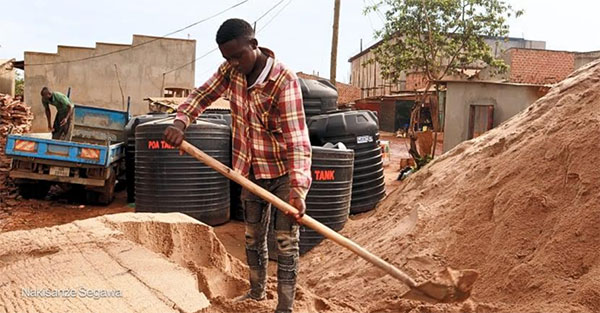
For 18-year-old Serunjoji, who works as a day laborer loading trucks with sand, the excitement of voting for the first time outweighs any confusion about the candidates whose names will appear on his ballot.
“I don’t know what he is going to do if elected president,” he said of his chosen candidate. “I just like him because he relates to me.”