The Independent Uganda: You get the Truth we Pay the Price


How Entebbe’s 16 million-litre fuel hydrant is navigating a spiralling crisis
NEWS ANALYSIS | IAN KATUSIIME | When geopolitical tensions in the Middle East boil over into a fully fledged conflict, the repercussions are felt far and wide, particularly for countries that import oil from the Arabian Peninsula. The US/Israel war on Iran has disrupted the global energy market, and East African nations are feeling the pinch.
There have been sharp spikes in oil prices and refined product prices. For a land-locked nation like Uganda, the impact is being felt acutely on the tarmac of Entebbe International Airport.
The East African nation’s aviation survival is measured not in flight hours but in litres. Every drop of Jet A-1 (standard aviation fuel) keeping the country connected to the global economy must first survive a perilous 1,000-kilometre overland journey by truck from the Port of Mombasa at the Kenyan coast.
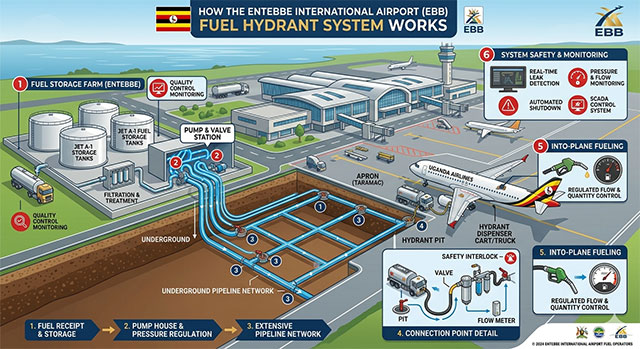
Yet beneath Entebbe’s newly commercialised aprons lies a high-tech line of defense. In December 2024, the Uganda Civil Aviation Authority (UCAA) signed a 25-year Build-Operate-Transfer (BOT) agreement with UAE-based Tristar Group to operate a fuel hydrant system, an underground storage tank also known as a fuel farm.
The upgraded pipeline system expanded capacity from the old refuelling site, whose capacity was 7.5 million litres, up to an active 16 million litres. Long-term expansion plans are aiming for 22 million litres, according to UCAA. It is an open-access fuel farm where any oil company can rent space to store and pump fuel to aeroplanes.
Tristar fully commercialised the main passenger terminal hydrant system, replacing the old system with a 7-kilometre, double-line underground fuel hydrant pipeline. The pipeline feeds directly into 43 automated fuel hydrant pits across the cargo and passenger aprons, drastically speeding up aircraft turnaround times. The fuel hydrant systems eliminated the need for fuel trucks driving across the tarmac to replenish aircraft fuel.
The farm utilises automated control systems alongside localized leak detection technology. This allows the UCAA to cut off or isolate fuel lines instantly from a master monitor during an emergency.
Backed by the Uganda National Oil Company’s (UNOC) centralized state import monopoly—which maintains an 18.5-million-litre strategic buffer—this localized infrastructural modernization serves as the primary firewall protecting both domestic and international carriers from extreme international spot-market volatility.
But as the fuel shortage becomes more acute, how long can these 43 fuel pits outrun global maritime chokepoints?
Vianney Luggya, the Public Relations Officer of UCAA, told The Independent that the hydrant system has been “valuable” at a time of scarcity because it enhances fuel storage and supply efficiency.
“Since its introduction, storage capacity has increased significantly from 7 million litres to 16 million litres at the moment, which enables the airport to manage larger fuel reserves and better manage supply during such times.”

Luggya said that the expanded capacity can at least “facilitate operations for a month”.
It was not clear what time period he meant by a month because the global fuel crisis has been on for months since the US and Israel launched missile attacks on Iran on Feb. 28. Iran responded by blockading the Strait of Hormuz, the narrow water channel in the Persian Gulf where 20% of the world’s oil flows.
Negotiations between the US and Iran have faltered, and there are fears that the fuel crisis can only get worse. However, UCAA has banked its hopes on the fuel farm that was constructed for a crisis like the current one.
The Independent could not get a comment from UNOC on how the company’s strategic reserves are helping the country weather the crisis and whether the airport has enough jet fuel stock to quickly refuel wide-body jets without causing tarmac gridlock.
Logistics and fuel supply
In 2024, UNOC took sole control over importing all refined petroleum products into the country. UNOC relies on its partner, Vitol Bahrain, to source products globally before pushing them via the Port of Mombasa and the Tanzanian Port of Dar-es-Salaam.
UNOC imports petrol, diesel, jet fuel and dual-purpose kerosene. However, because Uganda has a small aviation sector, the aviation fuel is imported in much smaller, targeted batches, probably less than 20% of the total fuel inventory. Some reports suggested UNOC had 26 million litres of jet fuel in stock by the end of April, but now it is June and the situation looks dire.
According to estimates, Uganda consumes 600,000-700,000 litres of jet fuel per day. This translates to about 18 million litres a month. When you do the maths, over 500 truckloads are needed in a month to keep Entebbe’s operations running.
If the blockade in the Strait of Hormuz goes on for one month, Uganda’s aviation fuel supply could be in jeopardy. Entebbe’s high-tech hydrant system will remain perfectly functional, but its tanks could run dry unless UNOC sources alternative fuel consignments.
Aviation analysts say should the tensions in the Middle East persist and outrun Entebbe’s 30-day buffer, as UCAA puts it, it would throw Uganda’s aviation sector in disarray.
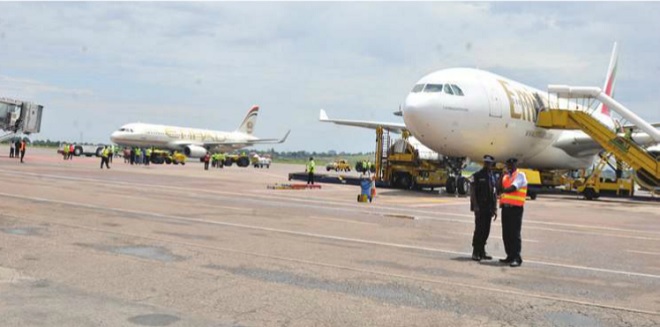
Uganda Airlines would bear the most devastating financial and operational blows, as the national carrier is headquartered at Entebbe.
To keep flying regional routes (like Nairobi, Johannesburg, or Kinshasa), the airline would be forced to “tanker” fuel, which means loading their Airbus A330neo or CRJ-900 aircraft with double the necessary fuel at foreign airports so they can fly into Entebbe, land, and take off again without refuelling locally.
Carrying heavy extra fuel makes an aeroplane burn significantly more fuel just to stay airborne. To stay within safe maximum landing weights, Uganda Airlines would have to intentionally leave behind thousands of kilograms of profitable cargo and passenger luggage at foreign hubs, causing revenue to crater.
Experts say that the airline would have to abandon its long-haul routes to Dubai and London because tankering is physically impossible with the immense distances involved. It would be a worst-case scenario for the airline just recovering from a management crisis where the previous CEO was forced out over incompetence and gross mismanagement.
But UCAA says the Tristar-built fuel hydrant system was designed for shocks like the global fuel crisis that has seen a litre of petrol hit Shs 6000.
Entebbe Airport has relatively modest aircraft movements at 34,000 per year, which the aviation regulator says is the reason there is no cause for alarm.
The new Tristar facility runs on an open-access model, meaning oil marketing companies Vivo and Total sell their fuel directly through Tristar’s underground hydrant. The contract is a Build Operate Transfer agreement, so the Ugandan taxpayer incurred zero costs. Under the 25-year concession, UCAA collects revenue on every litre sold by Vivo and Total.
When the fuel tankers arrive at the airport from the coast, they are directed to the fuel farm. They hook up their trucks and dump all their imported Jet A-1 into the exact same shared 16 million litre tanks managed by Tristar.
Sources say that if one supplier accidentally brings a bad, contaminated batch of jet fuel from the coast and dumps it into the Tristar farm, it contaminates the entire airport’s supply. Every single airline at Entebbe draws from that same pool. This forces Tristar to operate highly advanced, fully automated filtration and laboratory systems to test the fuel before it enters the shared tanks.
Trade economists argue that multinational oil giants have been stripped of their traditional logistics power at Entebbe because while Vivo and TotalEnergies manage the retail billing with the airlines, they are legally obligated to buy that fuel from UNOC at the wholesale level.
The economists argue that besides being just “middlemen” operating on top of a state-enforced import monopoly (UNOC), they also operate in a privately operated pipeline monopoly that is Tristar.
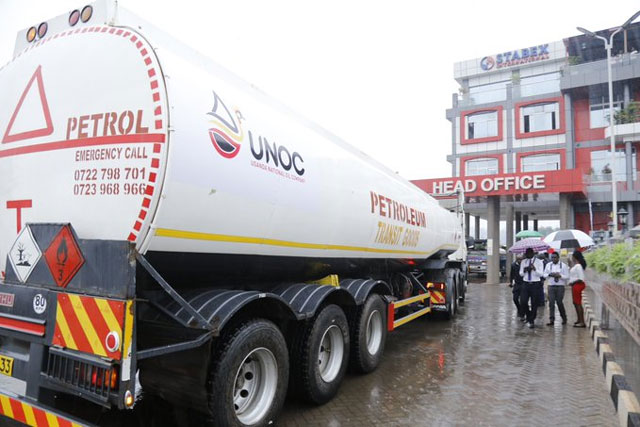
Construction of the fuel farm
China Communications Construction Company, the contractor behind the expansion of the airport, lobbied for the deal to build the hydrant, but UCAA awarded it to Tristar, an energy logistics giant headquartered in Dubai and operating in 30 countries across the Middle East, Asia, and Africa.
According to a technical report by Asha Kigenyi, the project manager of the construction of the fuel farm, Tristar had to manage a massive infrastructural overhaul without halting international flight traffic at the country’s sole international airport. The report stated that the process required phased construction engineering.
Tristar constructed the new state-of-the-art depot 2 kilometres away from active terminal passenger zones. The report by Kigenyi says this allowed engineers to pour concrete, erect massive new storage tanks, and build control rooms over a multi-year phase without interfering with everyday aircraft ground movements or fuel trucks.
Laying the new underground pipeline required a strict phased zoning system where engineers split Entebbe’s tarmac into distinct work zones according to UCAA documents. This meant routing commercial passengers away from active construction trenches.
During the delicate transitional periods when the automated control systems were being calibrated, a hybrid refuelling model was deployed; traditional fuel bowser trucks acted as a physical bridge, manually pumping Jet A-1 to keep carriers moving.
Through the new fuel farm, Entebbe Airport discarded manual, outdated logistics and deployed the exact digital and mechanical blueprints used by the world’s mega aviation hubs like Istanbul, Heathrow and Dubai to pump millions of litres of jet fuel directly into the wings of commercial aircraft with surgical precision, drastically cutting flight turnaround times and tarmac emissions.