The Independent Uganda: You get the Truth we Pay the Price


Kampala, Uganda | URN | The business community, economists and civil society have hailed Government on the proposed tax measures for 2026/2027, but say some are detrimental.
According to the budget proposals tabled by the Ministry of Finance, Planning and Economic Development before parliament on Wednesday, the total resource envelop is projected at UGX 84.2 trillion, with domestic revenues expected to fund 52.8 percent of the budget.
This means that Ugandans will be expected to contribute UGX 44.4 trillion, up from the planned UGX 37.2 trillion projected for the current financial year.
With the dwindling external support, and increasing demand to service and reduce the public debt that has now grown to UGX 126 trillion, the government has made a raft of measures through six tax bills including:
The Income Tax (Amendment) Bill, 2026; The Excise Duty (Amendment) Bill, 2026; The Value Added Tax (Amendment) Bill, 2026; and The Tax Procedures Code (Amendment) Bill, 2026, The Stamp Duty (Amendment) Bill, 2026; The External Trade (Amendment) Bill, 2026; The Lotteries and Gaming (Amendment) Bill, 2026; and The Traffic and Road Safety (Amendment) Bill, 2026.
The Tax Justice Network Uganda, a group of civil society organisations calling for a fair, equitable and transparent tax system, welcomed some of the proposals, but called for increased domestic revenues.
They condemned the tax exemptions of categories like members of parliament, which is now spreading to other sector like the judiciary, saying that this should be stopped so that all Ugandans pay taxes equitably.
SEATINI Uganda Executive Director, Jane Nalunga says that with the global economy being disrupted by geopolitics and the increasingly inward-looking policies of the donor community, Uganda should concentrate at growing the economy and boosting domestic revenue mobilisation. She however stresses the need for prudent use of the resources available.
The group also welcomed the proposed increase on the excise duty rate on un-denatured spirits of alcoholic strength by volume of less than 80 percent from UGX 1,700 per litre to UGX 3500.They say that this is not only good for raising revenues, but also helps reduce overconsumption of alcohol.
Talibita Moses, a lawyer with Uganda National Health Consumer’s Organisation, welcomed the increase in excise duty on sugar and cooking oils, saying that taxes should be used to discourage consumption of dangerous substances like sugar.
However, he says, while sugar is vital for micro and small-scale industries involved in foods and beverages, there should be a policy to make it hard for industrial products like sodas and confectionaries to compete with household producers.
But Moureen Wagubi, the Executive Director, Institute for Social Transformation says that while focus on the health of Ugandans is vital, the country is not yet at a stage where things like sugar and cooking oil should be discouraged.
She says if the MSMEs are thrown out of business because of the high costs of inputs, it will have a wider impact on the economy, and make women return to being dependents. She proposes a phased increased in the excise duty on sugar of UGX 300 a kilo, over at least three years.
Wagubi also condemned the Stamp Duty on land transfers, which she says will affect the bid by more people to acquire land.
The ministry has proposed to increase the Stamp Duty on land transfers from 1.5 percent to 3 percent on the value of the land in question.
The Stamp Duty amendment also affects transfers of motor vehicle transfers, where small motorcycles will be charged at UGX 50,000, small personal or regular vehicles UGX 100,000 and commercial vehicle at UGX 200,000.
Imelda Namugga, an economist and board member at Civil Society Budget Advocacy Group, says they welcome the Stamp Duty on vehicle registration and transfers, but notes that commercial vehicles should be categorised by size and effect on roads and the environment, with heavy duty transfers and registration being charged at UGX 400,000.
On land question, Namugga says a 3 percent Stamp Duty on transfer will make it hard for the poor, like orphans, to own land bequeathed them by parents.
The tax proposals also seek to increase excise duty at first registration on motorcycles from UGX 200,000 to UGX 500,000, which is likely to increase the cost of motorcycles.
There have been calls by some members of the public to restrict the importation of motorcycles, to help reduce their congestion on roads and the resultant challenges like causing road accidents.
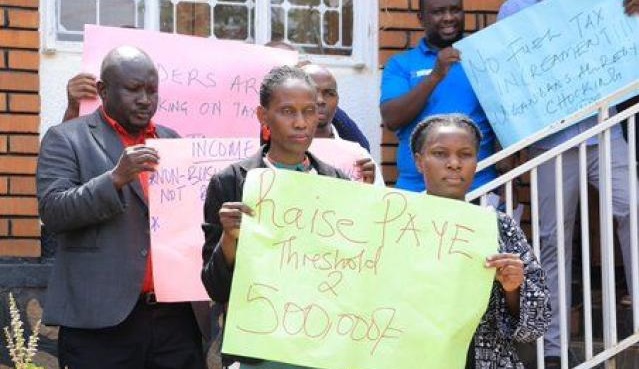
Another proposal that has caused debate is the increase in the threshold of Pay-as-You-Earn, from UGX 235,000 per month to UGX 335,000 per month, which the experts say is a step forward in ensuring increased purchasing power by the lower income earners as the government says.
Nalunga says that PAYE should be paid by persons earning UGX600,000 per month, because government economists estimate that for a Ugandans to access basic needs comfortably, they should at least earn UGX 550,000 monthly. So according to her, taxing a person earning less than that does not make sense.
Minister of State for Finance, Henry Musasizi explained that raising the PAYE threshold will lead to government losing some revenues.
But Aloysius Kittengo says that while this is true, it is unfair to use indirect taxes to again take away what the PAYE amendment had offered to the low-income earners through increased excise duty.
The Income Tax (Amendment) Bill 2026 also proposes to extend the tax holiday for Bujagali Hydropower Project from June 30, 2026 to June 30, 2032, another six years. This is not the first time this is coming up again. But Parliament has been hesitant to grant long-term tax exemptions for Hydropower, often opting for shorter, temporary extensions rather than government proposals of waivers running over several years.
In May 2025, Parliament rejected a government proposal to grant the project a seven-year tax waiver (which would have run until 2032), to the excitement of the civil society and other experts.
The Minister defended limited extensions as necessary to honor contracts and prevent higher electricity bills for Ugandans, arguing the relief allows Bujagali Energy Ltd to charge Uganda Electricity Transmission Company Limited (UETCL) a lower rate, potentially 19.58 percent less in some analyses.
Bujagali Energy Limited itself has warned that revoking the waiver could lead to increased end-user power tariffs. The exemption, if granted, could cost Ugandans about UGX 800 billion. The Tax Justice Alliance says that the exemptions have over the years, failed to lead to the promised lower cost of energy at the plants to 5.75 US Cents (UGX 214 at current exchange rates), and so must be rejected.
The introduction of taxes on plastics is welcomed as a positive environmental measure, with a recommendation to further increase such taxes to better address environmental degradation and promote sustainable practices.
On second-hand (worn) clothes, government proposes an excise dury increase to 30 percent, to reduce their importation. The other reason fronted is that it will help reduce dumping of old clothes which is harm to the environment.
Baker Bahasha, Research and Policy Alalyst at Kampala City Traders Association, proposes instead that while this tax affects the traders and that with the ability of Uganda’s production still low, it will not bear the fruits expected. He suggests that the used clothes should be categorised by quality because some of them come in when they are still good quality.