 The Independent Uganda: You get the Truth we Pay the Price


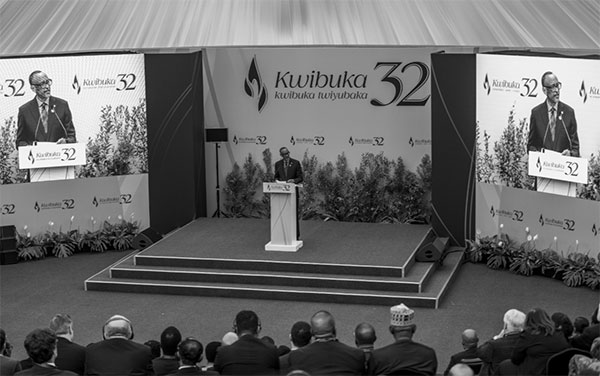
How a once shattered country has become a beacon of hope for the rest of Africa
THE LAST WORD | ANDREW M. MWENDA | Tuesday, April 7th Rwanda held commemorations marking 32 years since the beginning of the genocide that killed over a million of its Tutsi citizens. It is a genocide where Rwandans turned on each other over fictitious distinctions within their one culture, Tutsi and Hutu. These distinctions existed in precolonial Rwanda but were politicised with toxicity by Belgian colonialists. The consequences of this will continue to haunt Rwanda for decades to come.
However, efforts by the government to contain them are bearing fruits. They involve the reassertion of the shared and common Rwandan identity. The first part has been to inculcate in every person the identity that “I am a Rwandan” (ndi’munyarwanda).
The second goes beyond this to assert prestige in every person: “I have dignity” (ndafite agaciro). To be a Rwandan is to be self-respecting, to see yourself in nobler terms. The third picks from the second and mobilizes people around a shared national vision: “I am rebuilding my country.” Everyone is called upon to contribute to this vision: as taxpayers, as government employees, as members of any community during Umuganda (community work), as businesspersons running private enterprises, as priests shepherding their flock, even as ordinary citizens walking on the street, etc.
Rwanda is far behind Uganda and most especially Kenya in terms of human capital development: the skills and experience to manage and build things. But why does it achieve so much with so little while Uganda and Kenya achieve so little with so much? The answer is identity. As I have stated above, Rwandans have been mobilized to see themselves first as one people, second as special and third as sharing a vision of their future – as individuals and as members of a community. More than skills and pay, it is this identity that makes them achieve so much with so little. So, the policeman on the street wants his/her conduct to reflect his/her identity as special; so does the nurse in a hospital, the cleaner on the street, a civil servant in an office and the teacher in a school.
Words alone cannot bring about reconciliation and a shared vision. Actions do better. The fortunes of the current prime minister of Rwanda, Justin Sengiyumva, epitomise this. He was one of those people who fled to Congo after the 1994 genocide. But RPF, through its policy of reconciliation, returned him to Rwanda in 1996. He became director for internal and external trade and then a permanent secretary in the Ministry of Trade and later Education. Then he fell out with the government, ran into exile and is alleged to have joined both FDLR and RNC. Notwithstanding all this, the RPF convinced him to return home last year. President Paul Kagame first appointed him deputy governor of the central bank of Rwanda in February, and in July he became prime minister.
The lesson one learns from post-genocide Rwanda is that it is very easy to divide people and very difficult to unite them. Dividing people does not require facts but the creation of an imaginary enemy, the other. People will believe this out of fear. It is very difficult to debunk lies because they do not need facts to be believed; they need faith. They are not based on evidence but emotions. And once prejudice has become intuitive, it becomes ever more difficult to remove it from the social consciousness of a people. On the other hand, facts need to be backed with historic evidence and/or statistical data. These take a lot of effort to produce. It is even more difficult for most people to consume and understand such hard stuff.
Look at Israel, a highly educated society with many of its citizens coming from Europe and North America. The demonic and genocidal regime that rules that country has sold tall tales written 3,000 years ago. These Biblical myths claim that the land between the Jordan River and the Mediterranean Sea was given to “Jews” by “God”. On this myth, highly educated and “civilised” people in Israel, the USA and Europe have been complicit in the genocide of Palestinians, natives of that land. When I sit with my Israeli, European and American friends, people who have preached human rights all over the world, I cannot recognize them when it comes to speaking out about what is happening in Gaza.
Now imagine these lies and myths being sold to peasants living a bare existence in the hills of central Africa. Does it surprise anyone that after nearly a century of constant indoctrination Rwanda would descend into genocide? What is surprising, therefore, is not that Rwandans were made to hate each other. That is easy to achieve over one hundred years of indoctrination. What is astounding is that after only 32 years of post-genocide reconciliation, Rwandans now live together in peace and harmony. The Hitlerite prime minister of Israel, Benjamin Netanyahu, once asked Kagame this question. ‘Paul,’ he asked, ‘how did you pull this off?’
The answer in Rwanda has been simple but fundamental: we shall be governed by our hopes, not our fears. We will treat all Rwandans as one and equal people, period.
The victims of genocide, the Tutsi, are the people who wrestled power from the genocidaires. As Kagame has said many times, it is the victims who had something to give – forgiveness. This is a case of power being employed with humility and magnanimity – echoing the words of Winston Churchill: ‘In war, resolution; in defeat, defiance; in victory, magnanimity.’ The powerful are the ones who can give gifts. The Tutsi-led RPF captured power. They have not used it to rule, to dominate and to dictate. They used it to forgive, to share and to reconcile.
Today, the armed forces, the cabinet, the parliament – and many (and in many areas, most) positions of the government are run by people who in 1994 had run to exile, people who have previously fought the RPF-led government. Why? Because under the leadership of Kagame, Rwanda has resisted the temptation that has destroyed Israel – to run the government on fear based on historic grievances. It has made hope, trust, and faith in the goodness of people the cornerstone of its national reconstruction policy.
For this and many other reasons, Kagame, the RPF, or the Rwandan government deserves a Nobel Peace Prize. The fact that the Nobel Committee has never awarded them this prize, despite memoranda submitted to them explaining this, only demonstrates the political and partisan foundations of Western institutions.
***

amwenda@ugindependent.co.ug

Andrew,
I appreciate the emphasis you place on forgiveness, reconciliation, and nation-building in Rwanda. The story of Rwanda’s recovery after 1994 is indeed remarkable and offers valuable lessons to the world.
However, I think the comparison with Israel needs a bit more context and balance.
Israel’s situation is fundamentally different in that it has faced continuous and existential security threats since its founding in 1948. Unlike Rwanda, which largely dealt with an internal post-conflict reconstruction, Israel has had to navigate repeated wars, terrorism, and the persistent threat of annihilation from some of its neighbors and non-state actors. In such an environment, security concerns are not simply “fear-based governance,” but a matter of survival.
It is also important to note that Israel has made efforts toward peace and reconciliation over the years. Agreements such as the Camp David Accords with Egypt and the peace treaty with Jordan show a willingness to pursue coexistence. Even with the Palestinians, there have been multiple negotiations and concessions, though these efforts have often been complicated by cycles of violence and mistrust on both sides.
While Rwanda’s model of reconciliation is admirable, it cannot be directly applied to Israel’s context without acknowledging these ongoing external threats. Governance in Israel reflects a complex balance between democratic values, security needs, and a deeply divided regional reality.
Finally, regarding the Nobel Peace Prize, it has historically been influenced by political considerations across many regions, not just in Africa or the West. Both Rwanda’s leadership and Israel’s leaders have contributions that can be debated in terms of peace, but the absence of an award does not necessarily invalidate either country’s efforts or achievements.
In short, Rwanda’s journey is inspiring, but Israel’s choices must be understood within its unique and highly volatile security environment.
So, Tutsi were the victims of genocide (planning, profiling and execution) while Hutu were victims of circunstances. Finally, the distinction is made. I am aware that many people grapple with this question which they take as preferential treatment of victims from one side and, apparently, asking for clarification may get one accused of “genocide denial”. Remembrance should always come with more explanations and deeper reflection on the meaning of words, symbols, culture and identity. The Israel question is more complex because of longer historical and broader crosscutting considerations as opposed to Rwanda’s whiich came about due to colonial interference from less than a century and a half ago. Nevertheless, civilised co-existence is always a trensfetable answer in such scenarios, as President M7 would probably propose. Even in DRC, Sudan, etc. Let us even try it in Somalia and get the insurgents to lay down their arms and join a Gov’t of national unity.
The darkest hour in the Rwandese existence is without question the 1994 genocide what is not being talked about is the deceptive nature of Rwandese politics pre and post genocide. Prior to the genocide , the people of Rwanda seemed to be tolerant of each other at least in public and seemed to spend more time on singinging majyambere songs all the time.( The powerful radio Rwanda had it on it’s airwaves for most of the 1970s and 80s) and for us non Rwandans the concept of Tutsi or Hutu was non existent. Rwandans were simply Rwandans and at best non persons. Today the media propaganda has amplified the divide and made it uncomfortable to be a Hutu and the pretext of the genocide has given the Tutsi victors the pretext to wage war and expand the genocide ideology beyond the Rwandese borders . The hapless victims most of whose parents were born after 1994 have don’t future in any media house to express their side of the story.
The conciliatory tone of the Last Word is not surprising given the fact that the proKigali proxies wreaking havoc in the region are on the Blackfoot because of pressure from Donald Trump.
It is in everyone’s interests if all Banyarwanda could feel free to belong to this region which is their undisputed home for millennia but to take up arms and destabilize a whole region basing on selfish reasons is treachery and negates Pan Africanism that it claims to champion.
The said Ideology was a big failure in SriLanka in the recent past when the well placed Tamils tTigers were made to see reason and sit with the ret of SriLanka. The moratorium on Tamil business interests globally was the master stroke that made Sri Lanka what we see today. Rwanda too can pick lessons and make a positive contribution to the story of ethnic harmony the state of Israel can only provide the best defence technology but zero pragmatic advice on ethnic contradictions. They expect to live like Europeans on an Island in an Arab desert.
Thank you.