 The Independent Uganda: You get the Truth we Pay the Price


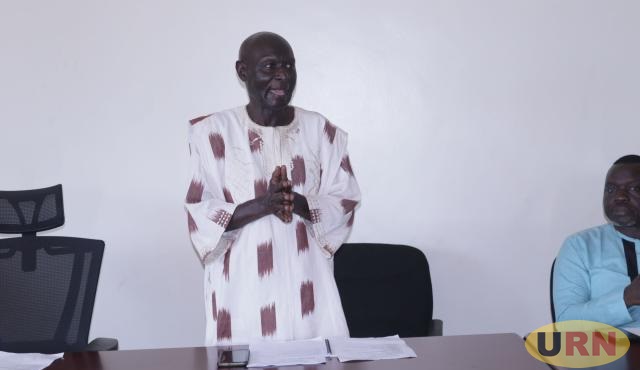
Kampala, Uganda | URN | Former Chief Justice Alfonse Owiny-Dollo Chigamoi has called on Ugandans to support former United Nations Under-Secretary-General Olara Otunnu’s bid to become the next UN Secretary-General, urging them to disregard criticism directed at his candidacy.
Owiny-Dollo described the negative comments surrounding Otunnu’s candidature as publicity that should not distract Ugandans from supporting a fellow Ugandan seeking the top leadership position at the United Nations. He alleged that Otunnu’s endorsement by Ugandan President Yoweri Kaguta Museveni has brought together Ugandans across political, religious and ethnic divides.
Owiny-Dollo made the remarks on Friday during the homecoming celebration of retired Lieutenant General Charles Otema Awany in Gulu City, following the former UPDF commander’s 47 years of military service. His comments come amid online criticism of Otunnu’s nomination, especially from a section of Ugandans in the diaspora, who have raised concerns over Otunnu’s silence over human rights abuses in the country before his endorsement.
Otunnu served as the Under-Secretary-General and Special Representative for Children and Armed Conflict, United Nations, from 1998-2005 and has been President Museveni’s critic for decades. He contested against Museveni in the 2011 presidential election on the opposition Uganda People’s Congress Party (UPC), a party he led between 2010 and 2015. Speaking at the celebration, Owiny-Dollo described Uganda’s nomination of Otunnu as an opportunity that should unite the country rather than divide it.
Owiny-Dollo said Otunnu’s candidature has generated an unprecedented level of unity among Ugandans, arguing that said support for Otunnu has cut across tribal, religious and political affiliations. “The Katikiro of Buganda, speaking for the kingdom of Buganda, said Olara Otunnu is a worthy choice. It’s the best choice. It’s one of the right things the President of Uganda, Yoweri Museveni-Kaguta, has done. Across political parties, Uganda People’s Congress, Democratic Party, and NUP have all issued statements that when it comes to Olara Otunnu, it’s the best choice,” said Justice Owiny-Dollo.
Owiny-Dollo appealed to Otunnu’s supporters not to engage with the critics and cautioned them against responding to social media attacks. “My appeal to Ugandans is: ignore those people. Let us move as one. Let us move as Ugandans, express our support and pray for our elder brother. Do not respond to these people who are saying all sorts of things against Olara Otunnu as a person or against the candidature of Ambassador Olara Otunnu. Please ignore them,” said Justice Owiny-Dollo.
Owiny-Dollo also described Museveni’s decision to nominate Otunnu as an act of statesmanship, saying it could provide an opportunity for greater national unity. “There is a wind, a wind of change blowing in this country; if we seize the time, we will have such a beautiful country to call our own because what has happened was, to me, the highest level of statesmanship exhibited by President Yoweri Museveni.” said Justice Owiny-Dollo.
Acholi Paramount Chief Rwot David Onen Acana II welcomed Otunnu’s nomination, describing it as a gesture of forgiveness and reconciliation by President Museveni. Acana said Museveni’s decision to endorse Otunnu demonstrated a willingness to reconcile with a former political opponent and urged Ugandans to support the candidature.
“I want to thank the President for showing the spirit of forgiveness and reconciliation for endorsing the name of Olara Otunnu to go and compete for the UN Secretary-General position,” Acana said. Otunnu is among eight candidates seeking to become the next UN Secretary-General and joined the race in July following his endorsement by the Ugandan government.
The other candidates are Rafael Grossi of Argentina, Rebeca Grynspan of Costa Rica, Michelle Bachelet of Chile, Macky Sall of Senegal, Maria Fernanda Espinosa of Antigua and Barbuda, Carolyn Rodrigues-Birkett of Guyana and Ivonne Baki of Ecuador.


The argument against Otunnu’s candidacy—and against the system that enables figures like him is rooted in a simple principle: there can be no genuine peace without absolute accountability.
As a survivor of the civil wars in Uganda, the stand against this nomination is a defence of historical truth. Political elites do not have the moral authority to forgive each other for the lives of regular citizens. Neither the accusers nor the counter-accusers are fit to represent humanity on the global stage. Until a transparent truth-telling process takes place, and those responsible face real legal consequences, these grand diplomatic gestures remain a profound insult to the memory of the dead and the dignity of the living.
The Fallacy of Political Forgiveness
Supporters and local leaders have praised Museveni’s endorsement of Otunnu as a “spirit of forgiveness and reconciliation”. This narrative must be firmly rejected. True forgiveness belongs exclusively to the victims of conflict, not to political actors who use the rhetoric of peace to obscure their own accountability.
Manufactured Forgiveness:
When President Museveni “forgives” Otunnu, and Otunnu silences his criticisms of the state’s ongoing human rights abuses in exchange for a UN campaign, they are trading away the rights of the victims. This political transaction bypasses the deep social wounds left by the National Resistance Army (NRA) in Northern Uganda and the UPC in the Luwero Triangle.
The Erasure of Victimhood:
For those who lost their families, homes, and futures to these insurgencies, seeing their former persecutors and elite representatives toast to “statesmanship” is a secondary violation. It reduces the catastrophic loss of Ugandan lives to mere leverage in a game of diplomatic chess.
Unfitness for Global Leadership
A state cannot field a credible candidate for global leadership when its own institutions have failed to provide independent, transparent accountability for war crimes. Likewise, a candidate cannot credibly lead an institution dedicated to global human rights when their own position relies on a compromised alliance with a regime they once accused of genocide.
Institutional Hypocrisy:
The United Nations was founded to save succeeding generations from the scourge of war and protect fundamental human rights. If the UN permits its highest office to be occupied by individuals who compromise on domestic atrocities for personal advancement, it loses its moral authority
Mr Dollo,
As a nation, Uganda must confront its painful history. True closure for survivors of past wars can only be achieved if all individuals responsible for human rights violations and the loss of civilian lives are held strictly accountable.
Former Foreign Minister Olara Otunnu is on record demanding that President Yoweri Museveni and key figures in his administration face the International Criminal Court (ICC) for alleged atrocities in Northern Uganda. However, his stance reveals a glaring double standard. Mr Otunnu remains completely silent about the brutal atrocities committed by the Tito Okello military junta, the very regime he served as Foreign Minister between 1985 and 1986.
During that dark period, the government army committed horrific acts, including:
– Targeting innocent children caught playing in fields or walking in groups across the Luwero region.
– Systematically murdering prominent community and political figures in Busoga
Given his high-ranking role in a regime that actively perpetrated these state-sponsored killings, why should Mr Otunnu be exempt from accountability today? Selective justice only undermines the reconciliation Uganda so desperately needs.
Help me understand why I should forfeit my right to justice because of the reconciation you mention involving Otunnu and the Govt of Uganda.
The historical landscape of Uganda from 1985 to 1986 is a period of profound chaos, brutal counter-insurgency, and severe state violence. Following the July 1985 coup that ousted Milton Obote, the Tito Okello military junta inherited an ongoing civil war against Yoweri Museveni’s National Resistance Army.
As debate continues surrounding Ambassador Olara Otunnu’s past bid for UN Secretary General, many Ugandans remain entirely unaware of his role as the global diplomatic face of this brutal military regime. While Ambassador Otunnu frequently highlights post 1986 human rights violations in Northern Uganda, he consistently avoids accountability for the state terror committed whilst he was Foreign Minister.
The Terror in Busoga and Luwero
Busoga Targetings:
As the rebellion expanded, the Okello junta grew paranoid. The state security apparatus systematically targeted, tortured, and assassinated local elders, businessmen, and community leaders in Busoga to crush suspected logistics networks.
Luwero Massacres:
The Uganda National Liberation Army implemented a ruthless counter insurgency campaign. Children playing in fields and innocent civilians were slaughtered on sight, categorized broadly by the junta as guerrilla sympathizers.
The Exploitation of the Karamojong
The Deception: Facing military collapse as the resistance advanced on Kampala, the Okello junta lured thousands of Karamojong warriors into the conflict.
The False Pretext: The junta manipulated historical grievances, promising the Karamojong they could reclaim their cattle from the Banyankole. Instead, these poorly trained youth were used as front line cannon fodder in urban warfare, leading to a catastrophic loss of Karamojong lives.
Dismantling the Otunnu Narrative
Supporters frequently use specific talking points to scrub this era from his record. Here is the reality behind those claims:
The Civilian Defense: Supporters argue Otunnu was a civilian diplomat who did not pull a trigger. In reality, as Foreign Minister, Otunnu was the chief international shield for the regime. Whilst innocent Ugandans were being massacred, foreign missions, including Uganda’s Mission to the Organisation of African Unity in Addis Ababa, were placed under immense pressure to defend the indefensible to the international community. A diplomat who sanitizes atrocities on the global stage bears direct institutional responsibility.
The Nairobi Peace Agreement: Supporters praise him for orchestrating the December 1985 Nairobi Peace Talks. In truth, the Nairobi talks were a cynical stalling tactic used by a crumbling junta. Whilst Otunnu was talking peace in Kenya, his military principals were actively arming and deploying the Karamojong back home. The agreement collapsed in days because the junta had no genuine interest in peace.
The Champion for Children Irony: Supporters highlight his later UN role protecting children in armed conflict. It is deeply hypocritical to champion child protection globally whilst refusing to acknowledge or account for the children slaughtered by the very junta you served as a cabinet minister.
The Story of Captain Otim
Fellow Ugandans, between 1985 and 1986, I was stationed in Addis Ababa, working at our embassy.
One afternoon, my boss, Ambassador Ucungi (may his soul rest in eternal peace), called me into his office. He motioned for me to close the door behind me. I did, took a seat, and watched as he took a deep breath before sharing a terrifying reality.
He told me about a man named Captain Otim.
Captain Otim, a Ugandan officer, had just completed his studies in China. He was on his way back home, flying from China to Uganda via an Ethiopian Airlines flight with a transit stop in Addis Ababa.
But there was a fatal complication. Captain Otim was from the Lango sub-region.
At that exact moment back home, the Okello junta was systematically targeting and slaughtering the Langi. Aware of the slaughter waiting for him at Entebbe, Captain Otim’s terrified family had desperately reached out to the Ambassador, pleading for his life.
Ambassador Ucungi looked at me and asked, “How can we save this man?”
Without hesitation, I acted. Relying on my diplomatic immunity, I rushed to the international departures area at Bole International Airport. I tracked down Captain Otim while he was still in transit, pulled him away from danger, and smuggled him out of the airport to absolute safety within Ethiopia.
That is how bad things were. That was the level of terror Ugandans were fleeing from.
Meanwhile, Olara Otunnu was sitting comfortably in Kampala as the Foreign Minister of that very same junta. Of course, he never knew what we did at the airport that day—because while his regime was hunting down citizens like Captain Otim, we were risking our lives to save them.