 The Independent Uganda: You get the Truth we Pay the Price


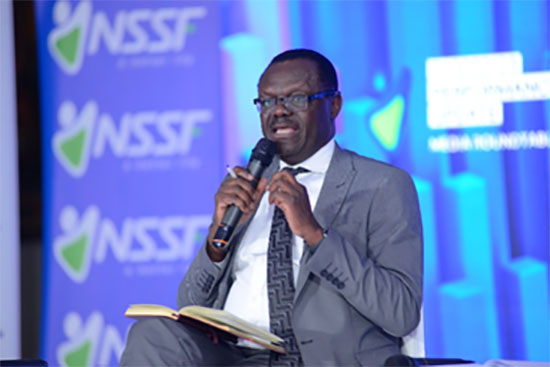
The pension fund has declared an interest rate of 22.53 percent for the financial year 2025/26, translating into Sh5.44 trillion
Kampala, Uganda | THE INDEPENDENT | Uganda’s biggest pool of long-term domestic savings has delivered its strongest return yet, putting the National Social Security Fund at the centre of a broader debate over how the country finances economic growth.
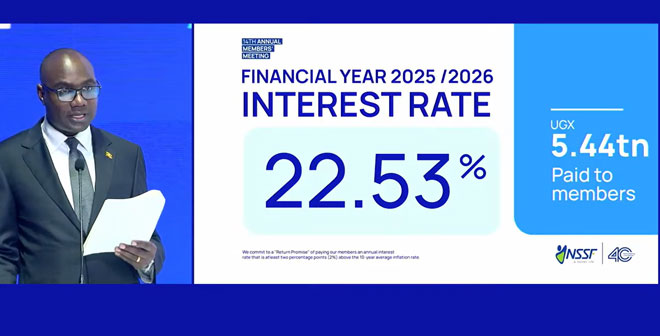
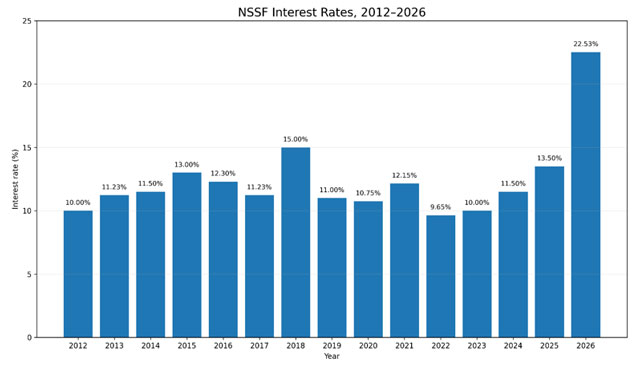
NSSF has declared an interest rate of 22.53 percent for the financial year 2025/26, translating into Sh5.44 trillion to be credited to members’ accounts. Both the rate and the amount are the highest in the Fund’s history.
The announcement, made at NSSF’s 14th Annual Members’ Meeting ( AMM) in Kampala on Sept.24, compares with a 13.5 percent interest rate for the previous financial year, when about Sh2.5 trillion was allocated to members.
The size of this year’s payout reflects how rapidly NSSF has grown into a major financial institution. Its assets under management increased from about Sh26 trillion to Sh32 trillion, while annual revenue rose 86 percent to a record Sh6.51 trillion. Member contributions increased 13 percent to Sh3.4 trillion, while the Fund paid out about Sh1.5 trillion to qualifying members.
NSSF’s Managing Director, Patrick Ayota, said the record performance reflects a combination of economic growth, stronger equity markets in East Africa and favourable currency movements.
That performance has strengthened the argument that Uganda’s pension savings are becoming too large to view simply through the narrow lens of retirement benefits.
NSSF is increasingly a source of long-term capital for the economy. The question now is how far that capital can be deployed to support development while protecting the interests of the workers whose savings make up the Fund.
Retirement savings to development capital
With assets approaching Sh33 trillion, NSSF has become one of Uganda’s most important institutional investors. Its investment decisions influence the government securities market, equities, property and potentially large infrastructure projects.
This has prompted policymakers to ask whether the Fund should play a larger role in financing projects that can raise productivity and generate economic returns.
Henry Tumukunde, the Minister of Gender, Labour and Social Development, made that argument forcefully at the members’ meeting.
NSSF, he said, must ensure that its financial strength is reflected in Uganda’s development agenda.
“This money should be turning around the economy. It must change the economy!” Tumukunde said. His comments capture a tension that is likely to become more pronounced as NSSF grows.
On one hand, Uganda needs more domestic capital to finance infrastructure and investment without relying excessively on foreign borrowing. On the other, pension savings have a specific purpose: generating sustainable returns for members over the long term.
The two objectives can overlap, but they are not automatically the same. An infrastructure project can be economically important to the country and still be a poor investment if its financial structure, risks or projected returns are inadequate.
That is why the Fund’s discussions around financing infrastructure, including the Kampala-Jinja Expressway, are significant.
Ayota recently said NSSF could potentially finance a substantial portion of the expressway if government puts in place the necessary guarantees, feasibility studies, designs and right of way.
The proposition is striking because it suggests Uganda could use its own savings to finance infrastructure that has traditionally depended heavily on external lenders and investors.

The expressway would also provide a test of whether pension money can be deployed into large public infrastructure on commercial terms.
For NSSF, the investment has to make sense financially. For government, it offers the possibility of retaining more of the financing relationship within the domestic economy.
For savers, however, the ultimate measure remains whether the investment generates an appropriate return relative to its risks.
The government wants more
Finance Minister Henry Musasizi welcomed NSSF’s performance and said the government would continue supporting the Fund as it balances investment with value creation for savers.
But the government also wants a much larger pool of domestic savings.
Uganda’s development plans require substantial financing for infrastructure, industry, housing, technology and other productive sectors. Increasing formal employment and bringing more workers into pension schemes would therefore have an effect beyond improving retirement security.
It would enlarge the country’s pool of long-term domestic capital. NSSF’s own ambitions reflect that opportunity.
The Fund plans to increase active membership to 15 million by 2030, while targeting assets of Sh50 trillion and eventually Sh80 trillion by 2035.
If those targets are achieved, NSSF’s importance to Uganda’s capital markets will be significantly greater than it is today.
But that growth will also bring greater scrutiny. The Fund’s chairman, David Ogong, pointed to one of the constraints: NSSF may have more resources available for investment, but its investment choices remain subject to the legal framework governing the Fund.
This means that calls for NSSF to finance more infrastructure will increasingly collide with questions about governance, risk allocation, transparency and the boundaries between public policy and commercial investment.
A private-sector test
Tumukunde also challenged NSSF to move away from what he described as a “Parastatal style” of management and adopt a private-sector approach.
“If you see someone not performing to your expectations, just let them go,” he said, arguing that appointments should be based on competence rather than academic qualifications alone.
The message is particularly relevant as the Fund moves into larger and more complex investments.
Managing a Sh32 trillion portfolio requires investment expertise, risk management and governance structures comparable with those of major institutional investors elsewhere.
The larger the Fund becomes, the more costly poor investment decisions could be for individual savers.
That is the paradox at the heart of NSSF’s growth. The same scale that gives it the ability to finance major projects also increases the consequences of investment mistakes.
The 22.53 percent interest rate is an extraordinary number, but a single year’s return should not become the benchmark by which members judge the Fund indefinitely.
Investment markets move in cycles. Equity gains can reverse. Currency movements can change direction. Property values fluctuate. Interest rates rise and fall.
What matters ultimately is whether NSSF can generate strong, sustainable risk-adjusted returns over the decades during which members’ savings remain invested.
That makes the current debate about infrastructure particularly important.
Uganda does not simply need more money. It needs more productive capital.
If NSSF can invest in infrastructure and other productive assets on commercially sound terms, while maintaining strong governance and adequate diversification, its expanding balance sheet could become an important source of domestic financing for the economy.
But if development objectives begin to override investment discipline, the distinction between a pension fund and a government financing vehicle could become blurred.
For now, NSSF’s record performance gives both sides of the debate more room. Members stand to receive the largest interest allocation in the Fund’s history. Government has a growing domestic institution capable of mobilising long-term capital. And NSSF has a stronger balance sheet from which to pursue new investments.
The next question is what happens to that capital after the record payout is declared. Uganda’s economic transformation will require more than savings. It will require those savings to be converted into productive investment.
NSSF now has enough capital to be part of that story. The challenge will be ensuring that the pursuit of national development and the protection of members’ retirement savings remain aligned.


The money in Uganda’s National Social Security Fund (NSSF) is not insured in the traditional sense. Instead, the NSSF operates under a quasi-government framework that ensures the safety and management of contributions made by members.
Accordingly, while there is no specific insurance backing the funds, the NSSF is regulated by the government, which provides a level of security for members’ savings.
This being the case, we need to tame the 23% return on investment euphoria if these unusually high returns are coming out of highly risky investments. After all tax payers will be on the hook to bail out the NSSF fund should the risky investments fail.