The Independent Uganda: You get the Truth we Pay the Price


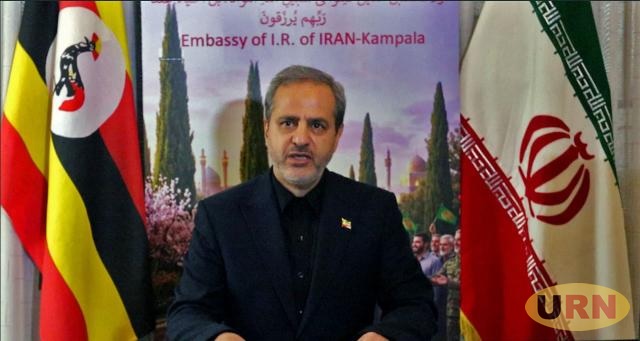
Kampala, Uganda | THE INDEPENDENT | Majid Saffar, the Ambassador of the Islamic Republic of Iran to Uganda, has issued a strong condemnation of what he described as a deadly joint attack by the United States and Israel on a primary school in southern Iran, intensifying debate around war crimes, civilian protection, and international humanitarian law.
Speaking at a press briefing in Kampala, Majid alleged that the February 28 strike targeted Shajar-e Tayyib Primary School in Minab, killing 168 civilians, most of them children aged between 7 and 12, an incident he described as mass killing and genocide.
“This attack constitutes a grave violation of international humanitarian law and amounts to war crimes and crimes against humanity,” said Majid Saffar, arguing that the school was a clearly identifiable civilian facility and not a legitimate military target.
According to the ambassador, the site was struck twice within a short interval by U.S. Tomahawk missiles. He stressed that the principles of distinction, proportionality, and precaution, cornerstones of international humanitarian law, were violated.
“Under no circumstances could this school have been considered a lawful military objective,” he said, citing publicly available imagery and reports that confirm the site’s civilian status. He framed the incident as a severe human rights violation, highlighting the loss of life, disruption of education, and long-term psychological trauma.
“This is not merely the killing of children,” he said. “It is the destruction of a future generation,” raising concerns about collective trauma and long-term societal impact.
Majid Saffar also linked the incident to what he described as a broader campaign of aggression against Iran, including strikes on residential areas, hospitals, and infrastructure during Ramadan and the Iranian New Year, pointing to civilian infrastructure attacks and escalation of conflict.
However, U.S. and Israeli officials have firmly rejected claims that they deliberately targeted civilians or a school. U.S. Defence Secretary Pete Hegseth addressed the allegations, stating,
“There’s only one entity in this conflict between us and Iran that never targets civilians,” while confirming an investigation into the incident, highlighting military accountability and rules of engagement. Similarly, U.S. Central Command spokesperson Tim Hawkins acknowledged the reports, saying, “We take these reports seriously and are looking into them,” signalling ongoing investigations into civilian harm.
Israeli officials also denied the allegations, stating that their operations are focused on security threats and asserting that “any suggestion of deliberately targeting children or educational facilities is categorically false,” raising the issue of urban warfare complexities.
Both governments reiterated concerns about Iran’s military posture and nuclear program, central to ongoing geopolitical tensions and regional security dynamics. Responding to those claims, Majid denied that Iran is developing weapons of mass destruction, emphasising nuclear transparency and non-proliferation.
“All reports confirm that Iran is not pursuing nuclear weapons,” he said. On the broader conflict, he attributed tensions to U.S. geopolitical ambitions, framing the crisis within global power struggles and resource politics, and criticising failed diplomacy. At the same time, he defended Iran’s actions as self-defence under Article 51 of the United Nations Charter, reinforcing arguments around sovereignty and national defence.
Turning to Africa and Uganda, the ambassador introduced a Pan-African perspective, urging nations to prioritise self-reliance, sovereignty, and fair cooperation. “My suggestion to fellow African countries is that you should do your best for yourselves. You should not wait for others to come to help you,” he said.
He emphasised that cooperation must not come with external pressure, stressing non-interference and equitable partnerships. Referencing Uganda, he pointed to the leadership of Yoweri Museveni as an example of resisting unfavourable external influence, highlighting economic independence and resource sovereignty.
He added that Iran is ready to expand cooperation with African countries in sectors such as agriculture, health, and technology, pointing to South-South cooperation and development partnerships.
The ambassador called on the international community and the United Nations to investigate the Minab incident and ensure accountability, justice, and adherence to international law, while urging responsible media coverage.
As fighting continues into its third week, the Minab school strike has become a flashpoint in debates over civilian protection, war crimes accountability, and modern warfare ethics, reflecting the broader stakes of an escalating international crisis.
***
URN