The Independent Uganda: You get the Truth we Pay the Price


Uganda’s challenge is not just building roads—but building a system where speed, transparency, and accountability move in the same direction
Kampala, Uganda | JULIUS BUSINGE | In the quiet hours of April 11, at exactly 02:20am East African Standard Time, Muhoozi Kainerugaba, the Chief of Defence Forces of the UPDF and Senior Presidential Advisor on Special Operations, dropped a message that would ripple across Uganda’s governance and infrastructure debate. Writing on X (formerly Twitter), he declared, “I’m going to say this today, and it will NEVER change. All and every road contract in Uganda need MY approval from now on! Those who doubt my instructions will discover truth.”
The statement—bold, direct, and unmistakably authoritative—instantly triggered online reactions. Among the earliest responses was from Sam Kakagye, who wrote: “For too long, road contracts in Uganda have been awarded without sufficient oversight, leading to inflated costs, substandard work, and endless delays. By requiring your personal approval on every road contract, you are establishing a clear line of accountability. Yebare Afande.”
That exchange captures the essence of a national dilemma. For some, Muhoozi’s declaration represents decisive leadership in a sector plagued by inefficiency. For others, it raises profound questions about institutional integrity, governance, and the concentration of power.
Power and influence
The proposal that Muhoozi Kainerugaba should approve all road contracts before execution marks a defining moment in Uganda’s governance conversation.
As head of the UPDF and senior presidential advisor on special operations, he already occupies a unique position at the intersection of military authority and civilian influence. His proximity to President Yoweri Museveni—his father—places him at the centre of decision-making in ways few officials can match.
Over time, his role has evolved beyond the military. He has been associated with coordination of infrastructure works in Kampala, played a visible part in strategic national projects such as the Hoima City Stadium—one of the venues for the upcoming Africa Cup of Nations—and has been linked to high-level institutional shifts, including recent changes at Uganda Airlines.
This expanding influence suggests a transition from purely military command to broader state coordination.
Insiders in government and experts say his direct access to the president allows him to bypass bureaucratic bottlenecks that often delay decision-making. They argue that this proximity could enable faster supervision of projects, ensuring that directives are implemented without the inertia that characterises many public institutions.
Budget and scandals
The scale of Uganda’s road sector makes any proposal for reform both urgent and consequential. In the coming budget to be read in June, Uganda has allocated approximately Shs4.17 trillion to the roads subsector. This marks a significant increase from FY2025/2026, when allocations stood at just over Shs3.6 trillion within the broader works and transport sector.
The rising budget reflects the government’s continued prioritisation of infrastructure as a driver of economic growth, as outlined in the Ministry of Finance’s “Background to the Budget FY2025/26” report (June 2025). Yet increased funding has not necessarily translated into improved outcomes.
A stark reminder of systemic weaknesses came from findings linked to the former Uganda National Roads Authority (UNRA). Investigations revealed that approximately Shs4 trillion had been misappropriated or poorly accounted for in road-related expenditures.
Development partners, including the World Bank, urged government to take decisive action, warning that continued inefficiencies could undermine confidence in Uganda’s infrastructure programme.
Experts say such figures illustrate the magnitude of governance challenges in the sector. The combination of rising budgets and historical mismanagement creates a high-stakes environment where even small inefficiencies translate into billions of shillings lost.
Efficiency versus control
Supporters of Muhoozi’s proposal argue that Uganda’s infrastructure challenges are rooted less in funding gaps and more in execution failures. They say centralising approval could reduce bureaucratic delays, enforce discipline among contractors, and ensure that projects are delivered on time.
Insiders in government say Muhoozi’s involvement in Kampala road projects demonstrated an ability to cut through administrative bottlenecks, aligning agencies and accelerating implementation. They argue that a single, powerful oversight figure could eliminate the fragmentation that often slows down public projects.
However, critics caution that efficiency gains may come at a cost. Uganda’s procurement system, overseen by the Public Procurement and Disposal of Public Assets Authority (PPDA) and implemented through the Ministry of Works and Transport, is designed to ensure transparency and competition. Concentrating approval powers in one office risks undermining these safeguards.
Others say procurement decisions should remain technical, guided by established criteria rather than personal authority. There is also concern that centralisation could create new bottlenecks if all contracts require approval from a single individual, potentially delaying rather than accelerating implementation.
Oversight and accountability
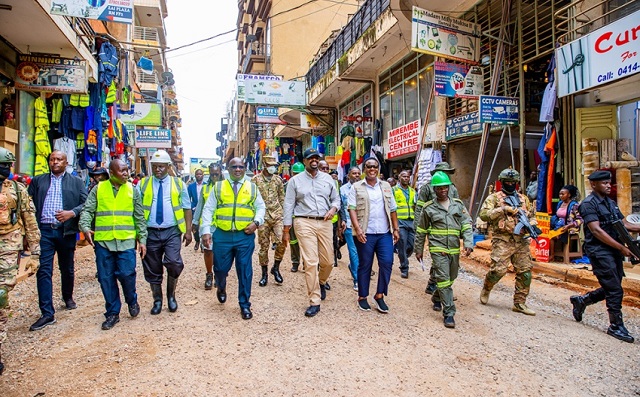
Recent interventions by government leaders highlight the urgency of addressing these challenges. In March 2026, Prime Minister Robinah Nabbanja conducted an inspection of road works in Kampala and delivered a scathing assessment of performance.
She openly criticised contractors and implementing agencies, asking: “Why are you making our government appear ridiculous?”
During the inspection, Nabbanja pointed to discrepancies between reported and actual progress, noting instances where contractors claimed 80% completion while physical verification suggested figures closer to 30%. She ordered value-for- money audits and demanded immediate correction of defects, including poor drainage and unsafe road structures.
Her remarks were echoed by Members of Parliament, who in parliamentary discussions called for faster execution of road projects and stricter enforcement of contracts.
Some MPs proposed 24-hour construction schedules to reduce delays, while others questioned whether contractors had the capacity to deliver on large-scale projects.
Beyond government, development partners have also raised concerns. The World Bank’s governance assessments, including a report titled “Enhancing Government Effectiveness and Transparency”, highlight weak contract management and enforcement as key barriers to infrastructure delivery. Reports indicate that despite significant financial inflows, Uganda continues to face challenges in planning, execution, and maintenance of road networks.
The World Bank and other experts say these recurring issues point to systemic weaknesses that require comprehensive reform. While stronger oversight is widely supported, the method of implementation remains contested.
Uganda’s roads sector stands at a crossroads. On one hand, Muhoozi Kainerugaba’s declaration reflects a growing demand for decisive leadership in a sector burdened by inefficiency and corruption. On the other, it raises fundamental questions about institutional independence, accountability, and the concentration of power.
Experts say centralised authority could accelerate project execution, improve efficiency, and strengthen the fight against corruption. Yet the same approach could undermine institutions, blur governance boundaries, and create new risks if not carefully managed.
As Uganda continues to invest heavily in infrastructure, the challenge will not only be to build roads, but to build a system that ensures those roads are delivered efficiently, transparently, and sustainably.