The Independent Uganda: You get the Truth we Pay the Price


The long running show adds another season
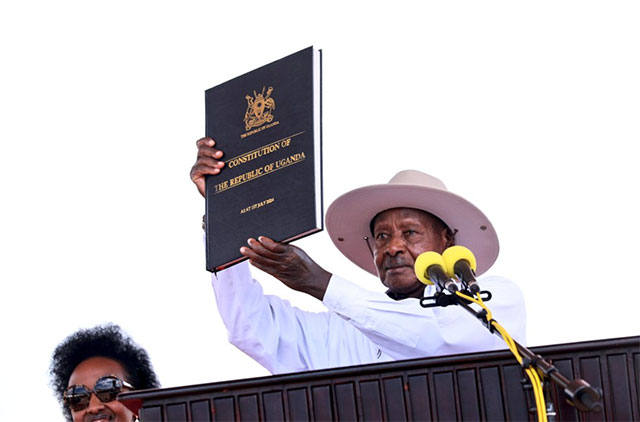
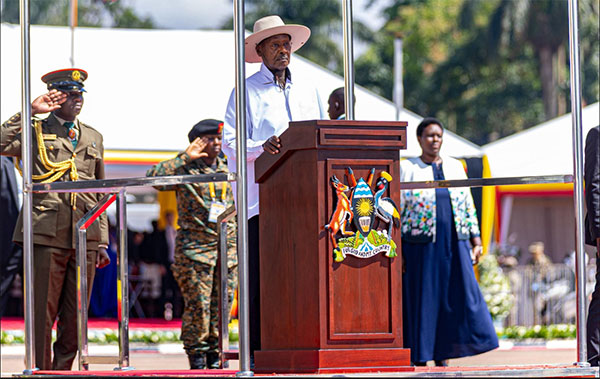
COVER STORY | IAN KATUSIIME | At exactly 11:50am, beneath Kampala’s unforgiving midday sun, President Yoweri Kaguta Museveni took the oath of office at the Kololo Independence Grounds for another term as a 21-gun salute cracked across the capital, announcing not so much a new chapter as the continuation of a very long one.
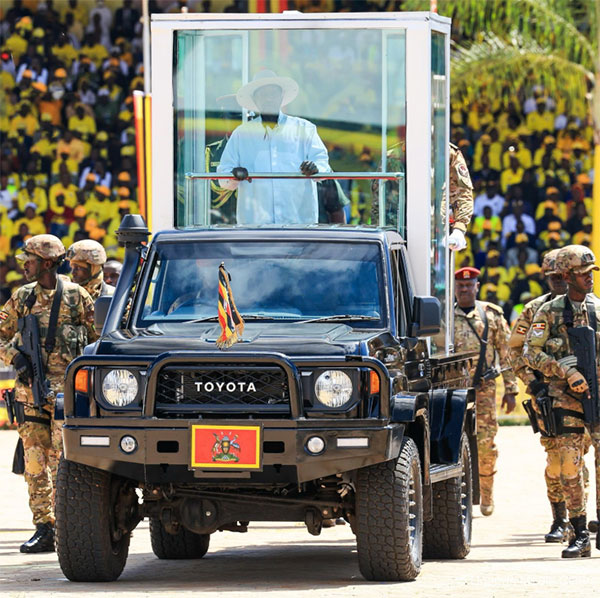
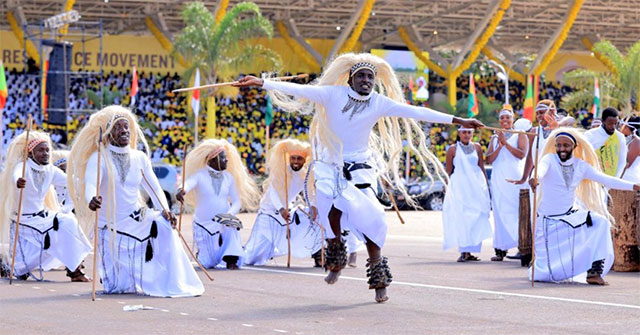
Fighter jets cut through the sky overhead, their sonic booms echoing across the city in repeated bursts. Brass bands played in tight formation. Military units stood in rigid symmetry, performing a choreography of state power that has become familiar in Uganda’s political life.
Yet for many observers, the moment carried less the feeling of renewal than of continuity stretched to its limit.
Museveni, 81, took the oath of office for another five-year term after nearly four decades in power, a tenure that has made him one of Africa’s longest-serving leaders and increasingly defined Uganda’s modern political identity itself.
He had earlier ruled the East African nation for 10 years without elections before opening up the political space in 1995, with the first elections held in 1996.
The inauguration followed a decisive electoral outcome. Museveni secured 71.65 percent of the vote, totaling 7,944,772 ballots. His closest challenger, Robert Kyagulanyi, widely known as Bobi Wine, of the opposition National Unity Platform, received 24.7 percent, or 2,741,238 votes.
However, in the aftermath of the vote, Kyagulanyi escaped to the United States with his family following a tense post-election period in which soldiers reportedly surrounded his residence and his wife was allegedly assaulted during the standoff, accusations the government has denied.
The episode added to long-standing concerns among opposition groups about the conduct of elections and the use of security forces in political contests.
But what was on display in Kololo was, therefore, not just a presidential inauguration but the consolidation of a system whose centre of gravity has shifted steadily toward the presidency and, more specifically, toward the First Family.
The contrast between Museveni’s early years in power and his current political posture was difficult to ignore. The insurgent leader who entered Kampala in 1986, promising political renewal, now presides over a state in which the boundaries between public office, family influence and political loyalty have become increasingly blurred.
Standing prominently at the ceremony was Gen. Muhoozi Kainerugaba, the president’s son and Chief of Defence Forces, widely viewed by analysts as central to the country’s unresolved succession question.
His visible role at such a major national event underscored what many in Kampala’s political establishment increasingly acknowledge privately: that questions about Uganda’s future leadership are no longer hypothetical.
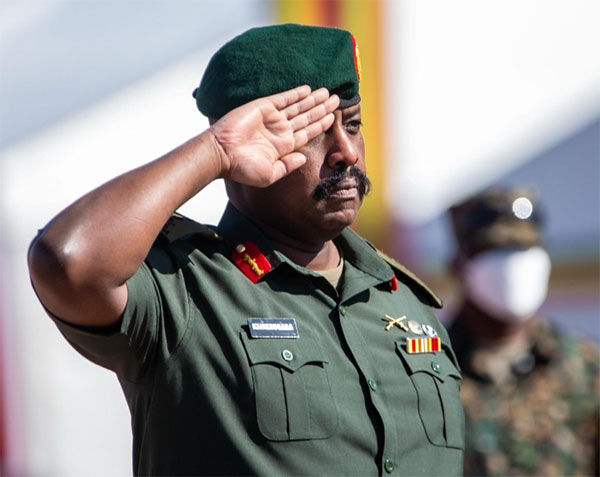
Alongside him, members of the First Family occupy an expanding sphere of influence. The president’s daughters – Natasha Karugire, Patience Rwabogo and Diana Kyaremera – have become intermediaries in political and policy networks, while his brother, Gen. Salim Saleh, continues to operate as one of the most powerful informal actors in the state.
The result, according to analysts, is an increasingly personalised system in which formal institutions coexist with family-linked power structures that shape decision-making behind the scenes.
However, one absence from the inauguration drew particular attention: First Lady Janet Museveni.
For decades, she has been one of Uganda’s most visible public figures, serving simultaneously as First Lady and Minister of Education and Sports. Her presence at political events has long been interpreted as both stabilising and symbolic.
Her reduced visibility in recent months has fuelled speculation in political and social circles, though no official explanation has been provided.
In a political environment where symbolism carries weight, absence itself becomes subject to interpretation, particularly within a leadership structure so closely associated with family continuity.
The cost of spectacle in a strained economy
The inauguration itself underscored the financial and political priorities of the state. The government spending on the ceremony is estimated to have been over 50 billion once security deployments, rehearsals, logistics and military coordination are included. Days before the event, the Ministry of Finance sought supplementary funding of Shs3 billion from Parliament to meet the costs.
State Minister for Finance, Henry Musasizi, defended the allocation, framing it as necessary for national prestige, unity and security.
But critics argue the scale of expenditure reflects a widening disconnect between state priorities and everyday economic realities.
Uganda continues to face high youth unemployment, rising living costs, and constrained fiscal space. For many households, economic pressure has become a defining feature of daily life, even as the state invests heavily in political ceremony.
The deployment of fighter jets over Kampala in the days leading up to the inauguration reinforced the sense of a state performing strength rather than quietly demonstrating institutional stability.
For supporters, such displays signal continuity and order. For critics, they suggest a system increasingly reliant on spectacle rather than governance confidence.
A controversial legislative turn
Just days before the inauguration, Parliament passed the Protection of Sovereignty Bill, 2026, a piece of legislation that has triggered concern among economists, diplomats and civil society groups.
The bill introduces broad provisions governing foreign funding and defines certain recipients of external support as potential agents of foreign influence. It also criminalises vaguely defined forms of economic sabotage.
Supporters argue the law is intended to protect national sovereignty and reduce external interference in domestic affairs. However, concerns within the financial and policy establishment have been more pronounced.
The Bank of Uganda governor, Dr. Michael Atingi-Ego, reportedly warned parliamentary committees that the legislation could introduce radical uncertainty into the economy at a time when Uganda depends heavily on external capital flows.
He said the country receives significant foreign investment and more than US$ 1.5 billion in annual diaspora remittances. Economists fear that ambiguity in the new legal framework could dampen investor confidence and complicate financial inflows.
The governor’s warning that a country without reserves is not sovereign was notable for its directness in a political environment where technocratic caution often competes with political imperatives.
Though President Museveni later made a clarification that the proposed law does not target investors and remittances, the damage is seen to have been done.
As a result, Parliament ultimately proceeded with the bill, albeit with minimal changes following public outcry of the implications, as the legislators chose the immediate comfort of political fortification over the long-term health of the economy, effectively sacrificing the nation’s financial stability at the altar of the President’s enduring grip on power.
Days later, Muhoozi fired off a Twitter warning to the Central Bank Governor to “be careful with his comments”.
The Speaker of Parliament, Anita Among, meanwhile, ensured nothing went wrong as she sought to win favour of the powers that be with the impending election of Speaker of the 12th Parliament.
Among is seeking a full second term, having taken over from the late Jacob Oulanya barely a year into his term.
She has been an unapologetic lieutenant of Museveni: silencing critical legislators during plenary sessions and idolising the First Family in a rare show of the legislature kowtowing to the executive, unseen before in Uganda’s history.
The cabinet equation
Attention is now turning to the formation of a new cabinet, a process widely seen as a barometer of internal political negotiations within the ruling elite.
Uganda’s cabinet, among the largest in Africa, has long been criticised for its size, age profile and effectiveness.
The outgoing cabinet has faced repeated scrutiny over corruption scandals and administrative underperformance.
A notable case involved the diversion of iron sheets intended for vulnerable communities in Karamoja, implicating senior officials, including Vice President Jessica Alupo, Prime Minister Robinah Nabbanja and Finance Minister Matia Kasaija.
Despite public criticism, most officials retained their positions, reinforcing perceptions that political continuity often outweighs accountability in cabinet decisions.
Analysts expect the next cabinet to reflect a similar pattern, limited structural overhaul but careful redistribution of influence among competing factions.
Increasingly, however, cabinet formation is inseparable from the succession question. Gen. Muhoozi’s political visibility has grown significantly in recent years, supported by his own network of allies and the Patriotic League of Uganda, a movement that has become an informal platform for political mobilisation.
Several figures associated with this network are expected to either retain or gain ministerial positions, particularly those aligned with emerging power centres.
At the same time, established political actors are navigating a shifting environment in which proximity to influence has become as important as formal rank.
Veteran politician Kahinda Otafiire has publicly expressed reservations about Muhoozi’s political ambitions, highlighting tensions within the ruling establishment itself.
Other senior figures are perceived as closer to Muhoozi’s orbit, reflecting a gradual but visible realignment within Uganda’s political elite.
External pressure and narrowing room for manoeuvre
Interestingly, Uganda’s internal political developments are unfolding amid growing international scrutiny. Several senior officials, including Anita Among, have faced sanctions from Western governments over allegations relating to corruption and human rights concerns. Diplomatic tensions have also been heightened by controversial public statements from senior political and military figures.
There are also growing concerns among diplomats that Uganda could face a more constrained international environment if governance trends continue in their current direction.
Some analysts draw parallels with Zimbabwe, where prolonged political centralisation and sanctions contributed to economic isolation and long-term financial strain. However, the government rejects such comparisons, insisting it is pursuing an independent development path.
But the country remains deeply integrated into global financial systems, donor networks and investment flows, making it sensitive to shifts in sentiment and policy.
By 2031, Museveni will be 86. His presidency will have extended beyond the combined tenure of all Uganda’s post-independence leaders before him.
Gen. Muhoozi, meanwhile, will be in his late 50s, part of a leadership cohort increasingly distant from Uganda’s demographic reality, where nearly four-fifths of the population is under 30.
Speaking as he took the oath of office, President Museveni said: “I, Yoweri Tibuhaburwa Kaguta Museveni, swear in the name of the Almighty God that I will be faithful and bear true allegiance to the Republic of Uganda and that I will preserve, protect and defend the Constitution. So help me God,” he said.
Leaders present
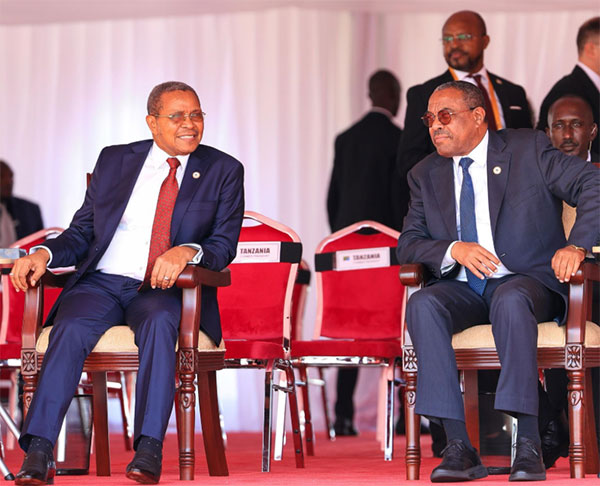
Togolese President Faure Essozimna Gnassingbé, in office for 21 years, and Salva Kiir Mayardit of South Sudan, who has led his country for 15 years, were among the African leaders who attended the event.
Other leaders present included Brice Clotaire Oligui Nguema of Gabon, Brahim Ghali of the Sahrawi Arab Democratic Republic, Taye Atske Selassie Amde of Ethiopia, Félix Antoine Tshisekedi of the Democratic Republic of the Congo, Azouz Nasri of Algeria, Hassan Sheikh Mohamud of Somalia, Daniel Francisco Chapo of Mozambique, Samia Suluhu of Tanzania, Évariste Ndayishimiye of Burundi, Uhuru Kenyatta, former president of Kenya, and Olusegun Obasanja, former president of Nigeria.
Nicholas Checker, Senior Bureau Official for African Affairs for the United States, represented President Donald Trump. However, notably absent were William Ruto of Kenya and Paul Kagame of Rwanda.
Presidential & parliamentary elections (Museveni era)
- 1996 – First post-1986 general elections (Movement system) -Winner-Yoweri Museveni
- 2001 – Second elections under Movement system-Winner-Yoweri Museveni
- 2006 – First multiparty elections after 2005 referendum -Winner-Yoweri Museveni
- 2011 – General elections (multiparty system) -Winner-Yoweri Museveni
- 2016 – General elections (multiparty system) -Winner-Yoweri Museveni
- 2021 – General elections (highly contested, multiparty system)-Yoweri Museveni
- 2026 – General elections (highly contested, Multiparty system)-Yoweri Museveni