The Independent Uganda: You get the Truth we Pay the Price


Kampala, Uganda | PATRICIA AKANKWATSA | For many schools, the decision to move away from firewood and charcoal is not necessarily about whether cleaner cooking is desirable. It is about whether they can afford the technology to make the switch.
A new financing partnership between Ecobank Uganda and Eco Stove Ltd is seeking to address that problem by allowing schools to acquire institutional clean-cooking equipment and pay for it over time rather than meeting the full cost upfront.
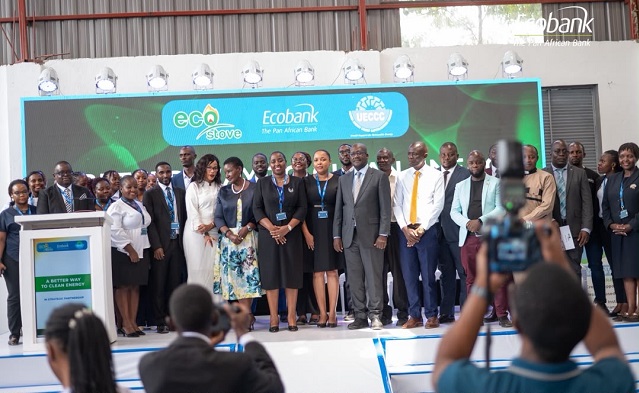
The Green Energy Financing Programme, launched in Bujjuko along Mityana Road on Aug. 13, brings together the bank’s lending capacity and Eco Stove’s institutional cooking technologies.
The initiative targets schools and other educational institutions that prepare large quantities of food each day but continue to depend heavily on biomass fuels.
Across Uganda, firewood and charcoal remain dominant cooking fuels, creating costs for institutions while contributing to pressure on forests and exposing kitchen workers to smoke.
Grace Muliisa, Managing Director of Ecobank Uganda, said the financing model could make clean cooking a business decision for schools rather than simply an environmental one.
“The transition to cleaner cooking should not be viewed only as an environmental ambition; it is also an economic opportunity for schools. By bringing together financing and efficient cooking technology, we are helping institutions reduce recurring fuel costs, improve operational efficiency and invest in infrastructure that delivers value over the long term. This partnership with Eco Stove reflects our commitment to financing solutions that create measurable economic, social and environmental impact.”
Tackling the upfront cost
The biggest hurdle for many institutions is the initial investment required to replace existing cooking systems.
Elizabeth Mwerinde Kasedde Head of Consumer and Commercial Banking at Ecobank Uganda, said the new financing product is designed around that challenge.
Schools typically need to prepare several meals each day for large numbers of learners, making their kitchens significant consumers of energy. Yet the cost of acquiring efficient cooking equipment can make firewood appear to be the cheaper option in the short term.
Under the new arrangement, qualifying schools can finance the acquisition of clean-cooking equipment and repay the cost gradually.
The programme is supported by the Uganda Energy Credit Capitalisation Company (UECCC), which provides financing and technical support for clean-energy investments.
Roy Nyamutale Baguma, Managing Director of UECCC, said the arrangement gives institutions an opportunity to address the upfront cost of clean cooking without continuing to put pressure on Uganda’s forests.
“It is a real opportunity for schools and other private institutions to transition towards cleaner and more efficient preparation of meals without degrading and depleting Uganda’s forest cover,” he said.
UECCC is using concessional financing mechanisms to encourage financial institutions to lend to enterprises and institutions seeking clean-energy technologies.
Under the Electricity Access Scale-Up Project, the agency has established a credit support facility through which financial institutions such as Ecobank can access concessional lines of credit for clean-cooking investments.
A market still dominated by biomass
The financing push comes against a difficult clean-cooking landscape.
Baguma said the 2024 national census found that only 0.8% of Uganda’s 10.8 million households about 412,000 households use clean sources of energy for cooking.
The remaining households largely depend on biomass.
He said household air pollution affects more than 20 million Ugandans and contributes to about 13,000 deaths annually.
The environmental cost is also significant. Uganda’s forest cover has fallen from about 24% of total land area in 1990 to 12.7%, with charcoal production and firewood harvesting among the pressures on forests.
Government policy now targets reducing biomass energy use for cooking from 75% in 2024 to 50% by 2030, while increasing the share of clean cooking energy to 50%.
But the transition will require more than policy.
It will require technologies that households and institutions can afford, and financing mechanisms that spread the cost of switching.
Building a financing ecosystem
For Eco Stove, the partnership addresses a problem the company has encountered directly.
Rose Twine, founder of Eco Stove Ltd, said demand from schools exists, but many institutions struggle to turn interest into actual purchases because they cannot meet the initial cost.
“For many schools, the challenge is not recognizing the need for cleaner and more efficient cooking, but being able to make the initial investment. Working with Ecobank Uganda allows us to bridge that gap and make our technology more accessible to institutions. By reducing fuel consumption and improving kitchen efficiency, schools can achieve meaningful savings while creating healthier and more sustainable cooking environments.”
Twine said the company had received interest from schools seeking certification for its solutions but had seen some fail to proceed because of financing constraints.
The strategy is therefore increasingly shifting from simply selling cooking technology to building partnerships that can finance and distribute it.
The company has also entered into an arrangement with the Church of Uganda’s Church Commission, seeking to use the church’s extensive network of schools and institutions to expand clean-cooking adoption.
The partnership could eventually connect clean cooking with other environmental initiatives, including tree planting and the use of agricultural waste to produce briquettes.
Beyond one technology
The programme does not rely on a single cooking technology.
The partners are promoting a range of solutions, including solar energy and rock-based fuel stoves that use volcanic stones as a heat source.
UECCC also supports several other technologies, including electric pressure cookers, induction and electric stoves, LPG, biogas, ethanol and improved biomass stoves.
Baguma said this mix was necessary because Uganda’s institutions and households have different energy needs and levels of access.
Since November 2024, UECCC’s results-based financing facility has provided discounts on several clean-cooking technologies, including 50% for electric pressure cookers and improved biomass stoves, 40% for LPG and ethanol cookers and 30% for biogas digesters.
The agency says the programme has so far enabled 289,307 households to access clean-cooking solutions, benefiting more than 1.1 million people, including refugees.
It has partnered with 35 financial institutions and 120 energy service companies, 43 of them clean-cooking distributors.
For Ecobank, the school programme is also part of a broader push into sustainable finance.
Gekasedde said the bank plans to expand the initiative beyond its initial target group, including engaging church- owned schools through church commissioners