The Independent Uganda: You get the Truth we Pay the Price



The professionals who help move, hide and legitimise Uganda’s dirty money
Kampala, Uganda | IAN KATUSIIME | Uganda could be losing more than Shs2 trillion a year to illicit financial flows (IFFs), with trade misinvoicing alone estimated to have created a $6.6 billion gap between what Uganda reported trading and what its trading partners reported between 2006 and 2015. But the money does not move by itself.
A new report by Global Financial Integrity (GFI), a Washington D.C.-based think tank, points to an often less visible layer of the illicit-finance economy: lawyers, accountants, real-estate agents and trust and company-service providers who can provide the corporate structures, transactions and professional services through which questionable wealth is moved, concealed or made to appear legitimate.
The report, The Enablers Gap: Assessment of the Shadowy Craftsmen of Illicit Wealth, released on Sept. 22, raises a fundamental question for Uganda’s financial-crime enforcement system: when professionals sit at the intersection between illicit wealth and the legitimate economy, who is watching them?
The GFI report focuses on Uganda, Kenya and Ghana. It was authored by GFI Policy Director Africa and Maxwell Kpebesaan Kuu-ire, Policy Analyst West Africa. The report says IFFs cost Africa at least USD 50 billion annually, and the three countries each illustrate “a different facet of this problem.”
Ghana ranks third in sub-Saharan Africa , Kenya fifth and the study adds that “Uganda’s exposure is smaller in absolute terms but no less structurally significant.”
It states that behind nearly every significant movement of illicit capital across all three jurisdictions stands a professional enabler: a lawyer who structures the vehicle, an accountant who certifies the accounts, a real estate agent who closes the deal, or a trust and company service provider who maintains anonymity.
For Uganda’s case, the report’s concern is not simply that professionals could be used to move illicit wealth, but that the country’s oversight of these professions has significant gaps.
While Uganda’s anti-money-laundering framework brings lawyers, accountants, real-estate agents and trust and company-service providers within the category of accountable persons, GFI points to limited suspicious-transaction reporting from some of these sectors and weaknesses in supervision and enforcement.
The result is a potentially important blind spot: the enablers who may encounter suspicious transactions in the course of their work are not necessarily generating the financial intelligence needed to expose the networks behind them.
One of the case studies cited in the report is that of “Uganda v. Serwamba David Musoke & Others (2015)” where fraud at Equity Bank’s Oasis Mall branch in Kampala showed how illicit proceeds could move rapidly from a financial institution into the legitimate economy.
Musoke, then an operations manager at the branch, was convicted in a scheme in which USD1.45 million was fraudulently withdrawn from clients’ accounts over two days using impersonators, forged withdrawal slips and the circumvention of biometric controls.
Investigators subsequently traced part of the proceeds into land, vehicles and businesses, with the case also involving external accomplices and professionals whom investigators said helped move or conceal the money. Assets including land titles, vehicles and cash were identified and partially recovered.
Another case cited by the report is “Uganda v Kamya Valentino & 3 Others.” Kamya Valentino, an accountant at the Embassy of Sweden in Uganda, was responsible for managing the mission’s financial accounts.
Between 2016 and 2019, he diverted about Shs8.4 billion from the embassy, according to the case. “The money did not simply remain in bank accounts. Substantial amounts were transferred into accounts controlled by his wife and father-in-law, while proceeds were used to acquire prime real estate and high-end vehicles.”
According to the report, Kamya also used a company structure to distance himself from the assets, with his father-in-law listed as a shareholder and several properties registered in his wife’s name.
The arrangement shows the layers that can separate illicit proceeds from the person who ultimately controls them: money moves through relatives’ accounts, corporate vehicles and physical assets, creating multiple points at which the original source of the funds can become harder to see.
The report says the corporate registry is one of the first places investigators should be able to look when trying to establish who ultimately controls a company but gaps in beneficial ownership information can create precisely the opacity that professional enablers exploit.
URSB gaps
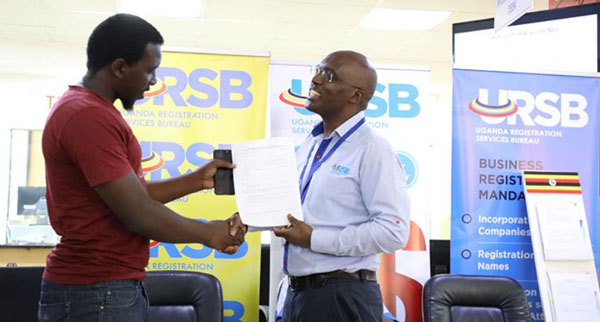
Uganda now requires companies to maintain beneficial ownership registers, identifying the natural persons who ultimately own or control them, and Uganda Registration Services Bureau (URSB) maintains a central Beneficial Ownership Register accessible to government agencies.
Yet GFI has previously warned that inadequate ownership information can handicap efforts to trace illicit proceeds, noting that Uganda loses trillions annually to IFFs and that anonymous companies can be used to conceal the identity of those behind illicit wealth.
One contentious question is whether the information submitted is complete, accurate, verified and actually connected to the other systems that follow money.
A company can have a named shareholder on paper while the person ultimately controlling or benefiting from it sits behind relatives, nominees or another corporate vehicle — precisely the kind of structure seen in the Kamya case.
GFI’s latest report argues for stronger integration between company registries, financial intelligence, tax authorities and law enforcement; without that connectivity, the corporate registry risks becoming a record of who owns a company on paper rather than a tool for establishing who owns the wealth in reality.
Uganda’s Financial Intelligence Authority (FIA) classifies the enablers as “accountable persons” under the country’s anti-money-laundering framework, placing obligations on them to identify clients, conduct due diligence and report suspicious transactions.
Yet the scale of suspicious activity detected from these sectors, the number of cases referred for investigation and the sanctions imposed on non-compliant professionals remain crucial pieces of a largely hidden picture.
The Independent asked the FIA how many suspicious transaction reports it has received from lawyers, accountants, real-estate agents and trust and company-service providers over the past three years, and how many resulted in investigations, prosecutions, asset recovery or other enforcement action.
FIA was also asked how many professionals have been sanctioned for anti-money laundering breaches and what weaknesses it has identified in their customer due-diligence and beneficial-ownership checks. Our queries were unanswered.
The professionals at the centre of this system do not necessarily deal in dirty money themselves. Their ordinary work is fundamental to the functioning of the economy: lawyers incorporate companies and structure transactions; accountants prepare and certify financial records; real-estate agents facilitate property purchases; and trust and company-service providers can establish companies, provide registered addresses or arrange directors and shareholders.
Uganda’s anti-money-laundering framework recognises these professions as “accountable persons” and places them under obligations to conduct due diligence and report suspicious activity.
The gap becomes more significant because the professionals identified by the report occupy some of the most important gateways into Uganda’s formal economy.
Lawyers can establish companies and structure transactions; accountants can prepare financial statements and advise on tax and corporate arrangements; real-estate professionals can facilitate the conversion of cash or unexplained wealth into property; while trust and company-service providers can create and maintain the corporate vehicles through which ownership and control become harder to see.
GFI argues that these professions can therefore become “enablers” of illicit wealth when their services are misused, particularly where customer due diligence, beneficial-ownership checks and suspicious-transaction reporting are weak.
Experts say Uganda’’s regulatory system may not be able to distinguish ordinary professional services from the deliberate use of those services to conceal the origins or ultimate ownership of wealth.
The report says mobile-money transactions can permit multiple smaller transactions to be used to evade detection thresholds and calls for stronger monitoring and financial reporting requirements.
Uganda has already seen how corporate identities, large numbers of small transactions and weaknesses across interconnected systems can combine to conceal the movement of illicit money.
In the 2020 Pegasus Technologies hack, fraudsters used roughly 2,000 MTN and Airtel SIM cards to receive billions of shillings after breaching the payment aggregator’s systems before the money was withdrawn through mobile-money agents across the country.
Police later said about 1,630 SIM cards had been fraudulently registered and used in the operation. Some of the numbers were reportedly registered in company names, raising questions about how corporate identities were being used to facilitate access to financial services.
FIA said the relatively small size of individual transactions made the fraud harder to detect until the transactions were viewed collectively. The episode offers a striking illustration of the broader problem facing Uganda’s anti-money-laundering system: a single transaction may appear ordinary, but thousands of transactions, companies, accounts or assets can reveal a very different picture when the data is connected.
Real estate puzzle
Uganda’s real estate has for long been one of those puzzles that many experts point to as a test case for money laundering. Suburbs like Buwaate, Kitukutwe, Bulindo have mushrooming apartment blocks and gated developments.
Property developers are responding to genuine demand from a rapidly expanding urban population, but the speed and scale of construction raise a less visible question: how is the money flowing into the sector being sourced, verified and tracked?
Uganda’s residential property prices have continued to rise, with the Uganda Bureau of Statistics recording annual residential property inflation of 6.4% in the year to the fourth quarter of financial year 2025/26, following 10.5% in the previous quarter.
GFI’s separate assessment of Uganda’s property sector identifies real-estate brokers, including lawyers, financial institutions, corporate bodies, public officials and politically exposed persons among the actors who can feature in the money-laundering chain, and says Uganda has no publicly accessible register showing the beneficial owners of real estate.
The proliferation of apartment developments in areas such as Buwate, Bulindo and Kitukutwe is therefore not evidence that illicit money is financing the construction boom but it provides a compelling physical backdrop to a question raised by GFI: when millions of shillings are converted from financial wealth into land, apartments and rental income, how effectively can Ugandan authorities establish who ultimately owns the asset and where the money used to acquire or develop it came from?
GFI says the country’s predominantly cash-based environment makes land transactions particularly difficult for tax authorities to detect, especially in rural and unregistered land-tenure systems. It explicitly warns that failure to detect these transactions creates opportunities to conceal wealth.
The report recommends greater transparency and access to information in land and real-estate transactions and specifically calls for stronger regulation of cash-based real-estate transactions.
GFI also raises questions about Uganda’s public procurement system, where opaque corporate structures can become particularly consequential because companies are able to access public funds through government contracts.
The Public Procurement and Disposal of Public Assets Authority (PPDA) maintains procurement information, including records of bidders, awarded contracts and suppliers, providing a potential trail for examining who sits behind companies doing business with the state.
The Independent could not establish whether PPDA procurement oversight routinely checks the beneficial ownership of suppliers, whether it cross-references procurement data with Uganda’s beneficial ownership records, and whether it has identified cases in which connected companies, undisclosed owners or professional intermediaries raised red flags in public contracts.
GFI says the designated non-financial businesses and professions (DNFBP) — lawyers, accountants, real-estate professionals, trust/company-service providers and others — remain under-supervised relative to banks, and that suspicious-transaction reporting from professional sectors is minimal.
GFI Recommendations
GFI recommends connecting financial intelligence, tax, company registry, central bank and law-enforcement data on an integrated platform, instead of agencies relying on slow, request-by-request information sharing.
Uganda was removed from the FATF grey list in 2025 following reforms. But GFI explicitly cautions that legislative/institutional progress does not necessarily translate into effectiveness, and says Uganda’s DNFBP supervisory regime remains comparatively underdeveloped.
The report also recommends that governments conduct “ex-ante corruption” (pre-emptive corruption) and illicit-finance risk assessments before major government transactions involving offshore vehicles, special-purpose vehicles (SPV) or complex cross-border structures are approved.
Uganda has used SPVs extensively in public-private partnerships (PPPs), with the country’s framework requiring private parties to establish an SPV to implement a project.
The structure is not inherently suspicious; indeed, it is a normal mechanism for ring-fencing the finances and risks of large infrastructure projects. But it can make beneficial ownership harder to follow when ownership runs through multiple companies or jurisdictions.
The Bujagali hydropower project offers a simpler picture of the complexity that can arise around large investments. The project involved several companies, including Bujagali Energy Limited and other companies linked to its foreign investors.
MIGA, the World Bank’s political-risk insurer, provided a $115 million guarantee linked to one of the foreign investment vehicles. Parliament later recorded that the project had total equity of about $199.9 million, including a $20 million contribution from the Ugandan government.
The structure itself was legitimate, but it demonstrates the difficulty investigators can face when trying to establish who ultimately owns or controls companies involved in major projects.
More recently, the East African Crude Oil Pipeline has been structured through EACOP Co., whose shareholders include Uganda’s National Oil Company and foreign entities including Total Holdings International B.V. and CNOOC Uganda Limited.
Experts say these structures are not evidence of wrongdoing. They do, however, illustrate the question at the heart of Uganda’s beneficial-ownership regime: when public institutions deal with companies whose ownership stretches across several corporate vehicles and jurisdictions, can authorities reliably establish the natural persons ultimately controlling or benefiting from those structures — and can that information be connected to procurement, tax, financial-intelligence and law-enforcement databases?
The cases documented over the years show how easily money can disappear behind relatives, companies and thousands of seemingly ordinary transactions. The accountability question for those whose systems allow it to disappear remains unresolved.