 The Independent Uganda: You get the Truth we Pay the Price


Parliament approves UPDF deployment to Gaza after heated debate
Kampala, Uganda | URN | Parliament on Thursday approved the deployment of the Uganda People’s Defence Forces (UPDF) to the Gaza Strip after a heated and deeply divided debate.
The motion, introduced unexpectedly during plenary by the Minister ofa Defence and Veteran Affairs, Kiryowa Kiwanuka, triggered fierce procedural objections from opposition legislators, who accused the government of ambushing Parliament.
The deployment was presented under Section 38 of the Uganda People’s Defence Forces Act, which empowers the President to deploy UPDF troops outside Uganda for peace-support operations, subject to parliamentary approval.
It is also anchored in Article 210 of the Constitution, which mandates Parliament to regulate the UPDF through legislation, including its deployment beyond Uganda’s borders.
Deputy Speaker Thomas Tayebwa admitted that although the motion had been submitted earlier by the defence minister, it had unintentionally been omitted from the day’s Order Paper due to an administrative oversight.
Nevertheless, he ruled that the House should proceed with debate, noting that government business enjoys priority under the Rules of Procedure of Parliament.
“The minister did his part by submitting the motion in time. The omission was on my side. Parliament’s duty now is to debate and decide, either approve or reject it,” Tayebwa ruled.
Defence minister makes case
Presenting the motion, the defence minister argued that Uganda’s proposed deployment is intended to support an International Stabilisation Force established following the devastating conflict triggered by the 7 October 2023 Hamas attack on Israel and Israel’s subsequent military offensive in Gaza.
He cited United Nations Security Council Resolution 2803 (2025), which, according to government, created a transitional “Board of Peace” to coordinate post-war governance and reconstruction in Gaza while calling upon member states to contribute personnel, equipment and financial resources to the stabilisation mission.
The minister told Parliament that in July 2026, United States President Donald Trump, through several emissaries, formally requested President Yoweri Museveni to contribute a UPDF contingent to the multinational force.
He further disclosed that planning meetings had already taken place between senior UPDF commanders, officials from the U.S. Embassy in Kampala and representatives of the International Stabilisation Force.
Kiryowa defended the deployment as consistent with Uganda’s longstanding foreign policy of supporting regional and international peace operations.
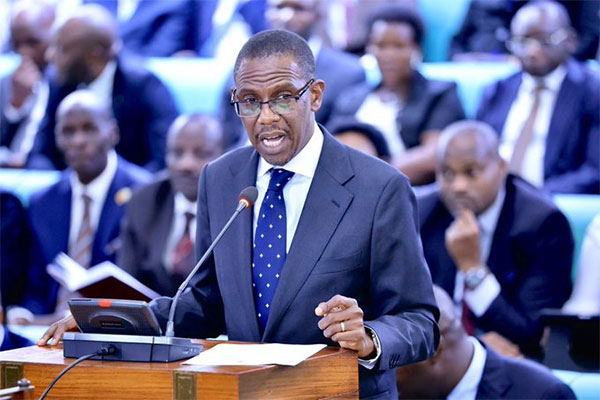
“Uganda has built a strong professional force that has successfully served in Somalia, South Sudan, the Central African Republic and several United Nations peacekeeping missions. Our participation will support ceasefire implementation, protect civilians, facilitate disarmament and contribute to long-term peace and stability,” he told Parliament.
He assured legislators that UPDF personnel would operate under clearly defined rules of engagement, remain politically neutral and comply fully with international humanitarian law.
Questions raised
While few MPs openly opposed Uganda’s participation in peacekeeping missions, several questioned the speed with which Parliament was being asked to authorize deployment into one of the world’s most volatile conflict theatres.
Civilians in Gaza continue to face intense military strikes, shelling, gunfire and naval fire from Israel, among other threats to their safety, UN humanitarians said Thursday.
The UN Children’s Fund said Thursday that at least 300 children have been killed in Gaza in the past 300 days since a ceasefire was announced in October 2025, amounting to an average of one child every day. As of August 1, 2026, the overall death toll in Gaza during the conflict has surpassed 73,000 people, according to figures from the territory’s health ministry cited by Agence France-Presse (AFP).
Opposition Chief Whip Paul Mwiru argued that Members had received the Order Paper only hours before the sitting and had insufficient time to study the legal, military and diplomatic implications of the proposed deployment.
“This is not an ordinary motion. We are committing Ugandan soldiers to an active war zone. Parliament deserves adequate time to consult technical officers, examine previous deployments and fully appreciate the implications before making such a decision,” Mwiru argued.
Tayebwa, however, rejected calls to defer debate, insisting that Parliament’s responsibility was to deliberate and determine the matter without unnecessary delay. The debate quickly shifted from Gaza to Uganda’s broader military footprint abroad.
John Baptist Nambeshe, the MP for Manjiya County, questioned why Parliament had not received comprehensive reports evaluating Uganda’s ongoing peace support operations in Somalia, the Democratic Republic of Congo, South Sudan and the Central African Republic before being asked to approve another deployment.
“This is not like the other theatres. Gaza is an active war zone where distinguishing between combatants and civilians is extremely difficult. Urban warfare and constant attacks make the risks much higher,” Nambeshe said.
Kalungu West MP Joseph Ssewungu echoed those concerns, arguing that Parliament has a constitutional obligation to protect Ugandan soldiers through rigorous scrutiny before authorising deployment.
He criticised government for failing to adequately brief legislators on the size of the contingent, troop welfare, Uganda’s strategic interests, expected benefits and operational risks.
Recalling the death of a Ugandan soldier shortly after deployment to Somalia, Ssewungu cautioned against treating military deployments as routine approvals.
“When you are sending our sons and daughters into conflict, Parliament must know why they are going, how they will be protected and what national interest Uganda is pursuing,” he said.
Tayebwa rules
Several MPs proposed referring the motion to the Committee on Defence and Internal Affairs for detailed scrutiny before consideration by the House.
However, Tayebwa ruled that Parliament’s Rules of Procedure do not require troop deployment motions to undergo committee examination before plenary debate.
“If the Rules intended such motions to first go before a committee, they would expressly say so. My responsibility is to apply the Rules as they exist,” he ruled.
Government MPs dismissed claims that Parliament had been ambushed. Health Minister Dr Chris Baryomunsi argued that legislators are elected to debate and decide matters as they arise.
“Members of Parliament are representatives, not delegates. We routinely respond to urgent national matters. There is no justification for fearing debate,” he said.
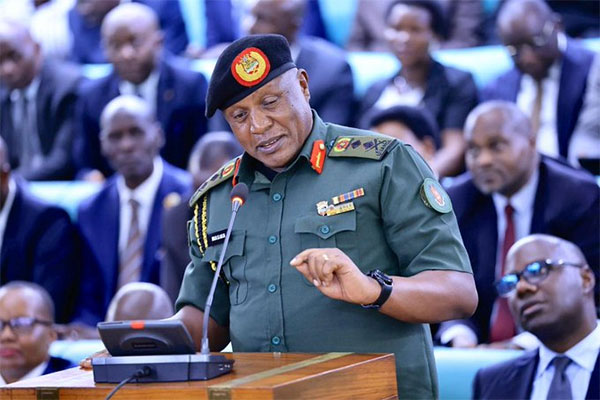
UPDF representative Major General Henry Masiko Ndarubweine mounted a robust defence of Uganda’s military credentials, describing the invitation as international recognition of the professionalism the force has demonstrated over decades of peace support operations.
“Uganda should be proud that its army is regarded as an anchor of stability in a region of turbulence. The UPDF is trained to confront threats, protect humanity and restore peace, not to avoid difficult missions,” Masiko said.
He pointed to Uganda’s intervention in Somalia as evidence of the UPDF’s capability to operate successfully in high-risk environments where other international forces had struggled.
Following the debate, Tayebwa put the motion to a vote without referring it for further scrutiny.
The majority of Members supported the resolution, formally authorising President Museveni to deploy a UPDF contingent to the Gaza Strip under Section 38 of the UPDF Act.
The decision marks one of Uganda’s most politically sensitive peace support commitments in recent years, extending the country’s already significant military footprint beyond Africa into one of the world’s most contested conflict zones.

Regardless of the potential risks and litany of considerations, anything done for peace is a plus for any country and citizen of the world. Viva, UPDF!!
We leave things of Generals to Generals, but I think it’s not bad to ask questions as citizens.
Gaza is very far. And most people that side don’t even see Africans as human beings (that’s putting it mildly). Are there no places that genuinely need Uganda’s support in Africa before we can think of sending our men and women in uniform to go and fight costly (not just money but Ugandan lives and even Ugandan priorities) battles that we don’t even properly understand in Gaza… why go through all that trouble without first asking those countries in the neighbourhood of Gaza?
And why does it seem as though haraka haraka is increasingly becoming normalized in parliament?
On priorities… we have very important bills that are still stuck in parliament such as the Marriage and Divorce Bill and very many burning issues that Ugandans need parliament to urgently… yet we somehow find time for things of Gaza and other random non-priorities for Ugandans… in Gaza they don’t even need Ugandans for anything but parliament is squandering taxpayers’ money on such (besides the fact that time is money, parliament sessions are not for free, in case you didn’t know).