The Independent Uganda: You get the Truth we Pay the Price


A nationwide aquaculture boom takes hold, but production remains uneven
Kampala, Uganda | JULIUS BUSINGE | Uganda’s aquaculture sector is taking shape unevenly across the country, with some regions emerging as clear leaders while others are still building capacity, according to the latest national census.
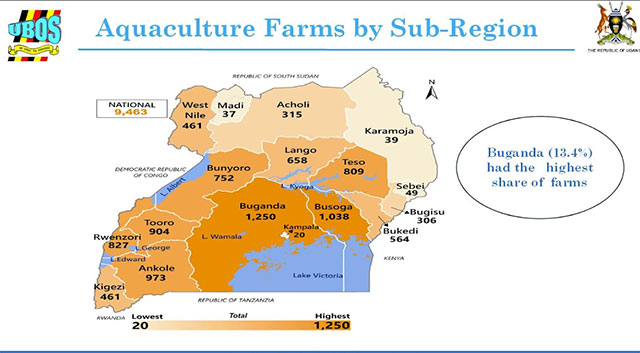
Figures from the Uganda Bureau of Statistics (UBOS) show that the Buganda sub-region leads the country in fish farming, accounting for 13.4% of all aquaculture farms — a total of 1,270. It is followed by a spread of activity across regions, including Busoga sub-region, Ankole sub-region, Tooro sub-region and Rwenzori sub-region, pointing to a sector that is national in reach but regionally varied in intensity.
The census, released on April 30 in Kampala, counted 9,463 aquaculture farms nationwide. Of these, 6,408 are located in rural areas and 3,055 in urban settings — reflecting a familiar pattern in Uganda’s wider agricultural economy, where rural communities dominate production even as urban systems expand.
But the distribution tells only part of the story. While rural areas host the majority of farms, production is concentrated closer to towns and cities. Urban and peri-urban farms account for more than 70% of total output, suggesting that access to markets, inputs and infrastructure is shaping where fish farming is most productive.
For communities, this split has tangible implications. Rural households remain central to aquaculture as a source of livelihoods and subsistence, while urban producers are increasingly driving commercial output and supply chains. Together, the two systems underpin a sector that contributes to food security, incomes and employment in a country where agriculture still accounts for about a quarter of economic output.
“We are setting the pace for aquaculture statistics in Africa. This report comes at a critical time to guide government and private sector planning,” said Chris Mukiza, UBOS executive director.
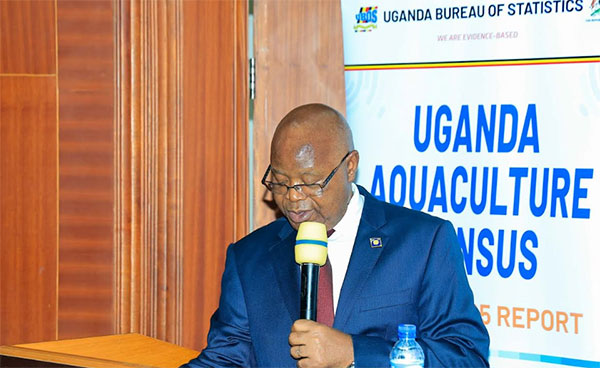
Setting the pace
The report is Uganda’s first aquaculture census and, according to UBOS, one of the most comprehensive exercises of its kind on the continent. It maps not just where farms are located but also how they operate — from production systems to access to services.
Across the country, most farms are focused on grow-out production, with limited hatchery activity. This points to a structural gap in the supply of fingerlings, a key input that could influence future growth if addressed.
Production itself is dominated by a narrow range of species. Tilapia accounts for more than four-fifths of output, followed by catfish, reflecting both market demand and the suitability of these species to local conditions.
Farming methods also vary by region. Pond systems are the most widespread, particularly in leading regions such as Buganda and Ankole, while cage and tank systems remain less common. This suggests differing levels of investment, access to water bodies and technical expertise across the country.
Extension services remains a challenge
Access to support services presents another divide. Just over half of farmers reported receiving extension services, leaving a significant proportion operating without formal technical guidance. Where services are available, they tend to focus on feed formulation, farm construction and disease control — areas seen as critical to improving yields.
Mukiza said such data is essential for identifying gaps and directing investment. He urged policymakers and industry players to use the findings to strengthen the sector.
“We are setting the pace for aquaculture statistics in Africa. This report comes at a critical time to guide government and private sector planning,” he said.
Taken together, the findings suggest a sector at a turning point: geographically widespread, commercially promising, but uneven in capacity.