The Independent Uganda: You get the Truth we Pay the Price


The East African nation is trying to build alternative fuel routes rather than depend on a single route
NEWS ANALYSIS | JULIUS BUSINGE | Uganda’s oil story has, for more than a decade, been told from the shores of Lake Albert. That is where the country’s biggest oil discoveries were made, where production facilities are being built and where billions of dollars have been committed to turning underground resources into an export industry.
But on the outskirts of the capital, another part of Uganda’s oil story is beginning to take shape. In Mpigi District, about an hour from the capital, the government is building what will become one of Uganda’s largest petroleum storage facilities.
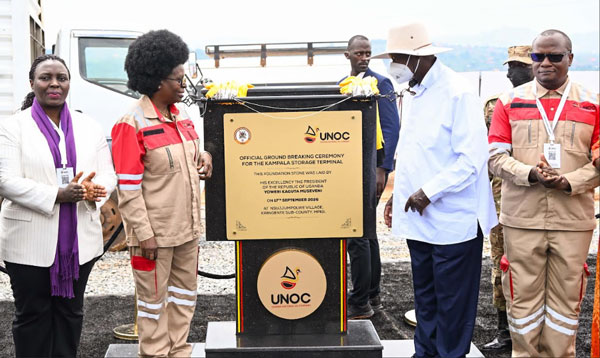
When President Yoweri Museveni broke ground for the Kampala Storage Terminal on Sept.18, the ceremony marked more than the start of another infrastructure project.
The 320-million-litre terminal is part of a wider attempt by government to change its position in the petroleum supply chain. The question is no longer simply how Uganda will produce oil.
It is how the country will move it, store fuel, refine it, import what it still needs and eventually sell more of it to neighbouring markets.
An oil producer that still needs imported fuel
Uganda expects to begin commercial oil production by June 2027. The country estimates more than 6.5 billion barrels of petroleum resources in place. The Kingfisher project, operated by China’s CNOOC, and the Tilenga project, operated by TotalEnergies, are expected to provide most of the production.
Uganda has named its crude blend Pearl Sweet. Production is expected eventually to reach about 230,000 barrels per day, while recoverable reserves are estimated at about 1.65 billion barrels, according to the Ministry of Energy and Mineral Development.
Most of the crude will be transported through the 1,443km East African Crude Oil Pipeline to Tanga on Tanzania’s Indian Ocean coast.
But Uganda will remain dependent on imported petrol, diesel and other refined products for some time. The country uses about 240 million litres of petroleum products every month.
More than 95% of these products are imported, mostly through Kenya. About 2.96 billion litres enter through the Kenyan supply route each year, with much of the fuel arriving at the port of Mombasa before being transported through Kenya’s pipeline and storage network.
That creates an important distinction. Uganda may soon produce crude oil, but that does not mean it will immediately produce all the fuel its economy consumes. And this is where the infrastructure becomes important.
For years, Uganda has relied heavily on infrastructure outside its borders to bring fuel into the country. That is beginning to change.
Early this year, Uganda acquired a 20.15% stake in Kenya Pipeline Company for about $255 million. KPC operates much of the infrastructure through which petroleum products move from Mombasa towards Uganda and other markets.
The investment gives Uganda a direct financial interest in a supply chain on which its economy already depends.
The government has also been expanding its own storage capacity. Uganda currently has about 160 million litres of petroleum storage capacity. That includes 30 million litres at the Jinja Storage Terminal, 70 million litres at Mahathi Infra Uganda’s facility at Kawuku and about 60 million litres operated by private fuel companies.

Jinja is particularly important because it is operated by UNOC. The terminal provides bonded storage for oil marketing companies and allows the government to maintain strategic fuel stocks. Its capacity is expected to rise to about 40 million litres.
UNOC is also developing a pipeline and oil jetty that would connect Jinja to Lake Victoria and potentially allow fuel to be transported from Kisumu in Kenya.
But President Museveni has raised concerns about transporting petroleum on Lake Victoria, warning of the consequences of a possible accident.
“…I’m not comfortable with that plan—transporting oil via water. I don’t like it, and I even told them. What if there is an accident?” he said. He has instead argued for greater use of pipelines and railways.
Then comes Mpigi
The Kampala Storage Terminal is on a completely different scale. Its 320 million litres of capacity would be more than 10 times the current capacity of the Jinja terminal.
At Uganda’s current rate of consumption, the new terminal could hold roughly 30 days of national fuel demand.
That matters because fuel supply is vulnerable to disruption. A problem at a port, a pipeline, a road corridor or a regional depot can affect supplies hundreds of kilometres away.
More storage gives Uganda a buffer. It allows fuel to be bought, transported and held before it is needed. It also gives the country more flexibility when international prices or regional demand changes. But storage does not automatically mean cheaper fuel.
The price motorists pay at the pump will still depend on international oil prices, exchange rates, taxes, transport costs and market competition. The bigger question is whether Uganda can make all these investments work together.
A refinery could change the equation
The next major piece of the puzzle is the planned refinery at Kabaale in Hoima. The refinery is expected to have an initial capacity of 60,000 barrels per day.
The government plans to connect it to the wider petroleum network through a 211km pipeline. If the refinery is completed as planned, the Kampala terminal could eventually receive fuel from two sources.
One would be imported petroleum products coming through regional supply routes. The other would be products refined from Uganda’s own crude.
That could make Mpigi an important meeting point between Uganda’s domestic oil industry and its imported fuel market.
The country would still need imports, but it would have another source of supply. And that is the bigger idea behind the storage investment. Uganda is trying to build alternatives rather than depend on a single route.
Looking towards Tanzania
The strategy extends beyond Uganda’s borders. Last month, Uganda and Tanzania signed an agreement involving UNOC, Tanzania Petroleum Development Corporation and Vitol Bahrain to develop a Tanga Regional Energy Hub.
The proposed facility would support petroleum storage, refining, logistics, trading and distribution.
The plans also include a multi-product pipeline that could allow refined petroleum products to move in either direction depending on where demand is strongest.
For Uganda, the project could create another connection to the regional petroleum market. It would also complement EACOP, which will carry Ugandan crude to Tanga.
The financing behind this infrastructure is significant. Vitol has extended a $2 billion facility to UNOC for strategic petroleum infrastructure, including the Kampala storage project.
This is a substantial financial commitment for a country whose oil industry is still being built. But there are also some risks that have little to do with oil prices. The Kampala Storage Terminal is being built in Mpigi, an area where farms, homes and wetlands sit close to expanding infrastructure.
A Kampala Capital City Authority-operated waste disposal site in Buyala Village is just over a kilometre from the planned terminal.
Energy Minister Monica Musenero has warned that the dumpsite could pose a fire risk. President Museveni has called for alternative methods of dealing with the waste, including converting it into energy.
He has also praised efforts to protect nearby papyrus wetlands. The location illustrates one of the difficult questions facing Uganda as its energy infrastructure expands.
Large petroleum facilities require land, roads, pipelines and transport links. They also have to coexist with communities and environmentally sensitive areas.
What happens after the first oil?
Uganda’s oil story has often been presented as a race towards first oil. But first oil will only be the beginning. Once crude starts flowing, the East African nation will have to demonstrate that it can manage a much larger and more complicated petroleum system.
Crude will have to move from the Albertine region to the coast. Some of it is expected to be refined domestically. Fuel will have to be stored and distributed across the country as imported products continue to arrive through regional supply routes. And Uganda will increasingly have to compete for customers in neighbouring markets.
That explains why projects such as the Kampala Storage Terminal matter. The terminal is not simply a collection of large fuel tanks in Mpigi.
It is one part of a network that includes the Jinja terminal, Kenya Pipeline Company, the planned Hoima refinery, EACOP and the proposed Tanga energy hub.
The government is trying to build a petroleum system in which Uganda has a greater role at several stages of the journey, from the oil well to the fuel station.
Whether that produces greater energy security, lower costs or more regional business will depend on how well the projects are financed, completed and connected.