 The Independent Uganda: You get the Truth we Pay the Price


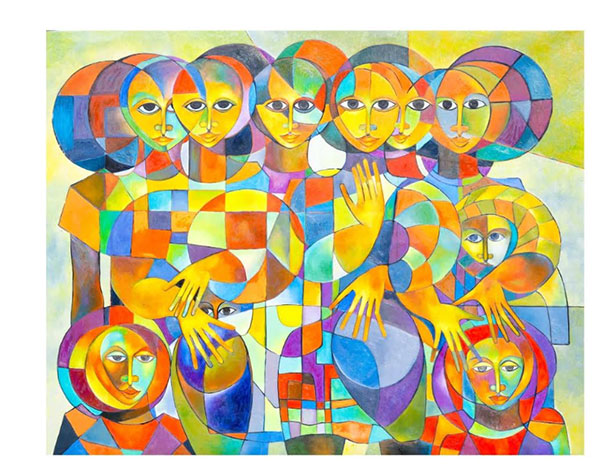
Kizito’s beautiful paintings in his new solo show, Hands of the Beholder, communicate more than the physical beauty of the woman, but prompt conversations on the power of togetherness and harmony in these contemporary times.
ARTS | DOMINIC MUWANGUZI | There are several words, such as ‘beautiful’, ‘impressive’, ‘brilliant’ and ‘expressive’, that can be used to describe Prof. Kizito Maria Kasule’s paintings. And these adjectives reveal much more than how his art is visually attractive, but how it radiates with a singular beauty and energy. Hands of the Beholder, his current solo show at Umoja Art Gallery, is nothing short of this character. The artist presents us with eleven paintings – more than half of these in mural sizes – in his signature style of stylistic approaches on canvas that seize the viewer’s gaze at once and lead them into a confluence of emotions. The paintings are washed in earthy colours of red, green, blue and yellow that effuse a particular warmth not only on canvas but also in the gallery space, prompting the viewer to spend more time in the gallery as they enjoy the art.
Kizito’s female figures on canvas are entwined with one another, with the usual facial or gestural expressions that denote a sense of communal living and expressive emotions. The artist is generally inspired by the socio-economic and sometimes political wellbeing of his immediate community and personal experience. Hence, his art offers commentary on issues of gender (women as mothers or social activists), cultural identity and economic survival. In particular, the body of work in this exhibition contextualises itself in the power of togetherness, harmony and the quiet yet profound feminine strengths that are critical in shaping society. The recurrent compositions of female figures clasped together on canvas are evocative of the power of togetherness and harmonious living that the artist seeks to explore in his expressive and exploratory art. This is much more visible in Collective Gaze 2026 where the artist paints a group of women with wide and bold stares and performing different gestural expressions, a symbol of their wide-ranging emotions. The same energy of togetherness and harmony is evident in Guardians of Memory and Ancestral Rhythm, which has women embracing one another as a sign of unity that the artist advocates for.
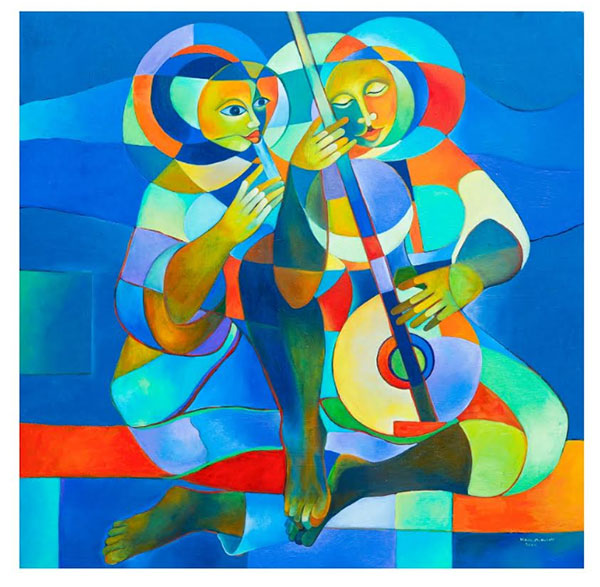
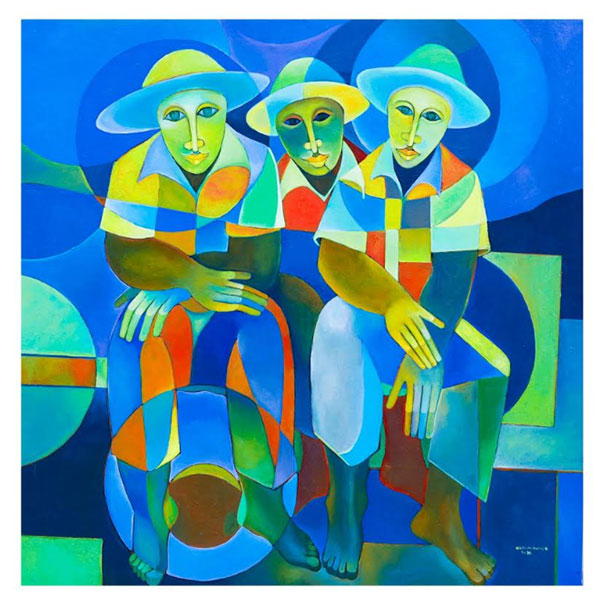
But there’s another theme in the artist’s work that can’t be ignored. Kizito’s women are not the regular type but beauty queens. The artist achieves this identity for his models by presenting them with well-chiselled body features like a round face, almond-shaped eyes and sensuous lips that are typically associated with women of such beauty. Yet within the context of this exhibition, the artist wishes the viewer to see beauty as something that’s more than the physical.
He, therefore, presents beauty as a socially constructed concept, one deeply rooted in culture, history, and often religious or societal values that can influence humanity to make decisions that uphold their personal identity and relevance. This school of thought is partly inspired by the artist’s scholarly background as an art academic at the College of Engineering Design Art and Technology (CEDAT), Makerere University, where research takes a central position in both his art teaching and making. Equally, his deep-rooted connection with his cultural heritage as a Muganda and strong religious belief in the Roman Catholic faith have a critical part to play in this philosophy. In both institutions beauty is understood and appreciated as more than a physical attribute but one that is ingrained in the deeper wellbeing of people and, therefore, contributes to how they relate to their immediate surroundings and express themselves.
The exhibition Hands of the Beholder is more than a celebration of stylistic approaches on canvas that the artist has come to be known for over many decades. Yes, Kizito is a master of his craft, making many of the audience revel in the stunningly beautiful art he makes and often impatiently wait for his next exhibition. But like the multi-dimensional approach to his art, he is also able to instigate conversations on impertinent issues of society as a social commentator. In this body of work, the artist critically invites us to reflect on the importance of living together as a gesture of peace and unity, especially in these times when the world is broken in almost every sector of its existence. As such, these mural-sized paintings cease to be decorative gems but strong metaphors for healing and rehabilitation.
*****
The exhibition, Hands of the Beholder, is showing at Umoja Art gallery located in Bukoto, plot 1800 Moyo close, Mukalazi Road, behind Princess Kevina Apartments, Kampala.



Is the last art piece a tribute to H.E YKMTibuhaburwa, the General of the revolution? Most ordinary people don’t know how to interpret art. They appreciate it only for the aesthetics.
This is the beauty of great art. It can be ambiguous and therefor, interpreted differently according to how one feels and understands the context within which it is created.