The Independent Uganda: You get the Truth we Pay the Price


Data is now Airtel Africa’s main revenue driver, overtaking voice, while mobile money continues to grow in importance
Kampala, Uganda | THE INDEPENDENT | Airtel Africa has reported a sharp rise in annual profit, with profit after tax more than doubling to $813m in the year to March 2026, up from $328m a year earlier, as rising data consumption and mobile money usage continued to reshape its revenue base across African markets.
The telecoms group said the improvement in profitability was driven by stronger operating performance, disciplined cost control and expanding margins across its footprint.
Revenue growth also accelerated during the period. Constant-currency revenue rose 24%, the fastest pace in the company’s history, while reported revenue increased 29.5% to $6.415bn, compared with $4.955bn in the previous year. The difference reflected foreign exchange movements across several markets, including gains in East Africa where the Ugandan shilling appreciated against the US dollar.
Earnings before interest, tax, depreciation and amortisation (EBITDA) rose 37.2% to $3.162bn, with margins expanding to 49.3%. The company said margins briefly exceeded 50% in the final quarter, reflecting improved efficiency and stronger revenue mix.
Data takes lead
The results underline a structural shift in Airtel Africa’s business model, with data now the largest revenue contributor, overtaking traditional voice services, while mobile financial services continue to grow in importance.
East Africa, which includes Uganda, remained a key growth region. Revenue in the region rose 18.9% to $2.192bn in reported currency and 13.8% in constant currency, supported by an 8.7% increase in the customer base to 84.3 million subscribers.
Data consumption trends accelerated strongly across the region. The number of data customers rose 15.7% to 36.5 million, while data traffic increased 50.3%, driven by rising demand for streaming, social media and other digital services. Smartphone penetration reached 46.6%, with average monthly usage climbing to 8.0 gigabytes per user, up 28% year on year.
Investment in network capacity continued, with more than 2,200 5G-enabled sites now active across five East African markets, as operators expand infrastructure to meet rising bandwidth demand.
Mobile money also remained a major contributor to growth. Airtel Money, the group’s financial services arm, increased its customer base by 21.3% to 54.1 million users, reinforcing its position as a key driver of financial inclusion in markets where access to formal banking remains limited.
New partnerships
During the year, Airtel Africa announced a partnership with SpaceX to roll out Starlink Direct-to-Cell satellite connectivity across its 14 markets, aimed at extending mobile coverage to remote and underserved regions without relying on traditional terrestrial infrastructure.
The group also agreed infrastructure-sharing arrangements with MTN Group in Uganda and Nigeria, part of a wider industry trend towards cost efficiency and reduced duplication of network investment.
Airtel Africa ended the year with 183.5 million customers across 14 markets, with data now its largest source of revenue and Airtel Money increasingly positioned as a core financial services platform rather than a supplementary offering.
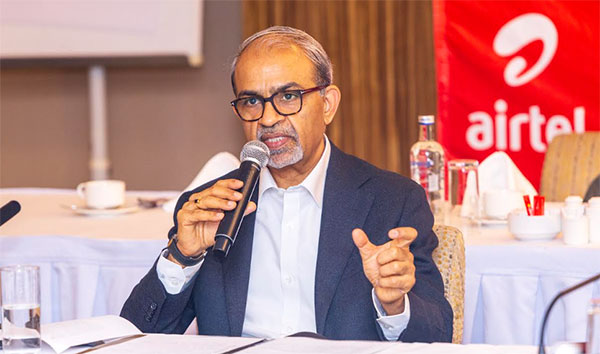
Airtel Africa CEO Sunil Taldar said the performance reflected both favourable industry dynamics and the company’s focus on digital transformation and efficiency gains, including increased use of artificial intelligence in network optimisation, customer onboarding and service delivery.
He said these initiatives had supported higher margins and improved customer experience, while smartphone customers rose 22% to 91 million, driving a near 50% increase in data traffic.
Looking ahead, Airtel Africa said it enters FY2027 with strong momentum, supported by continued investment in infrastructure, expansion of mobile financial services and sustained demand for digital connectivity, with East Africa and Uganda remaining central to its growth strategy.