The Independent Uganda: You get the Truth we Pay the Price


In June 2026, Uganda and UNESCO validated the country’s AI Readiness Assessment on its preparedness to adopt and govern AI responsibly
NEWS ANALYSIS | IAN KATUSIIME | The machine that decides the price of a Ugandan’s airline ticket, helps a farmer detect pest damage or writes a student’s essay has almost nothing in common with the room where Artificial Intelligence was born.
Seventy years ago, a small group of scientists gathered at Dartmouth College in New Hampshire, U.S. with an audacious proposition: that human intelligence could be described precisely enough for a machine to simulate it.
They could not have known how long the journey would take. Nor could they have imagined that, seven decades later, their experiment would reach a country thousands of miles away where artificial intelligence is becoming part of agriculture, finance, healthcare, education, aviation and government.
Uganda is not where AI began but increasingly, it is where its consequences are being felt.
But it all came together in 1956 when four scientists brainstormed on an idea: can machines think?
John McCarthy, Marvin Minsky, Nathaniel Rochester and Claude Shannon proposed bringing together researchers for what became the ‘Dartmouth Summer Research Project on Artificial Intelligence’, a gathering now widely regarded as the event that gave the emerging field both its name and its intellectual starting point.
The workshop lasted about two months and became the seminal event around which AI emerged as a field.
According to Dartmouth archives, the scientists thought that if reasoning, learning, language and problem-solving could be broken down into rules and patterns, perhaps a machine could learn to perform them. They did not have the computing power, data or algorithms that would make that vision practical for decades. But they had planted a seed.
The dream quickly collided with reality. The pioneers of AI had promised more than the technology of the time could deliver.
Early systems could solve tightly defined problems, play simple games and manipulate symbols, but they struggled with the messy complexity of the real world: language was ambiguous, vision was difficult, common sense was elusive and computers simply lacked the processing power and data needed to tackle them.
First AI winter
Governments and companies that had poured money into the field began to lose patience as grand predictions failed to materialise. Research funding was cut, projects were abandoned and enthusiasm turned to scepticism.
The period became known as the first “AI winter” — a reminder that technological revolutions do not always move in a straight line. AI had not died; it had simply run ahead of the machines needed to make its promises real.
The second revolution in AI began when researchers stopped trying to tell machines exactly what to think and started teaching them how to learn from enormous amounts of data.
The internet was generating information on a scale earlier generations of AI researchers could scarcely have imagined, while increasingly powerful computers — particularly graphics processing units, or GPUs — made it possible to train neural networks on that data.
Then, in 2012, three University of Toronto researchers; Alex Krizhevsky, Ilya Sutskever and Geoffrey Hinton demonstrated what happened when the pieces came together.

Their neural network, known as AlexNet, trained on roughly 1.2 million images using GPUs, dramatically outperformed competing systems in the image-recognition challenge.
Computer scientists say the breakthrough happened because many of the underlying ideas were decades old: data, computing power and algorithms had finally reached a point where they could work at a scale that mattered.
AI had transitioned from programming intelligence into a machine to giving a machine enough data and computing power to discover patterns for itself.
Then, in 2022, AI crossed a new threshold. OpenAI released ChatGPT, and a technology that had largely lived inside research labs and corporate systems suddenly appeared in an ordinary web browser, capable of answering questions, drafting essays, writing code and holding conversations in remarkably human-like language.
Within months, generative AI had become a global phenomenon, finding its way into classrooms, newsrooms, businesses and international organisations, while governments scrambled to understand its implications and develop rules for its use.
The first AI revolution had largely happened behind the scenes — in search engines, recommendation systems, financial models and industrial automation.
The generative AI revolution put the machine directly in people’s hands. ChatGPT was soon joined by Google’s Gemini, DeepSeek and a rapidly expanding ecosystem of AI assistants, turning artificial intelligence from something most people encountered without knowing it into a technology they could actively summon, question and use.
AI threats in Uganda
Uganda’s Intelligent Transport Monitoring System (ITMS) offers a more consequential example of AI entering everyday life. The system, developed with Russian company Joint Stock Company Global Security, combines digital number plates, tracking devices, CCTV and data analytics to identify and monitor vehicles; the ITMS itself describes the platform as using AI, data analytics and the Internet of Things.
An investigation by The Independent revealed how ITMS functions as an AI-enabled surveillance system that has bolstered the power of the Ugandan state.
It is capable of linking different streams of information. The system can integrate vehicle information with CCTV and other government databases to facilitate comprehensive vehicle and personal identification although there is little evidence from Uganda Police to show for reduced vehicle theft or vehicle-enabled crime.
ITMS has alarmed digital-rights groups. CIPESA has warned that the system could enable authorities to track the location of vehicles and build detailed records of people’s movements, particularly in a country where safeguards around government-held data and CCTV surveillance remain limited.
Human Rights Watch has similarly described the system as raising concerns about mass surveillance and called for stronger oversight and human-rights protections.
The promise of AI here is therefore double-edged: the same technology that can help police locate a vehicle involved in a crime can also create an infrastructure capable of mapping where millions of people go, when they go there and, potentially, who they meet.
Uganda’s AI strategy discussions explicitly identify agriculture among the sectors where emerging technologies are expected to have an impact. The Ministry of ICT’s 2026 strategy consultations cover agriculture, health, finance, education, tourism, manufacturing and research.
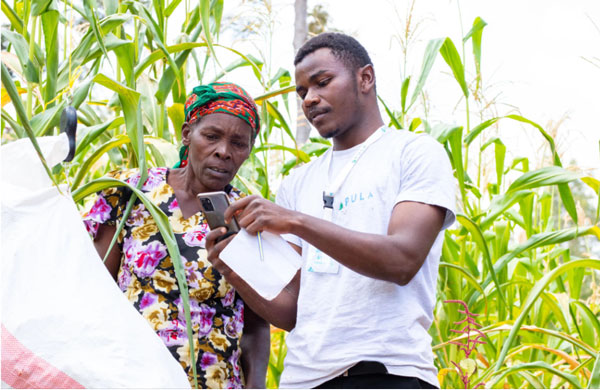
Agric-Care Uganda, a company in the agricultural value chain, has documented the transformations AI is making as far as Napak district in Karamoja sub-region. A farmer is able to point their smartphone camera at a maize leaf showing the early signs of pest damage.
“Within seconds, an app identifies the pest, recommends a MAAIF-approved treatment, and flags-automatically-that one of the chemicals he was about to buy is banned in the European Union due to its carcinogenic properties,” says a statement on the company site. The farmer chooses a safer alternative.
This is IntelliFarmAI in action — a Ugandan-built, AI-powered farmer decision-support system designed to tackle some of the persistent problems holding back the country’s agriculture: limited soil information, inadequate extension services, inefficient fertiliser use, unsafe agrochemical practices and the export rejections that can cost farmers and the wider economy millions.

There are other examples in livestock and her management. Jaguza Livestock is a company that provides solar-powered smart ear tags for cattle, goats, and pigs. These tags use machine learning to track feeding patterns, temperature, and movement—often spotting animal illness 48 hours before visible symptoms show, while also acting as an anti-theft GPS alert.
Uganda’s healthcare system is also benefiting from AI. The Mak Ocular System, developed at Makerere University with support from Google.org, is a locally developed mobile microscopy system.
It uses AI object detection to scan blood smears and automatically spot malaria trophozoites, tuberculosis, and cervical cancer. This greatly speeds up testing in rural labs that lack expert pathologists.
Mak Ocular was designed to solve a critical healthcare bottleneck: the severe shortage of human pathologists and laboratory technicians in rural Ugandan health centers. Instead of requiring expensive digital laboratory setups, the tool utilizes a standard smartphone mounted onto a basic optical microscope via a custom 3D-printed adapter.
The laboratory technician places a standard blood smear slide under the microscope, focuses it, and uses the smartphone camera to capture high-resolution images of the sample.
Uganda’s financial sector is rapidly adopting AI to accelerate financial inclusion, automate lending for the unbanked, and combat cyber fraud. Spearheaded by commercial banks, microfinance institutions, and local fintech innovators, AI is shifting the sector from physical brick-and-mortar operations toward dynamic digital ecosystems.
Tier 1 institutions like Centenary Bank (through its GonzaPay wallet) and Post Bank Uganda are integrating AI to scan alternative, dynamic datasets. The algorithms evaluate mobile money histories, airtime purchases, utility bill patterns, and retail transaction volumes to instantly determine a borrower’s creditworthiness.
This process—called Alternative Credit Scoring—is how banks lend money to individuals who lack formal bank accounts, salary slips, or land titles. When a user applies for a micro-loan through a mobile wallet or banking app, they grant permission for the AI algorithm to analyze their smartphone metadata.
The system evaluates several non-traditional data points: mobile money transactions, utility and bill payments.
Financial institutions are using multilingual AI chatbots for individuals who do not speak English or have low literacy. FINCA Uganda partnered with technology firms to deploy an AI agent named Flora.
The bot processes over 91,000 interactions monthly across WhatsApp, Messenger, and web chat. It handles balance checks, microloan FAQs, and account requests, freeing up branch staff to process more complex financial services.
Uganda’s AI ecosystem
However, Uganda is trying to build its own AI policy and ecosystem. The Ministry of ICT says Uganda’s National AI and Emerging Technologies Strategy is being developed around both adoption and governance, with AI as the flagship technology alongside cloud, big data, blockchain and quantum computing.
In June 2026, Uganda and UNESCO validated the country’s AI Readiness Assessment, looking at the country’s preparedness to adopt and govern AI responsibly.
A month later, Uganda told the UN Global Dialogue on AI Governance that developing countries should have a greater role in shaping global AI rules. This was during the High-Level Governmental Plenary Segment of the inaugural United Nations Global Dialogue on AI Governance in Geneva, Switzerland.
The dialogue brought together representatives from all 193 United Nations Member States to discuss how AI can be developed and governed in a way that is safe, inclusive and beneficial to all.
Uganda’s delegation was led by the Minister of State for ICT Alioni Yorke Odria, who delivered the country’s statement on behalf of President Yoweri Museveni.
The delegation also included the Permanent Secretary, Dr. Aminah Zawedde; Nyombi Thembo, the Executive Director of the Uganda Communications Commission (UCC); the Executive Director of the National Information Technology Authority – Uganda (NITA-U), Hatwib Mugasa; and members of Uganda’s AI Task Force.
Addressing the plenary, Odria said Uganda is committed to using AI to support sustainable development, accelerate digital transformation and improve people’s lives.
“Uganda does not come to this Dialogue to receive policies and guidelines written for us by others. We come to help write them,” he said.
The World Bank’s 2026 World Development Report makes a fascinating argument: developing countries do not need to spend trillions of dollars building frontier AI models to benefit from the technology.
They need to adopt, adapt and advance — adopting tools that already exist, adapting them to local languages, institutions, data and development needs, and eventually building the capacity to advance the technology themselves.
AI researchers say the opportunity is enormous, arguing a Ugandan farmer should not need an agricultural scientist to access expert advice if an AI system can deliver it through a smartphone, voice call or even a basic mobile phone.
They say the same for a rural health worker who could use an AI assistant to help interpret symptoms, flag possible diagnoses or determine when a patient needs referral to a specialist — extending scarce medical expertise into places where doctors are few.
The World Bank argues that AI can help developing countries overcome precisely these shortages of skilled workers.
But that opportunity comes with a paradox: will AI help African countries like Uganda close its development gap, or reproduce it in digital form? Uganda, like other low income countries, faces a tall order when it comes to building the infrastructure, skills, data and institutions needed to make AI useful on their own terms.
A farmer cannot benefit from an AI agricultural adviser without electricity, connectivity and affordable devices; a health worker cannot rely on an AI diagnostic tool without trustworthy local health data, training and systems for human oversight.
And if the most powerful models, computing infrastructure and AI companies remain concentrated in a handful of countries and corporations, African economies risk becoming consumers of intelligence produced elsewhere — dependent on technologies that may not understand their languages, institutions or realities.
The World Bank’s warning is therefore as much about development strategy as technology: AI could allow countries to compress decades of progress into years, but only if they build the foundations that allow them to use, shape and adapt the technology.
In 1956, scientists asked themselves “can machines simulate intelligence? In 2026, they are asking “What should machines be allowed to decide?”
Dartmouth University itself is framing its 70th-anniversary conversation around precisely this problem in a conference slated for late October themed “What Must Remain Human?” The conference will examine responsibility, human judgment and when decisions should not be delegated to AI.