The Independent Uganda: You get the Truth we Pay the Price


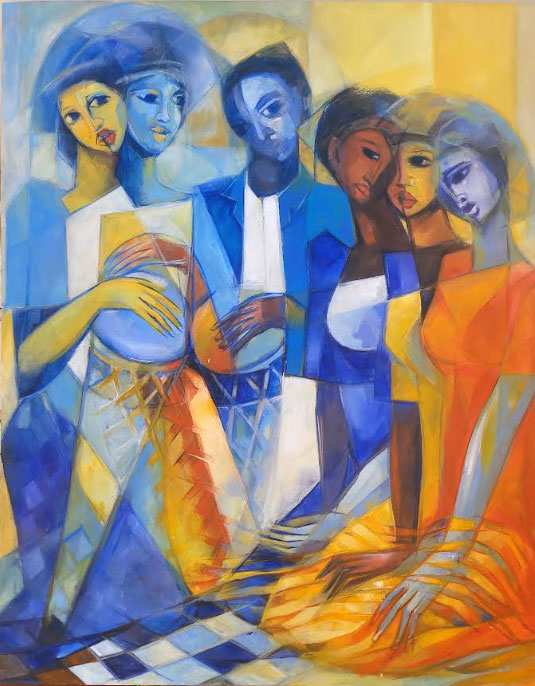
From a senior art lecturer at Makerere University Art School to now a full-time artist in his retirement, Paul Lubowa uses his phase in his life to self- discover himself as an artist and individual, and through the process creates art that permeate with new energy and rhythm.
ARTS | DOMINIC MUWANGUZI | There are few artists in Uganda today one can comfortably call exceptional with their art. Paul Lubowa belongs to this category; not because he’s extremely good as a painter – which often is relative – or is a senior artist who has a lot of experience borrowed from his many years of mentoring artists at Makerere University art school; but for the fact that he is curious, authentic and articulate with his work. The artist paints what he observes in his immediate surroundings and underscores this with how these experiences make him feel both as an individual and as an artist. As such, he emphasizes the aspect of what the story is in his compositions to create a strong connection between his paintings and his audience.
The artist’s themes in his paintings revolve around the subject of traditional cultural activities which are a reflection of the different traditions and norms of his cultural heritage. Lubowa’s cultural heritage is Buganda, a monarchy in central Uganda, feted for its rich and beautiful traditions that are evident in the ordinary way of living of its people. The artist finds inspiration in these activities to build conversations on themes like introduction ceremonies (Kwanjula), gendered cultural roles and musical fetes. The recurrent deployment of motifs like the Gomesi, Kanzu, long drum and mat on his canvases is a representation of the rich material culture of the Baganda, where these physical objects are used to define or communicate the unique identity of this cultural grouping.
Through the use of a bright palette of blues, yellows, orange and greens, he is able to convey the mood and feelings that accompany such community engagements, while delicately alluding to the nature of the Baganda people, who are very popular for their homely reception and the rush vegetation that surrounds the Kingdom. These warm and bright hues created with acrylic paint nonetheless expose a certain quality about the artist as one with an incisive eye that can clearly and sharply see how colour can be used to create depth in a painting. From a critical perspective, Lubowa’s paintings will illuminate the viewer’s gaze with their colourful intensity that evokes a sense of tranquillity and peace.
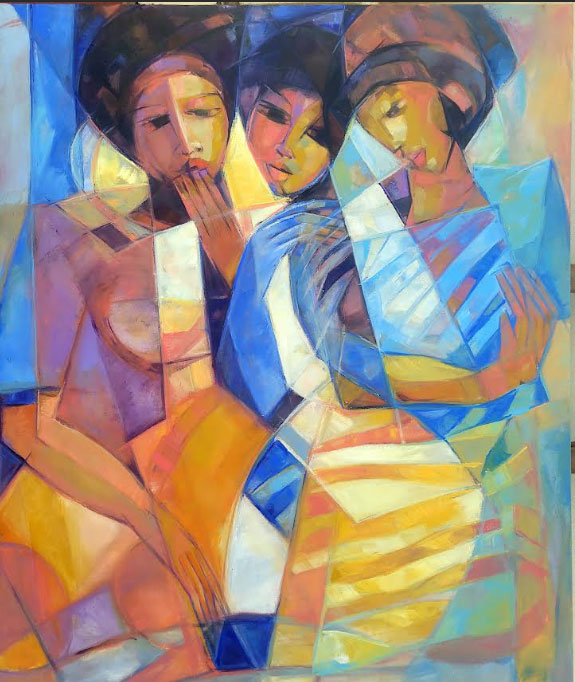
But a more interesting aspect of Lubowa’s paintings is how he integrates and includes the theme of transition on canvas. In spite of the physical transition where the artist has retired from art teaching at Margaret Trowel School of Industrial and Fine Arts Makerere and is now a full-time artist, artistically he has transitioned in the way he composes his compositions to emphasize the aspect of dialogue between the painting and the viewer.
As such, through his cubist style Lubowa hides the subject matter in his paintings by breaking his figures into geometrical shapes to create an impression of multiple figures or objects that emerge from one single painting. Although the artist has always worked with this style, this time on can discern a sense of maturity and refinement in the technique, perhaps ushered in by his newly found freedom from the many distractions that come with regular teaching engagements at the university. Notably, the theme of rhythm and vigour that permeates in his paintings this time is profound, especially in the new body of work created during this period of retirement.
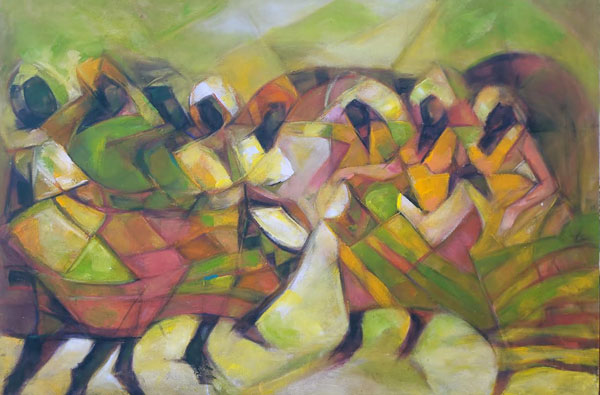
Dancing to the molody by Paul Lubowa. COURTESY of AKA Gallery
The act of inclusion of the theme of transition into his work demonstrates Lubowa’s open-mindedness, which is another quality of a good artist. Through this acceptance of new ideas, the artist is able to self-discover himself and consequently build new confidence for himself both as an artist and individual. As such, it is not surprising that Lubowa strongly believes that retirement is a period for self-discovery and renewal of the mind to confront new life challenges. This is a departure from the popular belief that retirement is a period to sit back and relax or, in unfortunate circumstances, to wallow in regret about what one did not do or achieve during their employment.
In this, the title ‘Transition’ takes on a metaphorical meaning besides its literal meaning of a process of changing from one state, place or form to another, to mean a moment of self-discovery, resilience and perseverance that is critical to the artist’s art-making process. Lubowa’s new approach on canvas during this period of retirement clearly demonstrates this type of shift where he revisits his old works to find inspiration in them to create new works but also refine them with his newly found vitality and concentration. As such, the artist uses this exhibition not only to showcase his new body of work and new approaches on canvas but also to inspire his contemporaries and many of us to embrace this critical phase in human life, which contributes to our maturity and growth.
******
The exhibition Transition is showing now at AKA gallery located on Plot 44 Bukoto Street next to Alliance Francaise and Goethe Zentrum Kampala, Kamwokya. The gallery is open Tuesday- Saturday 10 am- 5pm.