The Independent Uganda: You get the Truth we Pay the Price


As Museveni takes the oath for his seventh term, let’s reflect on his achievements over the past six terms.
COMMENT | NANTEZA SARAH KYOBE | On May 12, 2026, Yoweri Museveni will take the oath of office for a seventh time as president of Uganda. Statistics show that 75% to 80% of the country’s population was born after 1986 and, therefore, is the only president a majority of Ugandans have known. The majority have grown, studied, graduated, and given birth to children under his regime. I can’t describe what life was like under the previous regime, even though I was born there; I only know it from Google or from people who experienced it.
Over the past six terms of his rule, Museveni has contributed positively to his country. A few challenges that need to be addressed remain; the most significant is corruption, which is hindering development.
Museveni has been spot on, particularly about the country’s peace and security. The country is experiencing relative peace and security, with a strong, professional army and a police force that maintains order. Before he took power, the country had experienced several civil wars. He suppressed the conflicts that began during his regime, including the Northern Uganda Conflict (1986–2006), waged by the Lord’s Resistance Army (LRA), led by Joseph Kony, and Alice Auma’s Holy Spirit Movement.
Security under the previous regime was poor. Roadblocks were the order of the day, manned by the army; soldiers would stop cars and buses and take whatever they wanted, robbing people in broad daylight. At night, it was a different story; soldiers would knock on people’s doors, asking in Swahili for money. No wonder many older people do not want to associate themselves with Swahili, saying it’s a language for thieves.
It is a different story today: there are no roadblocks; people move freely 24/7, assured of security from the police and the army, and mingle with security personnel freely.
Road construction is another plus for Museveni. As I speak, Uganda has over 6,000 km of paved roads, connecting district to district and border to border, making trade and movement of people smooth. The most recent major projects include the Kampala-Entebbe Expressway and the Kampala Northern Bypass,
The movement of people and goods in the past regime was difficult because many roads were made of murram. Only about 1,175 to 1,500 km of roads were paved
For example, my first time trip to my village, Muwanga, Kiboga district, was a bad experience around 1997 because of the dusty murram road. Now we enjoy a Tarmac Road up to Katera, where we branch off to our village Muwanga, which I call “Kaalo matendo”.
I have even heard stories that if one had to travel to and from Kampala, it took a week or more because of the poor roads.
The government’s heavy investment in roads and transportation has enhanced connectivity between regions, making travel easier for citizens and promoting trade.
This expanded road network has not only facilitated commerce but also increased access to services such as education and healthcare.
Parents can now access any school of their choice across the country due to improved road connectivity. I attended secondary school in Mukono District at St. Joseph’s SSS Naggalama, travelling all the way from Entebbe because of good road connectivity.
On the education side, Museveni’s government introduced Universal Primary Education (UPE), which greatly increased primary school enrolment, making education more accessible. This has enable many pupils across the country to express themselves in English using basic English
Following UPE’s success, Universal Secondary Education (USE) was introduced, providing free secondary education to many students who had completed primary school. One of my work colleagues is a proud advocate of government-free education.
Primary schools have been established in every parish and a secondary school in each sub-county, and about 90% of sub-counties now have a secondary school.
The gender gap in education has narrowed, shifting from 70% boys and 30% girls to 55% boys and 45% girls. Girls lacking formal education have been skilled through the President’s initiative to skill the girl child.
Schools, both secondary and primary, have been built. Over 117 Seed secondary schools have been constructed under the Uganda Intergovernmental Fiscal Transfers (UgIFT) program.
Despite the challenges still present in the education system, we have seen an educated nation so far, given what has been accomplished in the education sector.
In health, a lot has been achieved, although a challenge remains: public allegations that health facilities lack medicines.
Life expectancy in Uganda has increased significantly, reaching approximately 68–69 years as of 2024–2025, according to the national census reports. This improvement, up from 43 years in 1986.
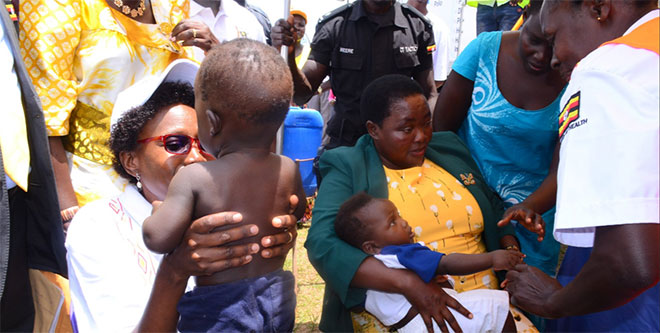
A Health Center III (HCIII) has been established in every sub-county and a Health Center IV (HCIV) in each county, ensuring that even remote populations have access to healthcare. Many HCIIIs are being upgraded to HCIVs with surgical theatres and ambulance services to improve emergency care. Regional hospitals, like Moroto Hospital, have been modernized to reduce congestion at Mulago.
The COVID-19 pandemic created major challenges worldwide. In Uganda, President Museveni swiftly imposed border closures, travel restrictions, and curfews to control the virus.
His tactics worked wonders; he even received a global award at the First International Post-COVID Conference for his effective COVID-19 management.
Fighting HIV/AIDS is another area where Museveni has achieved major success in health.
The Presidential Fast-Track Initiative to eliminate HIV/AIDS, the “ABC” approach (Abstinence, Be Faithful, Condoms), and the establishment of the Uganda AIDS Commission (UAC) have led to 97% of people living with HIV being virally suppressed. The national HIV prevalence among adults has declined to 4.9%, and new infections have decreased from 96,000 in 2010 to 37,000 in 2024.
Yes, there may still be challenges the president needs to address in the coming seventh term, but that doesn’t diminish his credit for the massive gains achieved so far.
 Nanteza Sarah Kyobe works with Uganda Media Centre