 The Independent Uganda: You get the Truth we Pay the Price



COMMENT | CRISPIN KAHERU | Anyone who watched Olara Otunnu face the UN General Assembly in this week’s interactive dialogue saw something different in modern diplomacy. He answered hard questions without notes, without hedging, and without losing his composure, meeting probing queries from ambassadors with clarity and, occasionally, his characteristic flash of humor.
In a process that has produced plenty of rehearsed talking points from other contenders, his ease stood out, and it should matter to the 193 governments now deciding who leads the world body into a dangerous decade.
What many may not know is that Otunnu is not auditioning for the UN Secretary General job that he has only studied from the outside. He has lived inside nearly every part of the UN system for more than four decades.
He was Uganda’s ambassador to the UN in the early 1980s, presided over the Security Council, chaired the UN’s top human rights body, and served as Uganda’s foreign minister during the 1985 Nairobi peace talks that sought to end the bloody Ugandan Bush War. Well, that negotiation ultimately collapsed, but it placed Otunnu at the center of one of Africa’s most consequential attempts at brokered peace, an early lesson in the limits and possibilities of diplomacy that few of his rivals for the top UN job can claim.
Kofi Annan later made him the first UN Under-Secretary-General for Children and Armed Conflict, a post he held from 1997 to 2005. In that role he put child soldiers and attacks on schools onto the Security Council’s permanent agenda and built the monitoring system, anchored in Resolution 1612, that still tracks violations against children in war zones today. Now, that is not a talking point. It is a functioning piece of UN machinery that has outlived his tenure by two decades. That is proof of concept, proof that his ideas survive contact with bureaucratic reality.
Until recently, when he began to speak about it publicly, few delegates knew that the very procedure used to select every Secretary-General since 1981, the confidential straw-ballot system, was invented by Otunnu himself. As Security Council president that December, he devised it to break a deadlock over choosing Javier Pérez de Cuéllar. He designed the mechanism the UN still uses to pick its own leader. That is the kind of structural problem-solving the UN needs now, when deadlock, not disagreement, is its biggest enemy.
I liked the way Otunnu pivoted his recent community work into an anchor for his ambition to lead the UN, and rightly so. He has spent the last five years living in northern Uganda, helping communities rebuild after two decades of war left by the Lord’s Resistance Army. That is a region once shattered by exactly the kind of protracted, low-visibility conflict the Security Council too often deprioritized in favor of headline crises. Now, a Secretary-General who has walked, slept, and lived in that reality understands something that maps, briefings, or even media reports may not teach.
Sceptics will note his age, 75, making him the oldest candidate in the field. But age paired with an unmatched institutional memory is an asset when the UN faces its most consequential leadership transition in a generation. Early Security Council straw polls show him trailing better-funded campaigns from Latin America, which only underscores why broader support, from Kampala to Kingston, from small island states to landlocked nations, from wealthy capitals to fragile ones, matters now. This is not a regional contest disguised as a global one. It is a test of whether the UN wants a technician or a builder of consensus.
Wars in Ukraine, Gaza, Sudan, and the Sahel are testing whether the UN Charter still means anything. Artificial intelligence, climate shocks, and economic fragmentation are all reshaping every assumption the UN was built on.
Otunnu’s candidacy offers something distinctive. It offers a leader tested across peace negotiations, human rights institutions, and grassroots recovery, who has already proven he can turn deadlock into agreement. Member states from every continent, peaceful and war-torn, rich and poor, should recognize that pedigree now, while there is still time to choose it.
****
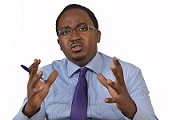
The author is a member, Uganda Human Rights Commission (UHRC)
What does “good” peace negotiation look like?
Olara Otunnu studied at Oxford alongside Tony Blair. But when it came to resolving real-world conflicts, their paths couldn’t have been more different.
When Tony Blair became British Prime Minister, he took on a brutal, 30-year conflict in Northern Ireland. He tirelessly brought deeply divided factions to the negotiating table, took immense political risks, and successfully delivered the 1998 Good Friday Agreement—ending the violence for good.
In contrast, look at Olara Otunnu’s record as Uganda’s Foreign Minister. He negotiated the 1985 Nairobi Peace Accord between the government and the NRA rebels. Instead of delivering peace, that agreement collapsed almost immediately, escalating the civil war and plunging Uganda into further bloodshed.
Before we rush to claim Otunnu is the right fit to lead global diplomacy at the UN, we must examine his actual track record in his own backyard. If you want to know what effective peacebuilding looks like, look at Tony Blair’s legacy in Northern Ireland—not the failed diplomacy of his Oxford classmate in Uganda.