 The Independent Uganda: You get the Truth we Pay the Price


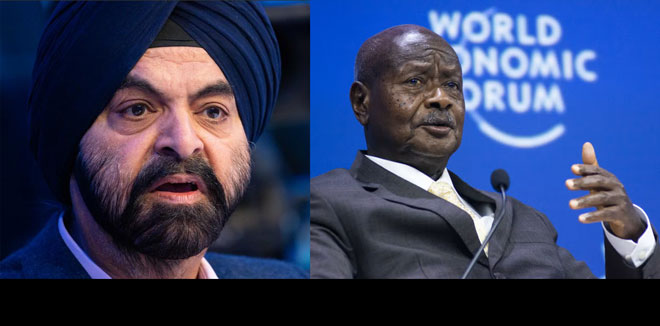
COVER STORY | For a decade, President Yoweri Museveni has promised, and repeatedly proclaimed, Uganda’s arrival in the lower-middle-income club. The World Bank keeps saying not yet. Behind the numbers lies a deeper contest over growth, population, political legacy and who gets to define Uganda’s economic progress, reports Ronald Musoke.
For President Museveni, who has been in power uninterrupted for 40 straight years, Uganda’s journey to lower-middle-income status has become more than an economic target. It is a measure of distance travelled.
When he took the oath of office for a fifth consecutive five-year term in May 2016, Museveni promised that Uganda would attain middle-income status by 2020. The optimism was partly fuelled by an expected oil windfall, which the government expected by 2019. He told his outgoing Cabinet that Uganda’s economic prospects were about to change dramatically: oil money, he said, would allow the government to finance infrastructure without relying so heavily on borrowing.
But the deadline passed without the promised arrival. Then, six years later, Museveni declared victory. Addressing the nation on June 7, 2022, he said Uganda’s GDP per capita had reached US$1,046, above the US$1,036 threshold he cited for lower-middle-income status.
“We have now passed that figure. Congratulations,” he said. The declaration was important politically. Museveni presented it as fulfilment of Point Five of his ruling party, the NRM’s 10-Point Programme (the construction of an independent, self-sustaining national economy). But the celebration lasted only days before the numbers themselves became contested.
On June 30, 2022, the World Bank published its 19th Uganda Economic Update, a periodic report that the World Bank does for member countries to analyze recent macro-economic development, near-term outlook, and structural policy challenges.
Its calculation placed Uganda’s gross national income (GNI) per capita at about US$840, well below the World Bank’s lower-middle-income threshold. The Bank’s assessment was blunt: Uganda’s economy was growing too slowly, while its population was growing too quickly, and the country would therefore take longer to make the transition. The clash that followed was not merely between a President and an international financial institution. It was a clash between two ways of describing the same country.
The Bank that wouldn’t say “Congratulations”
The World Bank’s position was not that Uganda had made no progress. It was quite the opposite. Its 2022 classification statement acknowledged that Uganda’s GNI per capita had improved significantly over several decades. But it added a crucial caveat: progress had slowed in recent years while Uganda maintained a high population-growth rate. The bank said deeper reforms would be needed to accelerate GNI per capita.
To the World Bank, that distinction matters. Its classification system is not designed to measure how impressive Uganda’s economic growth has been since 1986. It asks a narrower question: what is the country’s income per person, using the same methodology applied across economies?
The Bank uses GNI per capita, rather than GDP per capita, and converts it into dollars using the so-called Atlas method—a “smoothing” technique used to gauge the size of member country economies and classify them by income level using GNI per capita in American dollars.
Its classification for 2022, based on FY2020/21 data, placed Uganda at US$840 and therefore in the low-income category. But the Bank’s resident economists said something broader too. Seven months before Museveni’s declaration, Richard Walker, then a World Bank senior economist and co-author of the Uganda Economic Update, had warned that Uganda was moving more slowly than its ambitions suggested.
“Even with higher growth prospects, per capita GDP will remain well below the target of the Third National Development Plan (NDPIII), meaning Uganda will now take longer to become a lower-middle-income country,” he said.
Then came the list of obstacles: “Significant uncertainty remains on the evolution of COVID-19; weather shocks are a perennial threat; while lower revenues, spending pressures and adjustments to the government’s debt profile could jeopardize Uganda’s hard-earned macroeconomic stability.”
Uganda’s statistical counterattack
The government did not accept the bank’s verdict. On July 6, 2022, the Uganda Bureau of Statistics’ (UBOS) executive director, Dr Chris Mukiza (PhD) told journalists that Uganda was already within the lower-middle-income threshold. He accused the World Bank of using the wrong parameters.
The government’s objection had several components. It argued that the World Bank was working with FY2020/21 data, whereas Museveni’s announcement relied on the more recent FY2021/22 figures. UBOS also challenged the population denominator. The World Bank had used a UN mid-year population estimate of 47.1 million for Uganda, while Uganda’s official projection for the same period was 42.4 million, a difference of 4.7 million people. That is not a minor statistical footnote.

If national income is the cake, then population is the number of people among whom the cake is divided. A smaller denominator produces a larger slice for each person. And Uganda’s disagreement with the World Bank therefore contained a paradox: the fight over the denominator was, in effect, a fight over Uganda’s place in the global income hierarchy. The two institutions even met at the Ministry of Finance on July 4, 2022 to try to synchronize the figures. No joint press statement emerged. The numbers remained politically charged.
But the bank’s economists were pointing somewhere else. In the 2021 Uganda Economic Update, the bank said the recovery was being weakened by COVID-19, rising poverty and household vulnerability, widening inequality and threats to human capital development.
Rosemary Mukami Kariuki, then World Bank Country Manager for Uganda, argued that a sustainable recovery required “prudent and transparent fiscal and debt management”.
The following year’s update was even more pointed. The Bank estimated Uganda’s GNI per capita at about US$840 and said it had increased only marginally. Growth was projected at 3.7% in 2022, well below the more than 6% expected before the pandemic.
Kariuki warned: “Rising commodity prices and the overall increase in cost of living pose new risks to livelihoods…” She argued that these shocks threatened to stall socio-economic transformation and called for measures to protect vulnerable households while managing debt and inflation.
The bank’s prescriptions went beyond macroeconomics: improve domestic revenue mobilisation, strengthen public-investment management, rationalize public expenditure, invest more strongly in human capital, improve the business environment and promote trade and investment.
In other words, the World Bank’s argument was not simply that Uganda needed a higher number. It was that Uganda needed an economy capable of generating sustained, broad-based income growth for a rapidly expanding population. That distinction may explain much of the friction. Museveni’s political narrative is about the transformation of Uganda. The Bank’s classification is about the income accruing per Ugandan.
The Togolese lesson
There is, however, a complication that makes Uganda’s objections to the denominator more interesting. This year’s World Bank classification published in July offers an African example in which population statistics really did help determine a country’s movement into a higher income group. Togo moved from low-income to lower-middle-income status. But it did not happen simply because Togolese incomes suddenly surged.
According to the World Bank’s analysis of the 2026–27 classifications, the country’s 2022 census led to an 11.7% downward revision of its population estimate. Since income classifications are calculated per person, the smaller population pushed Togo’s per-capita income high enough to cross the threshold.
That is striking when read against the 2022 Uganda dispute. Uganda’s government had argued that the World Bank’s larger population estimate depressed its per-capita figure. Togo’s experience demonstrates that population revisions can indeed materially affect a country’s income classification.
But there is an important difference. Togo’s classification changed within the World Bank’s own methodology, following new census evidence. The Bank did not abandon GNI or the Atlas method. It revised the underlying population data and applied the same rules. That distinction is crucial. It suggests that the real issue for Uganda is not necessarily that the World Bank’s methodology is incapable of recognising progress. Rather, the quality and comparability of the underlying national statistics can themselves become decisive.
The Bank’s 2026 review illustrates the point further. Togo was one of six economies to move into a higher income group, but the reasons varied dramatically. Vietnam’s rise reflected sustained export-led growth; the Philippines recorded broad-based expansion; Sri Lanka recovered from a severe economic crisis; Micronesia benefited from steady post-pandemic growth; and Jordan crossed the threshold after a national-accounts rebasing found its economy was nearly 10% larger than previously estimated. There was no single road into the club. And there was no special exemption for any country.
So why does Museveni want the Middle-Income label so badly?
This is perhaps the most intriguing question. Museveni’s repeated declarations suggest that lower-middle-income status has become a political symbol as much as an economic classification. The President has been in power since 1986.
The NRM’s central political claim is that it rescued Uganda from political instability, economic collapse and insecurity and then put the country on a path of sustained transformation. Lower-middle-income status offers a conveniently measurable endpoint to that narrative.
It is easier to tell voters that Uganda has moved from low-income to lower-middle-income than to explain a more complicated record of GDP growth, productivity, poverty, debt, human capital and inequality. Museveni himself makes the connection explicit.
In this year’s State of the Nation Address, he described Uganda as having been “metamorphos[ed]” into a lower-middle-income country through peace and the NRM’s boona bagaggawale—wealth-for-all—programme.
The word is revealing. Metamorphosis suggests a fundamental transformation: Uganda is no longer the country Museveni inherited. And there is considerable truth in the claim that Uganda’s economy has changed profoundly.
The World Bank itself acknowledges the country’s substantial long-term improvement in GNI per capita. Its disagreement is over whether Uganda has crossed this particular statistical threshold, under this particular methodology, at this particular point in time. That makes the politics of the argument more complicated. Museveni is not necessarily fighting over a meaningless number. He is fighting over the date at which the transformation becomes officially recognizable.
The economist who is less interested in the argument
For independent development economist Dr Fred Muhumuza, he offers a useful counterweight to both sides. His scepticism dates back to 2016, when Museveni was projecting lower-middle-income status by 2020.
Dr Muhumuza warned that Uganda would need an enormous expansion in GDP simply to keep pace with population growth. At the time, he pointed to the country’s poverty and vulnerability levels and questioned whether the target was realistic.
Dr Muhumuza’s broader argument is uncomfortable for a political narrative built around a single classification: a country can cross an income threshold without ordinary citizens necessarily experiencing a transformation commensurate with the label. That is also implicit in the World Bank’s own explanation of its system. Income classifications are useful for comparison and for guiding some aspects of lending policy, but they are not intended to capture every dimension of development or welfare.
The World Bank’s classification system itself acknowledges that GNI per capita does not measure inequality or provide a complete picture of development. This matters because Uganda’s argument risks becoming a debate over status rather than substance. A lower-middle-income classification would be politically significant. But it would not automatically mean that Ugandan households are prosperous, that poverty has disappeared, that productivity has surged, or that human capital has caught up with countries in the same income category.
The uncomfortable arithmetic of growth
There is perhaps a simpler way to understand why Uganda keeps getting close to the milestone and then falling short. Population growth matters. The World Bank has repeatedly highlighted Uganda’s rapid population growth as one of the reasons strong economic growth has not translated into sufficiently rapid per-capita income growth.

In 2021, the Bank said Uganda’s economy had been growing at rates insufficient to reach the middle-income target, while population growth was working in the opposite direction. The same logic appears in later updates. In the 2024 Uganda Economic Update, the Bank reported that rapid population growth had partially offset rising output even as per-capita income improved to about US$980, bringing Uganda closer to the lower-middle-income threshold. That is the paradox at the centre of Uganda’s economic story.
The economy can grow. GDP can rise. The government can point to new infrastructure, oil-related investment, expanding services and industrial activity. Yet if the number of people grows nearly as rapidly, the amount of income available per person moves much more slowly. For Museveni, that can look like an unfair refusal to recognise Uganda’s transformation. For the World Bank, it is precisely the transformation that matters: can economic growth outrun population growth sufficiently to raise incomes on a sustained basis?
Not a verdict on Uganda
The temptation in this debate is to choose sides. Either the World Bank is being stubborn and bureaucratic, refusing to acknowledge Uganda’s economic progress; or Museveni is manipulating statistics to manufacture a political victory. The evidence suggests something less dramatic and more interesting. Both sides are measuring something real.
Museveni is right that Uganda’s economy is dramatically larger and more diversified than it was when the NRM came to power. UBOS is right that population estimates and reference years can materially alter per-capita calculations. The World Bank is right that its income classifications need a common methodology if they are to be comparable across countries.
And the World Bank’s economists have a substantive argument beyond the classification itself: Uganda’s challenge is not simply to make GDP bigger, but to generate sustained per-capita income growth, broaden the productive economy, improve human capital, mobilise domestic revenue and manage debt.
Togo’s experience reinforces another point: statistical revisions can change a country’s classification. But Togo crossed the threshold because its new population data were incorporated into the same World Bank framework—not because the framework was bent to accommodate the government’s preferred conclusion. That may ultimately be the lesson for Uganda.
The most convincing way to become lower-middle-income may not be to win the argument over the definition. It may be to make the argument irrelevant. If Uganda can sustain sufficiently strong growth in incomes per person, improve productivity, manage its population dynamics, strengthen human capital and maintain credible national statistics, there will eventually be little room for disagreement over the label, a Kampala-based economist told The Independent.
Until then, Museveni and the World Bank are likely to continue having the same conversation; each armed with numbers, but asking subtly different questions about what those numbers mean. And that leaves the provocative question with which Uganda’s long middle-income journey began: Who gets to call Uganda middle income? Perhaps the more important question is whether, by the time everyone agrees on the answer, ordinary Ugandans will actually feel middle-income.


This is indeed an article written by a beautiful mind for beautiful minds. Leaving the bragging aside, the core of the debate should be at the question why the World Bank prefers the 2020/2021 population data and not the fresher 2021/2022 population data. Both our Statisticians and the World Bank’s seem to agree on everything but the set of data to use for the denominator. They both agree that Uganda’s economy has morphed, and the ball clearly is in the World Bank’s court to clarify why they prefer older data to the fresher data set.