The Independent Uganda: You get the Truth we Pay the Price


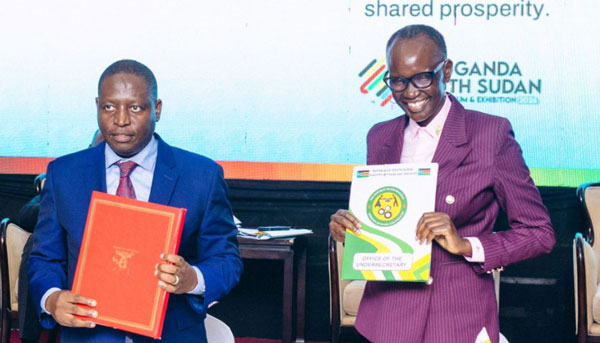
Kampala, Uganda | NEWS CORRESPONDENT | Uganda and South Sudan have signed a memorandum of understanding (MoU) on trade, with officials saying joint technical committees will be set up to oversee its implementation and tackle delays and costs facing traders on the route between the two countries.
The deal was signed on Wednesday in the Ugandan capital, Kampala, at the second Uganda-South Sudan Business Forum and Exhibition, held at Mestil Hotel under the theme “Easing the Cost of Doing Business and Unlocking Regional Market Opportunities for Uganda and South Sudan”.
Uganda’s Minister of State for Industry David Bahati and South Sudan’s Minister of Trade and Industry Dr Labanya Margaret Mathya signed the agreement, which officials said covers trade promotion, information exchange, investment facilitation and follow-up on agreed commitments.
Uganda’s Ambassador to South Sudan Brigadier General Ronnie Balya said the joint technical committees were intended to ensure “there is no laxity” once delegates return home. He said they would be backed by a joint communique, a roadmap with timelines and measurable outcomes for resolving border issues, and regular review meetings.
Bahati said the agreement must be judged by what it achieves. “We should judge the success of the MoU not by the signing ceremony alone,” he said, adding that the test would be the trade barriers resolved, the investments realised, the businesses established and the jobs created.
He said the deal should provide a practical foundation for regular consultations and a systematic forum for agreeing commitments between the two governments.
Bahati said trade remains heavily one-sided, with Uganda exporting goods worth $524m to South Sudan while South Sudan exports $22m worth to Uganda. “We need South Sudan. As much as you need us, we also need you,” he said, attributing part of the gap to population, which he put at 46 million for Uganda and 12.4 million for South Sudan.
He said Ugandan traders and transporters continue to report delays linked to South Sudan’s electronic permit system, repeated cargo verification, multiple checkpoints, unofficial charges and inconsistent clearance procedures along the Kampala-Gulu-Nimule-Juba corridor.
Bahati called for an urgent review of the e-permit system to improve transparency, end duplicate assessments and payments, clarify charges and establish a way of resolving disputes. He said a one-stop border post Uganda built at Elegu could not deliver its full benefits without matching facilities and coordinated operations at Nimule, on the South Sudanese side.
He also urged the two countries to trade goods they produce themselves rather than re-export imports, and to cooperate on steel production, saying Uganda spends about $1bn a year on steel imports and that both countries have large iron ore deposits.
Dr Labanya thanked Uganda for hosting her delegation and said Uganda remains one of South Sudan’s priority trading partners and the source of most of its goods. She obtained both her master’s and bachelor’s degrees in business administration from Makerere University.
She said a high-level committee set up by President Salva Kiir, on which she sits, was working to reduce non-tariff barriers. Alien registration had been abolished and hurdles around visa payments removed, she said, though foreigners working in South Sudan still need work permits.
Her assurances follow concerns among Ugandan traders ahead of the forum, after Juba disowned a threat to bar foreigners from the retail trade.
Dr Labanya acknowledged security concerns in some parts of South Sudan but said full flights and buses into Juba showed the capital was safe. She pointed to Ugandan chapati makers across the country and a Juba market in Konyokonyo known for Ugandan goods as signs of how closely the two economies are linked.
“South Sudan welcomes all investors of every kind,” she said, adding that Kiir was committed to continued trade between the two countries.
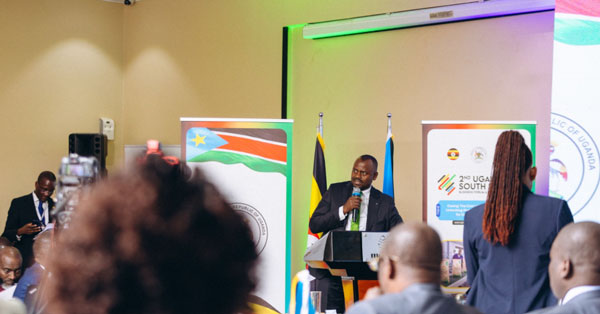
Uganda’s Minister of State for Foreign Affairs in charge of Regional Cooperation Haruna Kasolo Kyeyune, who closed the forum, said the agreement was a positive step but that its value would depend on follow-through.
“The significance of the MoU will ultimately depend on its implementation,” Kasolo said. He urged ministries and agencies in both countries to coordinate closely, set clear follow-up arrangements and keep the private sector involved, adding that commitments under the East African Community and the Common Market for Eastern and Southern Africa (COMESA) remained key tools for removing trade barriers.
Brig Gen Balya, who has served as ambassador in Juba since 2017 and previously headed Uganda’s Internal Security Organisation, said the forum was a chance for both business communities to take stock. “Are we progressing? Are we degenerating? Are we stagnating?” he asked.
The record is mixed. When the forum was launched in 2022, Uganda said it planned to increase its trade volume with South Sudan from $400m to $1bn. Uganda’s finance ministry now estimates annual exports to South Sudan at about $500m, while UN figures show South Sudan exported about $21.5m worth of goods to Uganda in 2025.
Brig Gen Balya said the committees and roadmap form part of wider efforts following a meeting in Juba last year between President Yoweri Museveni and Kiir, at which the two leaders called for joint border meetings on trade, security and immigration. An upcoming Joint Permanent Commission meeting is expected to take those efforts further, he said.
South Sudan’s Ambassador to Uganda Paul Malong Akaro defended the e-permit, saying it had improved revenue collection and border clearance since it was launched jointly with the Uganda Revenue Authority last year. He urged the revenue authorities of both countries to resolve future concerns through existing mechanisms.
Akaro said South Sudanese traders have their own grievances, saying they are unable to buy directly from Ugandan manufacturers and distributors and that Juba-based transporters from other neighbouring countries appear to monopolise the supply of Ugandan goods.
“Our traders don’t have access to manufacturers to buy goods from Uganda,” he said, adding that the issue had been raised with Uganda’s trade ministry.
He also asked the Uganda National Bureau of Standards and the South Sudan Bureau of Standards to address difficulties faced by South Sudanese exporters of dried fish transiting Uganda to the Democratic Republic of the Congo. “South Sudan remains open for business,” he said.
Vincent Bagiire Waiswa, the Permanent Secretary in Uganda’s Ministry of Foreign Affairs, said the first forum, held in Juba in July 2022, had given both sides a platform to engage on economic issues, and that he hoped the Kampala meeting would resolve some of the challenges facing traders.
South Sudan, which gained independence from Sudan in 2011, joined the East African Community in 2016. Both countries are also members of the Intergovernmental Authority on Development (IGAD).