The Independent Uganda: You get the Truth we Pay the Price


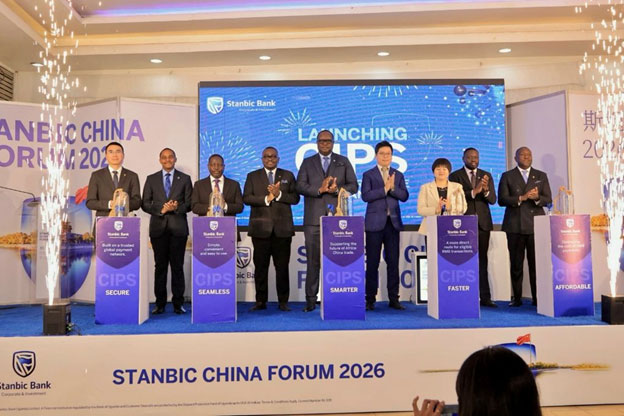
Stanbic’s China payment link is set to ease the country’s trade friction with Beijing
Kampala, Uganda | THE INDEPENDENT | Ugandan businesses trading with China are set to gain faster access to yuan payments after Stanbic Bank Uganda became the country’s first lender to connect to China’s Cross-Border Interbank Payment System, or CIPS.
The move could remove one of the less visible costs of Uganda’s growing dependence on Chinese goods: the complexity and currency risk involved in paying suppliers.
Ugandan importers have traditionally routed China-bound payments through correspondent banks, often converting shillings into US dollars before settling invoices in Chinese yuan. The additional transaction can increase costs, delay settlement and expose companies to movements in the dollar-shilling exchange rate.
Direct yuan settlement through CIPS allows participating banks to bypass some of those intermediaries and settle transactions through China’s official cross-border payment infrastructure.
That matters in a trade relationship heavily tilted towards China. Uganda imported about $3.3bn of goods from China in 2025, compared with exports of only $118mn, according to figures cited at the launch.
The imbalance has made China one of Uganda’s most important commercial partners, while also highlighting the country’s reliance on Chinese manufactured goods, machinery and other imports.
Stanbic Uganda chief executive Mumba Kalifungwa said direct renminbi settlement would reduce foreign exchange volatility and speed up payments.
“The system will give Ugandan businesses a competitive edge,” he said, adding that it would support the government’s ambition to expand the economy to $500bn by 2040.
Beyond cheaper payments
The significance of CIPS extends beyond reducing the cost of individual transactions. For importers, faster settlement can improve cash-flow planning and potentially shorten the time between paying suppliers and receiving goods. Exporters could gain quicker access to proceeds from Chinese customers.
The system may also reduce the operational burden on banks by limiting the number of correspondent relationships needed to complete cross-border transactions.
CIPS, launched by the People’s Bank of China in 2015, has become a central part of Beijing’s efforts to increase the international use of the renminbi and reduce reliance on traditional dollar-based payment channels.
For African economies, that push coincides with a rapid expansion of commercial ties with China. David Bahati, Uganda’s minister of state for industry, said the payment system could help address some of the financial and information barriers that have constrained trade between the two countries.
“China is one of Uganda’s most significant bilateral partners,” Bahati said. “This solution removes key bottlenecks and opens practical pathways for deeper industrial and commercial collaboration.”
The larger question is whether improved payment infrastructure can help Uganda extract more value from its relationship with China.
Africa’s trade with China has expanded rapidly, but much of the continent’s exports remain concentrated in commodities, while Chinese manufactured goods dominate imports. That imbalance has fuelled calls for greater investment in local manufacturing, processing and value addition.
Andrew Mashanda, Standard Bank Group’s head of business and commercial banking for Africa regions and offshore, said the next phase of Africa-China relations would need to move beyond trade volumes.
“The next chapter will be defined not just by trade volumes, but by what we build together,” he said, pointing to manufacturing, value addition and infrastructure.
Stanbic’s CIPS connection forms part of a wider strategy to deepen commercial links. The bank has also partnered with Guomao, a platform connecting Ugandan businesses with one of Beijing’s major wholesale markets.
For Uganda, the immediate benefit of CIPS is likely to be practical rather than transformative: fewer intermediaries, faster payments and potentially lower currency exposure.
It will not, however, narrow the country’s trade deficit with China by itself. The longer-term test will be whether easier financial links help Ugandan companies move beyond importing Chinese goods towards building businesses capable of selling more products and services into the Chinese and wider Asian markets.