 The Independent Uganda: You get the Truth we Pay the Price


But the virus is still advancing next door in DRC
Kampala, Uganda | RONALD MUSOKE | Uganda finally got the Ebola declaration it had effectively claimed for itself a month earlier. On Thursday, Aug. 27, the World Health Organization (WHO) and the Africa Centres for Disease Control and Prevention (Africa CDC) formally declared Uganda free of the Bundibugyo virus outbreak after the country completed the internationally recognised 42-day period without a new confirmed case.
This time, the announcement came with the congratulations that were conspicuously absent when Uganda made its own declaration on July 28. From Geneva, the WHO Director-General, Dr Tedros Adhanom Ghebreyesus, praised Uganda’s response.
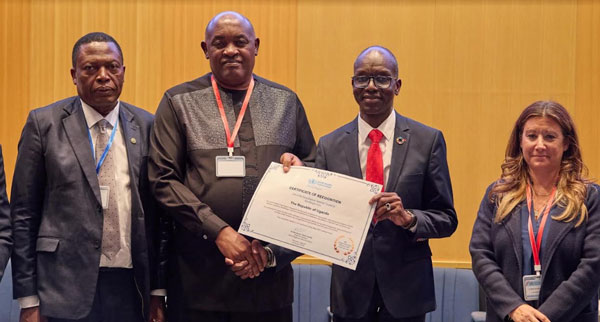
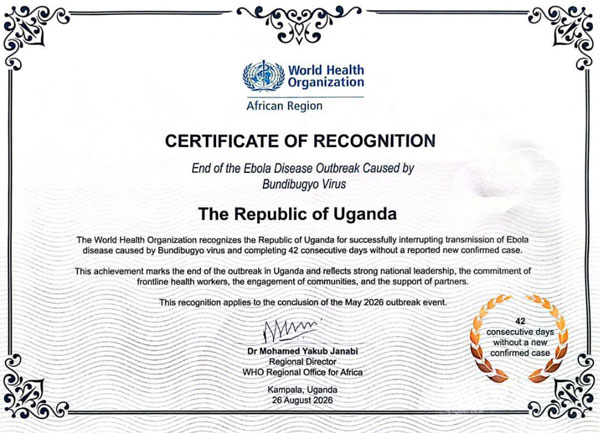
From Brazzaville, the WHO Regional Director for Africa, Dr Mohamed Janabi, described the end of the outbreak as an important milestone, and from Addis Ababa, the Africa CDC Director-General, Dr Jean Kaseya, hailed Uganda’s achievement as an important lesson for the continent. A formal certificate was presented to Uganda’s Minister of Health, Dr. Chris Baryomunsi in Kampala. The difference in tone from a month ago was striking.
On July 28, Uganda’s Ministry of Health announced that the country was Ebola-free, saying it had successfully completed what it described as the mandatory 42-day monitoring period. The ministry argued that the outbreak was fundamentally different from previous Ebola outbreaks because it arose from a fully documented importation event whose transmission chains had been identified and reconstructed.
There were no official congratulatory messages then from Africa CDC in Addis Ababa, WHO’s Africa office in Brazzaville or the WHO headquarters in Geneva. On Aug. 27, however, the international health authorities were unequivocal. Uganda had met the international benchmark.
The July declaration that raised eyebrows
Uganda’s 2026 Ebola outbreak was declared on May 15 after cases were imported from the Democratic Republic of Congo. The country eventually recorded 20 confirmed cases, 15 of them imported from the DRC and five locally acquired among contacts and health workers linked to those imported cases. Eighteen people recovered and two died. More than 800 contacts were identified and monitored. The outbreak was therefore closely linked to an epidemic unfolding across Uganda’s long western border.
But Ugandan health authorities argued that they had something that is not always available during an Ebola outbreak: a high degree of epidemiological certainty. The source of infection was known; the route of introduction had been established, confirmed cases were epidemiologically connected, transmission chains had been reconstructed, contacts had been identified and followed, and enhanced surveillance had detected no unexplained community transmission.
The Ministry also pointed to advances in molecular diagnostics, genomic sequencing, digital surveillance and real-time contact tracing as tools that had transformed the ability to determine whether transmission was continuing. It acknowledged that the 42-day rule remained an important safeguard, particularly where transmission is uncertain, but argued that a fixed time interval should not necessarily be the only basis for determining that transmission has ended when an imported outbreak has been fully characterised.
That was the basis for Uganda’s July announcement. It was not simply a declaration made in ignorance of the international standard. It was a challenge made to whether that standard should always be applied in precisely the same way when modern epidemiological tools provide a much clearer picture of an outbreak. But international certification follows its own rules.
However, WHO says the 42-day countdown, twice the upper limit of Ebola’s incubation period, is the internationally established benchmark for determining that transmission linked to an outbreak has ended. So, while Uganda announced the interruption of local transmission on July 28, surveillance continued.
The last imported patient had been discharged on July 16. Uganda then completed the additional monitoring period without detecting another case. On Aug. 27, there was nothing left for WHO and Africa CDC to wait for. The formal international declaration was announced.
The voices behind Uganda’s victory
Dr Tedros framed the achievement as evidence that Ebola can be controlled rapidly when countries invest in preparedness and act decisively. “Uganda has demonstrated that with decisive action, Ebola outbreaks can be brought under control quickly,” he said.
That is an important endorsement because Uganda’s success was not based on one intervention. It involved case detection and confirmation, contact tracing, isolation and clinical care, infection prevention and control, community engagement and surveillance in health facilities and at points of entry.
Dr Kaseya, the Africa CDC chief, went further, putting the Ugandan experience in a continental context. “Uganda has shown that Ebola can be stopped when leadership acts decisively, communities are trusted and public health systems reach people quickly,” he said.
In other words, Ebola outbreaks are not controlled through laboratories and isolation centres alone. They depend on people reporting illness, accepting contact tracing, cooperating with health workers and trusting public-health messages.
Dr Janabi, the WHO Africa regional director, offered another interpretation of the achievement. “Ending an Ebola outbreak is an important milestone, but the lasting achievement is a stronger ability to protect people from future health threats,” he said.
That may be the most consequential measure of Uganda’s 2026 experience. The question is not merely whether Uganda stopped this outbreak. It is whether the systems built and strengthened during the response will remain sufficiently strong to detect and stop the next imported case.
Uganda’s success meets the DRC’s crisis
That question is unavoidable because the outbreak that seeded Uganda’s epidemic is still raging in the DRC. Indeed, the juxtaposition could hardly be more dramatic. On the same day that Uganda received its formal international all-clear, the UN Secretary-General, António Guterres, was warning that the Ebola outbreak in the DRC was spreading faster than the response to contain it.
“The outbreak is the fastest-growing Ebola epidemic on record,” Guterres said. “It is growing faster and wider than the response to contain it. But it can be stopped.”
As of Aug. 25, according to Guterres, the DRC had recorded 5,713 confirmed cases and 2,744 deaths. That is no longer simply a neighbouring country’s public-health problem. For Uganda, it is a continuing security challenge—one that cannot be resolved by the completion of a 42-day countdown.
WHO and Africa CDC themselves acknowledged this when celebrating Uganda’s achievement. They noted that close social and economic ties; frequent population movement and cross-border trade mean neighbouring countries remain at risk of imported cases.
The numbers from Uganda tell the story. Fifteen of its 20 confirmed cases were imported from the DRC. In other words, the border was not an abstract risk during this outbreak. It was the route through which the overwhelming majority of Uganda’s cases arrived. That makes the reopening and continued movement across the Uganda-DRC border particularly significant.
Uganda cannot realistically seal itself off from the DRC. Families live on both sides, traders cross, workers move, communities interact, and economic activity depends on the border. And WHO does not recommend blanket travel or trade restrictions, border closures or denial of entry to travellers from affected countries.
Instead, it calls for proportionate public-health measures, including surveillance, rapid investigation of alerts, testing capacity, infection prevention and control, community engagement and cross-border coordination. That creates a delicate balancing act. Uganda must allow ordinary life and commerce to continue while ensuring that the end of the current outbreak does not become the beginning of another one.
The danger of celebrating too early
This is perhaps where the July episode acquires a deeper significance. Uganda’s argument in July was that the epidemiological evidence was already strong enough to establish that transmission had ended. The formal August international declaration demonstrates that the evidence held up through the additional international monitoring period. So, in retrospect, Uganda’s confidence was not followed by a resurgence of cases. But the episode also illustrates why the international 42-day benchmark remains useful. It creates a common standard.
It gives governments, neighbouring countries, health workers, travellers and international partners a clearly understood point at which an outbreak can officially be considered over. And it provides time for surveillance to catch transmission that may otherwise go unnoticed.
Uganda’s experience does not necessarily undermine that system. Instead, it raises a more interesting question about how scientific advances might eventually influence the way such standards are applied. For now, the rule remains. And Uganda has now met it.
Uganda’s western border remains the real test
The more immediate concern is what happens next. Africa CDC’s Dr Kaseya congratulated Uganda but immediately turned attention toward the DRC, saying the continent would only be secure when transmission was stopped everywhere. That is perhaps the most important message to emerge from Thursday’s declaration. Uganda’s outbreak is over. Uganda’s vulnerability is not.
The country has demonstrated that it can stop an imported Ebola outbreak quickly. But as long as the DRC epidemic continues to expand, Uganda will remain exposed to new introductions. The challenge will be to ensure that the surveillance systems, points-of-entry monitoring, laboratories, contact-tracing capacity and community networks developed during the outbreak remain active even after the headlines fade.
The international health agencies have already called for precisely that: continued disease surveillance and testing, rapid investigation of alerts, strong infection prevention and control, sustained community engagement and close coordination across borders. The lesson of 2026, therefore, is more complicated than a simple victory story. Uganda has shown that Ebola can be contained. It has shown that an outbreak imported across a porous border does not have to become a national catastrophe.
It has shown that decisive government leadership, public-health infrastructure and community cooperation can break chains of transmission. But it has also demonstrated how little geographical distance matters when an epidemic is raging next door. The 42-day countdown has ended in Uganda, but the countdown to the next potential importation has not. And that is why Uganda’s most important achievement may not be the certificate presented in Kampala on Aug. 27, but whether the country can preserve the vigilance that made that certificate possible.


The outbreak of Ebola continues in the Democratic Republic of the Congo (DRC). According to the UN Secretary General, the scale of the crisis has been underestimated by the world community, and there are sorely insufficient forces and means to combat the epidemic. The extract is taken from the Internet.
And I can beat Ebola absolutely for free, but first I will need to create a vaccine medicine from my strongest, acquired, trained t-cell immunity, proven by seven immunograms, two consultations with an immunologist made by one doctor and three general blood tests. If necessary, these documents will be submitted. And it’s very easy to create a medicine in two ways. If I have to get Ebola, I will get over it in a very mild form, as happened with the coronavirus, I got over it in a moderate form very easily in three days. When I get over Ebola, isolate B lymphocytes or monoclonal antibodies from my blood and read the code from them to make artificial monoclonal antibodies and B lymphocytes and clone them in a bioreactor
I suffer from three diseases: olivopontocerbilar degeneration, diabetes insipidus, and diabetes mellitus