The Independent Uganda: You get the Truth we Pay the Price


Kampala, Uganda | PATRICIA AKANKWATSA | A flagship agricultural cooperation programme between Uganda, China and the Food and Agriculture Organisation (FAO) of the United Nations formally entered its close-out phase, with officials signalling a shift from implementation to scaling and sustainability of results achieved over more than a decade.
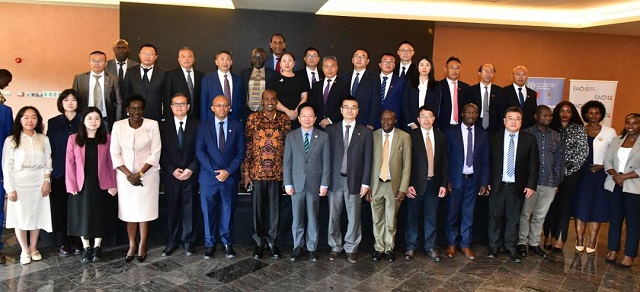
The FAO–China South–South Cooperation (SSC) Project was officially concluded at a high-level workshop held on April 16 at Speke Resort Munyonyo, bringing together government officials, development partners, researchers and farmer representatives.
Launched in 2012, the programme has run through three phases, positioning Uganda as the longest-standing beneficiary of the FAO–China SSC framework. Over that period, dozens of Chinese experts were deployed across the country to support technology transfer, farmer training and value chain development in crops, livestock and aquaculture.
Speaking at the closing event, Hon Frank Tumwebaze, Minister for Agriculture, Animal Industry and Fisheries (MAAIF), described the initiative as a model of practical cooperation among developing countries.
“For a long time, Uganda and China have enjoyed a warm relationship that has resulted in strong partnerships such as the FAO–China South–South Cooperation Project,” Tumwebaze said.
“This project has demonstrated how countries of the Global South can share knowledge and technology to transform agri-food systems for mutual benefit.”
He said the programme directly supported Uganda’s agro-industrialisation agenda by strengthening priority value chains including rice, millet, sorghum, chilli, livestock and fisheries sectors critical for rural livelihoods and food security.
According to the minister, the partnership has contributed to the development and adoption of improved technologies, including high-yielding crop varieties such as hybrid rice (WDR 73), foxtail millet and chilli, as well as livestock innovations like the Jianzhou “big-eared” goat.
“These achievements are testimony to a mutually beneficial partnership,” he said, adding that the collaboration had also opened new trade opportunities. Uganda has in recent years signed export protocols for products such as chilli and Hass avocado, while commodities like coffee continue to gain access to the Chinese market.
However, Tumwebaze cautioned that future progress will depend on accelerating the adoption of modern agricultural technologies, particularly as traditional production factors come under pressure.
“Land is no longer expanding, and labour is increasingly scarce,” he said. “We must adopt technologies that enable us to produce more from less mechanisation, irrigation, and modern inputs will define the future of sustainable production.”
He added that the government intends to integrate innovations from the project into national programmes such as the Parish Development Model (PDM) and the Fourth National Development Plan (NDP IV), with a focus on scaling successful interventions.
The Food and Agriculture Organization (FAO) said the project has also been notable for its financing model and level of national ownership.
Ezana Kassa, FAO Representative in Uganda, noted that Uganda became the first country in the Global South to co-finance the initiative through a unilateral trust fund marking a shift toward shared responsibility in development partnerships.
“Today’s event is a moment to consolidate the outcomes of the tripartite review and formally close this phase of the project,” Kassa said.
“Uganda remains one of the strongest examples of effective South–South cooperation in agriculture.”
He added that FAO would continue to support the government in ensuring that gains made under the programme are sustained and expanded.
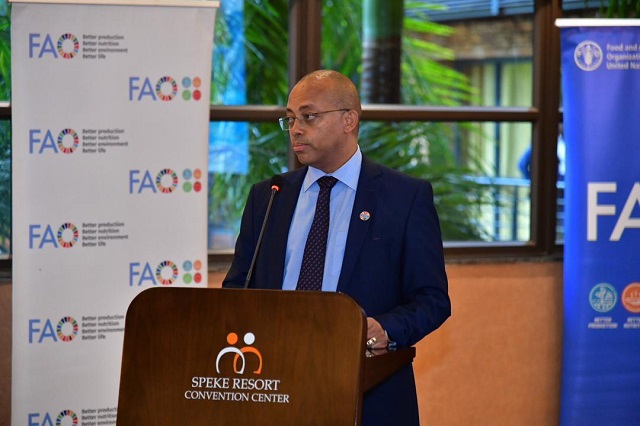
From the Chinese side, Ye Anping, Director of the South–South and Triangular Cooperation Division at FAO, highlighted the scale of technical support provided over the years.
“In total, more than 50 Chinese experts have been deployed to Uganda across the three phases,” he said.
“They have worked closely with national and district counterparts to design interventions based on farmers’ needs and local conditions.”
Ye said the programme’s integrated approach combining classroom training, field demonstrations and farmer-to-farmer exchange had been key to enabling adoption of new technologies.
At the implementation level, officials stressed that embedding project activities within national systems would be critical to sustaining results.
Samuel Muloma, a technical counterpart from MAAIF’s Department of Production, said the next step is to mainstream the programme’s interventions into existing policy frameworks.
“We need to integrate these activities into government programmes like the Parish Development Model and NDP IV,” Muloma said.
“Scaling should be done carefully, based on where technologies are appropriate, supported by further adaptive research.”
Martin Ameu, Assistant FAO Representative (Programme), emphasized that the project’s design had already factored in sustainability by aligning interventions with government priorities and institutions.
“Results are more sustainable when they are embedded in national systems,” Ameu said.
“What FAO will continue to do is provide technical support, track outcomes, and work with government to mobilise resources for scaling up.”
The United Nations Resident Coordinator, Leonard Zulu, framed the close-out as a transition point rather than an endpoint.
“The measure of success will not only be what we document today, but what we carry forward,” Zulu said.
“We must remain ambitious in sustaining and scaling these efforts.”
He pointed to opportunities to expand the programme’s impact through improved product quality, increased production volumes and stronger compliance with export standards, particularly under preferential trade arrangements.