The Independent Uganda: You get the Truth we Pay the Price



Kampala, Uganda | PATRICIA AKANKWATSA | Uganda’s national statistics body is moving to formalise its collaboration with cultural institutions as part of a broader strategy to improve data collection, quality and use at the community level.
The Uganda Bureau of Statistics (UBOS) hosted a delegation from the Tooro Kingdom on Wednesday to finalise discussions on a Memorandum of Understanding (MoU) aimed at strengthening statistical production between the two entities.
The planned agreement builds on earlier engagements between UBOS and cultural institutions, which have increasingly been seen as critical partners in closing data gaps, particularly in hard-to-reach communities.
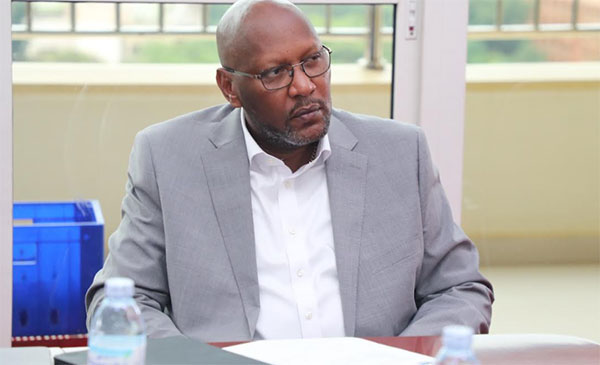
Speaking after a courtesy meeting with Tooro Kingdom officials, UBOS Executive Director and chief statistician Dr Chris N. Mukiza said the collaboration is part of a wider push to decentralise data systems and improve the reliability of administrative data.
“This afternoon we are honoured to host the Prime Minister of the Tooro Kingdom, who paid a courtesy call to the Government of Statistics. He came with his Minister of Lands and Housing to discuss matters of statistical development. We have covered several areas of cooperation,” Mukiza said.
He noted that UBOS has already been working with cultural institutions to strengthen statistics at the grassroots, citing previous engagements, including a meeting held on April 30, 2024.
“As you know, the Bureau in its coordination role is working with the current institutions to strengthen statistics, especially at the community level. We last had a meeting on 30th April 2024 about this cooperation. In fact, the Cabinet of Tooro played a very big hand in ensuring the successful conduct of the 2024 National Population and Housing Census,” he said.
Mukiza also pointed to the role of the kingdom in supporting enumeration efforts. “What I didn’t tell you, Prime Minister, is that we visited when we were training, and the Tooro Kingdom had the most sprint enumerators during training. During others, they would come and disappear, but here, as I have explained, they gave us very little hard time,” he said.
He added that the next phase of collaboration would be formalised through an MoU defining roles and responsibilities.
“So, we agreed to start a formal relationship through Memorandum of Understanding that will define each of us, our roles and obligations.”
At the centre of the partnership is a shift toward enabling institutions at the local level to generate and manage their own data, particularly administrative data produced through routine operations.
“Statistics, once somebody knows how to manage the simple data, can be produced better by the producers of those statistics. The administrative data is the data that you generate by your administrative or operational actions. And that’s where much of the activity is taking place,” Mukiza said.

Under the proposed arrangement, Tooro Kingdom will establish a dedicated statistics committee and eventually a full statistics unit to manage data collection and processing within its jurisdiction.
“So, the next step will be to agree on areas of cooperation. We have agreed to set up a statistics committee in Tooro Kingdom and eventually a statistics unit,” he said.
UBOS will then aggregate this locally generated data into a national database while supporting digitisation and standardisation.
“So, the MOU will help us to generalise and modernise the data and statistics from the administrative actions. As I told you, we need to digitise whatever we do. In the form, it brings efficiency.”
He added that decentralised data production would also improve ownership and use of statistics at the source.
“And in addition, to ensure that the producers of statistics process and own them and utilise them at the source. They understand better.”
UBOS argues that working through cultural institutions could significantly improve both the quality and cost-efficiency of data collection.
“Partnerships are a way to go. Because, first of all, the response rate from the members of the kingdom or the cultural group to their leaders or to the people they have sanctioned is much more likely to be higher than that of people who are coming from elsewhere to interview you,” Mukiza said.
He noted that this approach would reduce logistical costs associated with deploying enumerators from central locations.
“So, we are sure that it will improve the volume of the data which are produced, the quality of the data and the cost effectiveness. Instead of me now getting a lot of people from here and transporting them to Tooro Kingdom to collect that data, they will be doing their work. They will get the data, and for me, I will be getting it digitally to have a national-level database.”
The model also allows for the creation of parallel local databases within cultural institutions.
“But also, they will be having a local database within their own jurisdictions.”
Mukiza emphasised that the partnership would not impose additional financial burdens on the government.
“Actually, the cost of partnership is very minimal compared to no partnership at all,” he said.
“There is no additional financial implication for partnerships. In fact, the long-term benefit is that the cost will be minimised.”
UBOS has already begun rolling out similar arrangements with other cultural and regional institutions across the country.
The agency has established or is in the process of setting up statistical units in areas such as Bunyoro, Busoga and Bugisu, with plans to extend the model further, including collaboration with the Inter-Religious Council of Uganda.
The initiative aligns with broader decentralisation efforts within UBOS, including the establishment of regional offices to support local data systems.
For policymakers, the move is also tied to Uganda’s ability to meet international reporting obligations.
“You know that we have 201 data points in SDG that we are supposed to report on. However, we are at 148 now,” Mukiza said, referring to the United Nations Sustainable Development Goals framework.
“We will be able to buy administrative data from these institutions.”
He added that the long-term ambition is to move beyond administrative data toward more advanced systems.
“We should even improve from moving from admin data to harnessing big data. Through machine learning, AI and data science.”
The Prime Minister of Tooro Kingdom, Rt Hon. Calvin Armstrong Rwomiire Akiiki, welcomed the partnership, saying it would strengthen planning and decision-making within the kingdom.
“And we are here today to say we are ready to work with you, boss, and effectively put this collaboration on paper in an MOU, send an MOU, a partnership of our work together,” he said.
He emphasised the importance of data in governance.
“You said earlier in your remarks that you can’t manage what you can’t measure, and that’s very critical because we have quite a few issues that we need to digitise, to understand. And censuses will help us identify those issues and measure the impacts of our interventions, and we look forward to your support in ensuring that that happens.”
Rwomiire said the engagement marks both a continuation of earlier discussions and a renewed push to implement agreed priorities.
“So, this has been, as you mentioned, a courtesy call, but also exploring those opportunities that were discussed in 2024 and ensuring that they’re implemented.”
He added that the kingdom is now better prepared to operationalise the partnership.
“I think the change in leadership is partly of concern, but also the change of vision. We looked at creating structures and systems as a priority so that when we do these relationships, we are more prepared. So that caused us to go back to the drawing board, and now we are ready to proceed.”
The proposed UBOS–Tooro partnership reflects a growing recognition that effective planning depends on reliable, localised data systems.
By embedding statistical capacity within cultural institutions, UBOS hopes to close persistent data gaps, improve response rates, and ensure that data is not only collected but also used at the community level.