 The Independent Uganda: You get the Truth we Pay the Price


Labour minister challenges NSSF to move beyond custodianship, become an economic catalyst
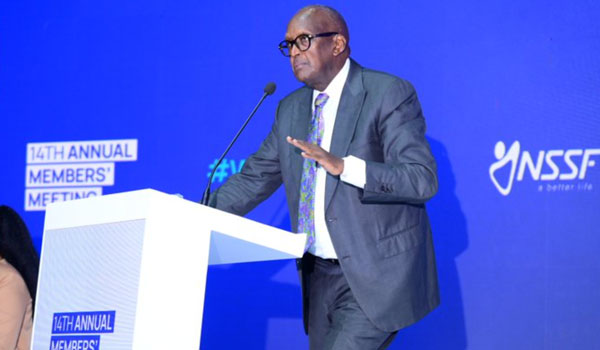
Kampala, Uganda | THE INDEPENDENT | Gender, Labour and Social Development Minister Lt.Gen Henry Tumukunde has challenged the National Social Security Fund (NSSF) to abandon its parastatal mindset and become a driving force in Uganda’s economy, warning that competence and not entitlement must determine who sits on the board and manages the fund.
Speaking at the 14th NSSF Annual Members’ Meeting in Kampala on Thursday, Tumukunde delivered a blunt assessment of the Fund’s role despite its strong financial performance, repeatedly questioning whether NSSF is doing enough with the billions under its management.
“Are you helping the economy grow?” he asked. “This money is for contributors. It should be turned around to its level maximum. Are you doing exactly that?”
Tumukunde said NSSF must stop seeing itself simply as a custodian of savings. “You can’t just be custodians of funds. This money should be turning around the economy,” he said. “The fund must be felt in the economy. It must be a driver in this economy.”
He pointed to other countries where pension funds play a central role in economic transformation. “Ask outsiders what runs their economies — Zambia, America. Pension funds are an important driver to turn around an economy,” he said. “The earlier you adapt to my thinking the better.”
Tumukunde suggested the Fund’s very name should change to reflect a more active role. “We should change names — National Social Custodians Fund,” he said, arguing that the current approach is too passive. “You must prove that this money is being maximally deployed, not just protectively defended.”
The minister directed sharp criticism at NSSF’s governance structure, questioning whether board members and management are selected on merit or retained out of habit.
“Why do you have to maintain people in your machine just because they started with you? Why is it a fait accompli — you are there, you are there?” he asked. “People must compete to stay in the fund. I’m the one who appoints the board; you must have horizontal exits. People must leave if they don’t qualify to stay any more.”
Tumukunde singled out the composition of the board, challenging the assumption that trade union affiliation alone qualifies someone to oversee a multi-trillion shilling institution. “This is workers’ money. Don’t you think you should also qualify to be a board member?” he asked. “We can’t leave it laissez-faire that for as long as you can assemble a trade union then you qualify to be a board member. Even among trade unions there are members who can compete to be members of the NSSF board. Why can’t they be given a chance to compete? This cannot be a space of incompetence or permanent retention.”
He warned that he would be questioning the permanent elements of the board. “You must qualify to preside over such a big institution like NSSF,” he said. “I don’t mind fighting these battles. You can’t protect what you have no competence to protect.”
Tumukunde also raised concerns about the divided oversight of NSSF between the gender and finance ministries. “I can’t pass a budget and you spend it without my consent. It doesn’t make sense,” he said. “I must be asked whether this money should be spent. I must get to understand why it is being spent. I must protect workers’ interests which you also purport to protect.”
Private Sector Mindset
The minister urged NSSF to adopt the discipline of a private financial institution. “Are you trying to bring yourself to a typical private running enterprise or are you simply a parastatal protecting the gains?” he asked. “You get money from the public, you invest in the most risk-averse asset. If you were to be evaluated by a properly running company — people who know exactly what they are doing — how would they rate you?”
He dismissed the argument that the Fund’s growth is an achievement in itself. “The economy is growing, salaries are growing, so it shouldn’t surprise us when the fund grows. But this fund must change. This fund must change. I don’t see the stories of success.”
Tumukunde also issued a warning to employers who fail to remit workers’ contributions, saying non-compliance should carry consequences for their trading licences. “If they don’t pay, it must affect their licensing. We should send their names to the Ministry of Trade and they will be de-licensed,” he said.
The minister closed with a direct challenge to the Fund’s leadership. “I can’t afford to be polite. For the few years I will be here, you must perform,” he said. “NSSF must see itself not simply as a custodian of savings but a catalyst of Uganda’s economic growth.”
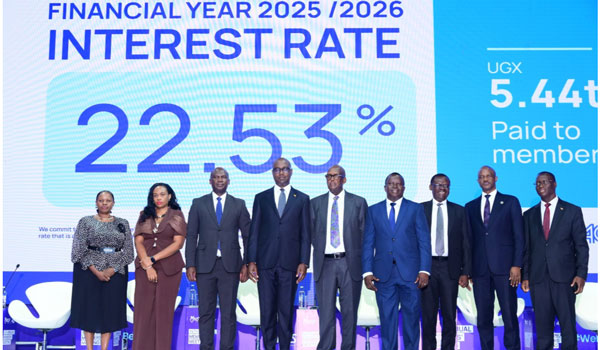
The remarks came despite NSSF declaring a record 22.53% interest rate for the 2025/26 financial year, with assets under management growing to Shs32.8 trillion. Fund Managing Director Patrick Ayota assured members their money is safe, citing strong performance in regional stock markets and currency appreciation as key drivers of the Fund’s growth.
*****
RELATED STORY

I feel like this time around heads might roll at the fund, how can someone be a board member for six terms nonstop?