The Independent Uganda: You get the Truth we Pay the Price


✳ Year – Interest
2012 ✅10.00%
2013 ✅11.23%
2014 ✅11.50%
2015 ✅13.00%
2016 ✅12.30%
2017 ✅11.23%
2018 ✅ 15%
2019 ✅ 11%
2020 ✅ 10.75%
2021 ✅ 12.15%
2022 ✅ 09.65%
2023 ✅ 10.00%
2024 ✅ 11.50%
2025 ✅ 13.5%
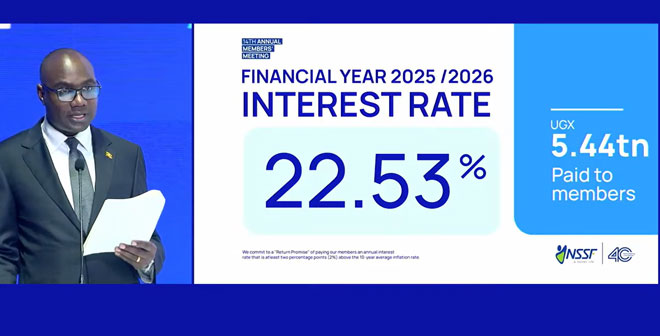
2025 ✅ 22.53%
Kampala, Uganda | URN & THE INDEPENDENT | The National Social Security Fund (NSSF) will pay a 22.53 percent interest rate to its member-savers for the year 2025/2026.
Announcing the interest rate at the 14th Annual Members’ Meeting today, Henry Musasizi, the Minister of Finance, Planning and Economic Development, said this was based on the good performance of the Fund.
The interest payout would total 5.44 trillion shillings, the highest interest and volume paid in the history of the fund.
For the year 2024/2025, NSSF declared an interest rate of 13.5 percent, which in value terms was about 2.5 trillion shillings.
NSSF recorded an 86 percent surge in annual revenues to a record 6.51 trillion shillings, while assets under management rose from 26 trillion shillings to 32 trillion. Member contributions rose 13 percent to 3.4 trillion, while 1.5 trillion shillings was paid out to qualifying savers.
Speaking about the revenue performance, Managing Director Patrick Ayota said the growth of the economy, the good performance of the stock markets in East Africa, where NSSF has invested significantly, as well as the appreciation of currencies against the Ugandan shilling, among others.
The Fund aims to expand its active membership to 15 million savers by 2030, according to its 10-year strategic plan, and scale total assets to 50 trillion and eventually 80 trillion shillings by 2035.
Henry Tumukunde, the Minister for Gender, Labour and Social Development, challenged the NSSF Board and Management to make sure that the value of the Fund (about 9 billion dollars) is reflected in the national development agenda.
He asked them whether they felt that they were investing the money to make the best return out of it. “This money should be turning around the economy. It must change the economy!”
Gen Tumukunde also urged them to move away from a “Parastatal style” of management to a private sector mindset of management.
“If you see someone not performing to your expectations, just let them go,” he said, calling for hiring on the basis of competence l, and not just academic papers.
“If you are going to interview somebody on his competence, you must have the competence yourself,” he challenged the board.
Earlier, MD Ayota had listed the government infrastructure projects that are in the pipeline for the Fund to finance, including the highly touted Kampala-Jinja Expressway.
David Ogong, the chairman of the Board of Directors, also informed the audience that their investment efforts can only go as far as the law allows, despite the Fund having more investable resources.
While urging NSSF on efforts to expand membership coverage, the Minister vowed to have defaulting employers deregistered by the Ministry of Trade.
”I give you powers, those of you who I control. Bring them to me, and we shall recommend to the Ministry of Trade to have their trading licenses revoked,” he said.
Finance Minister Musasizi commended the NSSF for its investments in government programmes, adding that the ministry would continue to support the fund to balance its investments with creating value for the savers.