The Independent Uganda: You get the Truth we Pay the Price


Kampala, Uganda | PATRICIA AKANKWATSA | For years, cooking at Buwambo Seed Secondary School depended on a resource increasingly difficult to justify: firewood.
The school spent about Shs10 million each term on firewood sourced from surrounding communities, while kitchen staff worked around smoke, soot and the disruptions that come with burning wood, according to headteacher William Kiwanuka Kasule..
That has now changed.
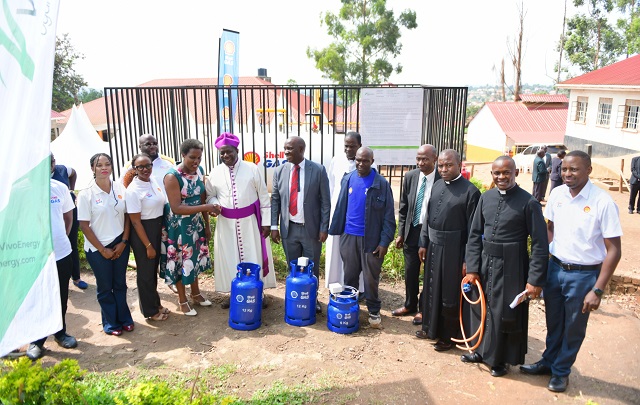
The school has switched to LPG under a Shell Gas bulk installation commissioned by Vivo Energy Uganda, placing it among a growing number of Ugandan schools moving away from biomass fuels as institutions look for cleaner and more efficient ways to prepare meals.
The installation is part of Vivo Energy Uganda’s push to expand LPG use beyond households and into institutions, including schools, hospitals and commercial facilities.
The company says the Buwambo installation is designed for large-scale cooking and includes a bulk storage tank, pressure regulation equipment, gas piping, isolation valves, emergency shut-off systems, leak detection and firefighting equipment.
The shift also reflects a wider policy challenge for Uganda, where schools and other institutions remain heavily dependent on firewood and charcoal despite the health and environmental costs associated with biomass cooking.
“At Vivo Energy Uganda, we believe energy has the power to transform lives beyond mobility. By supporting schools with safe and reliable Shell Gas solutions, we are helping create healthier learning environments, improving operational efficiency and contributing to Uganda’s transition towards cleaner sources of energy”, said Joanita Mukasa Menya, Managing Director of Vivo Energy Uganda.
“ We are proud to partner with educational institutions that are embracing innovation while safeguarding the wellbeing of their learners, staff and surrounding communities. This investment reflects our long-term commitment to supporting national development through sustainable energy solutions,” she added.
Lowering the cost of switching
The business challenge for many schools is not necessarily the willingness to adopt cleaner cooking technology, but the upfront cost.
Vivo Energy says it is responding to that barrier by taking on much of the capital cost of installations at schools that may not be able to finance them independently.
Under the arrangement, the company provides major components including the gas tank, piping and burners, while the school is required to construct a kitchen compatible with the system and purchase LPG from the company.
Menya said Buwambo Seed Secondary School is the first government-funded school where the company has installed the system under this approach.
She said the company has seen growing interest from schools already using the technology, with existing users becoming an important source of referrals.
The company expects demand to rise further during the school holidays as institutions undertake construction and renovation work.
For Vivo Energy, the attraction of the school market is built around three considerations: environmental protection, health and safety, and the potential to save time and improve operational efficiency.
The company is now looking at another large institutional consumer of cooking fuel — hospitals.
Menya said health facilities are the company’s next target, although the expansion will require significant capital investment.
From Shs10 million in firewood to LPG
At Buwambo, the transition has already changed how the school approaches its kitchen.
Kasule said the school previously relied on firewood bought from villages around the school, with the cost reaching about Shs10 million per term.
Beyond the financial cost, the system created operational problems. Firewood takes up storage space, requires regular transportation and makes cooking vulnerable to weather conditions.
With LPG, Kasule said the school is paying a subsidised rate of 500 per kilogramme, with one refill lasting approximately a month.
The school’s overall energy expenditure remains around Shs10 million per term, he said, but the difference is in what the school gets for that expenditure.
Cooking is faster, the kitchen is cleaner and staff no longer have to contend with smoke from wood-burning stoves.
The school also expects to reduce the number of kitchen workers required because gas cooking is less labour- intensive.
The shift could become particularly useful during the rainy season, when wet firewood can make cooking difficult.
For Kasule, however, the environmental argument is just as important.
A school teaching students about environmental protection and the dangers of deforestation, he said, could not continue relying heavily on firewood without creating a contradiction between its teaching and its own practices.
The health argument
Vivo Energy says the move to LPG also addresses occupational health concerns in institutional kitchens.
Unlike biomass fuels, LPG burns with little smoke and soot, potentially improving air quality for kitchen workers who spend hours preparing meals.
“Safety remains at the heart of every Shell Gas installation we undertake. From the initial engineering assessments and system design to installation, commissioning, staff training and ongoing maintenance, we ensure that every component meets rigorous international standards”, ” said Alvin Bamutire, LPG Manager at Vivo Energy Uganda.
Our institutional LPG solutions provide schools with a dependable, efficient and safe source of energy while giving them access to continuous technical support that guarantees reliable operations for years to come”, he added.
The company says every installation undergoes engineering assessments, pressure testing, safety inspections and operational trials before commissioning. Kitchen staff are also trained in LPG handling, emergency response and routine monitoring.
Kasule described the installation as a significant change for the institution.
“The commissioning of this Shell Gas bulk installation is a transformative investment for our school. It will enable us to prepare meals more efficiently, maintain a cleaner and healthier kitchen environment, and improve the overall welfare of both our learners and staff”
“We appreciate Vivo Energy Uganda for choosing to partner with Buwambo Seed Secondary School in advancing safe and sustainable cooking practices. This investment will have a lasting positive impact on our institution,” he said.
From schools to hospitals
The initiative comes as the Government pushes for greater adoption of clean cooking technologies and reduced dependence on firewood and charcoal.
Vivo Energy has already installed Shell Gas systems at institutions including King’s College Budo, St Peter’s Bombo Kalule, Kibuli Secondary School, Kiira College Butiki, Mengo Secondary School and Nabisunsa Girls’ School.
Church leaders have also expressed interest in expanding the model to other Church of Uganda institutions.
Archbishop Rt Rev Moses Banja said the move away from wood-based cooking was important because of its effects on forests and the health of kitchen workers. He pointed to existing installations at King’s College Budo and Mengo Senior School and said he wanted to see the model extended to other church-owned schools and health facilities.
Mengo Hospital, which has already partially adopted gas cooking, could be among the institutions considered for a wider transition.
For Vivo Energy, that expansion would take the business beyond schools and into a sector where institutional kitchens consume significant amounts of energy.
The company acknowledges that converting hospitals will require greater capital expenditure, but sees health facilities as an important next step in its clean-cooking strategy.