The Independent Uganda: You get the Truth we Pay the Price


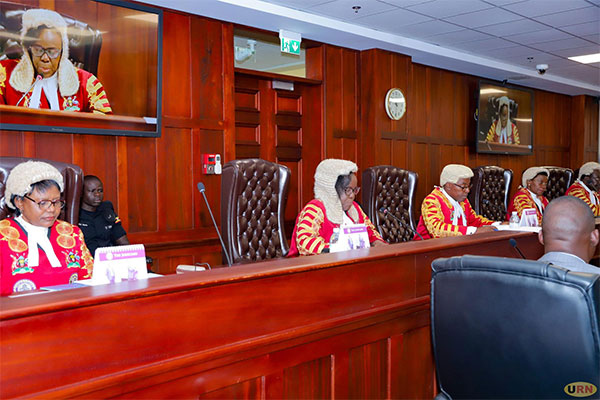
Kampala, Uganda | URN | The Supreme Court has overturned the conviction and sentence of Jackline Nakku, who had been jailed for murdering her husband. The Court held that the Court of Appeal failed to properly re-evaluate the circumstantial evidence.
Naku was left with about 4 years and 10 Months to complete her 20-year imprisonment sentence, which has now been set aside by this court.
Nakku was charged in the High Court with the murder of Ssenyonjo Eric Kiddu and, on June 12, 2019, was sentenced to 20 years’ imprisonment by Justice Suzan Okalany.
A panel of five justices that included Prof. Lilian Tibatemwa-Ekirikubinza, Percy Night Tuhaise, Christopher Izaama Madrama, Catherine Bamugemereire and Muzamiru Mutangula Kibeedi ruled that the Court of Appeal had erred in law and fact when it solely based its decision on circumstantial evidence to convict Nakku Jackline for murdering her husband, Ssenyojo Eric Kiddu.
“We hold that the Court of Appeal failed in its duty to re-evaluate the circumstantial evidence properly. The circumstantial evidence presented by the prosecution did not meet the criteria of achieving moral certainty as to the guilt of the appellant, and the rest of the evidence fails to meet the standard of proof beyond reasonable doubt,” the judgment reads in part.
According to court records, Nakku and Ssenyonjo had dated since 2013, leading to their marriage in 2015. However, their marriage developed frictions, forcing Nakku to relocate to Tanzania. Her husband had reportedly warned her employers in Uganda against employing her.
By the time she left for Tanzania, the two had had two children, whom she had left in the care of Ssenyonjo. When she returned to Uganda, she sought the intervention of police to return to her matrimonial home. Ssenyonjo accepted on the condition that they would occupy different bedrooms.
This went on until February 13, 2018, when two assailants allegedly entered their home and murdered Ssenyonjo. On the fateful day, the family had just celebrated the birthday of one of their children.
After the party, Ssenyonjo had gone out to watch football with one of his friends. When he returned at around midnight, Nakku told the court that assailants entered the house and bludgeoned him to death.
Nakku ran outside to alert neighbours without first making an alarm.
When she returned to the house with the neighbours, they found that Ssenyojo had already been killed.
She was subsequently arrested and charged with his murder. In convicting her, the High Court observed that she had acted in furtherance of a common intention with the physical assailants by opening the metallic side door for them and failing to raise an internal alarm to warn the maid or protect her husband.
The court further held that her conduct, after the offence, specifically her calm appearance and the fact that she wore slippers when fleeing, demonstrated a pre-arranged execution. She appealed both the conviction and sentence.
The court of appeal empaneled by Justices Richard Buteera, Irene Mulyagonja and Monica Mugenyi upheld the conviction and sentence arguing that the metallic side door showed no signs of forced entry, hence ruling out an external break-in and that Nakku’s mattress was neatly laid, supporting an inference that she had concealed the iron bar that was used in the murder under her bed and that her failure to alert the housemaid or children was inconsistent with innocence and that the historical marital friction established motive and malice aforethought.
But in its decision, the Supreme Court ruled that there were other more plausible explanations that the courts did not consider.
“We find that the Court of Appeal erred in law by adopting this single inference to the exclusion of other plausible, reasonable hypotheses evident on the record. The evidence demonstrates that the deceased returned home after midnight having consumed alcohol while watching a football match. It is entirely plausible that the deceased himself failed to engage the internal bolts or lock the padlock when the Appellant left him to attend to the crying child. It is equally plausible that the entrance was left unfastened by another occupant. By treating the absence of forced entry as conclusive proof of the Appellant’s active facilitation, the lower courts improperly converted mere suspicion into legal proof,” the court ruled.
It also noted that the lower courts failed to evaluate the credibility of prosecution witnesses in light of established legal principle regarding interested or hostile witnesses.
The Court held that the most critical prosecution witnesses were relatives of the deceased who seemed to hate Nakku. In their evidence, they had even alleged that one of the children was not for Ssenyonjo, which DNA tests ruled out.
“The courts below erred in attaching decisive weight to uncorroborated, biased testimony to infer motive. Moreover, the prosecution failed to call the housemaid, Akello Evelyn, an adult resident present during the incident whose evidence was essential to uncovering the truth. Unexplained omission of such a material witness entitles the court to draw an adverse inference that her testimony would have been unfavourable to the prosecution,” the court ruled. The court also noted that the sentencing of a mother to 20 years’ imprisonment when she was the children’s sole caregiver was manifestly harsh.
“In sentencing a mother, parent or primary caregiver, courts must actively evaluate the impact of a custodial sentence on dependent children and consider non-custodial options or mitigated sentences where appropriate. We therefore express our regrets about the fact that the system failed the appellant, who had submitted on the 22nd June 2026 that she was left with about 4 years and 10 Months to complete her 20-year imprisonment sentence, which has now been set aside by this court. Delays in hearing of appeals runs afoul of Article 126 (2) (b) of the Constitution which commands that “justice shall not be delayed,” the judges ruled noting that the lower courts’ failure to conduct a child welfare impact assessment regarding two infant children, one of whom suffers from a severe medical condition, would have constituted a grave omission justifying intervention by the Court of Appeal to adjust the sentence accordingly.