The Independent Uganda: You get the Truth we Pay the Price


Kampala, Uganda | NEWS CORRESPONDENT | For a woman in labour, the distance to the nearest health facility can mean the difference between life and death. Even after reaching a facility, her survival may depend on whether a skilled health worker is available, the right equipment is functioning and an effective referral system is in place when complications arise.
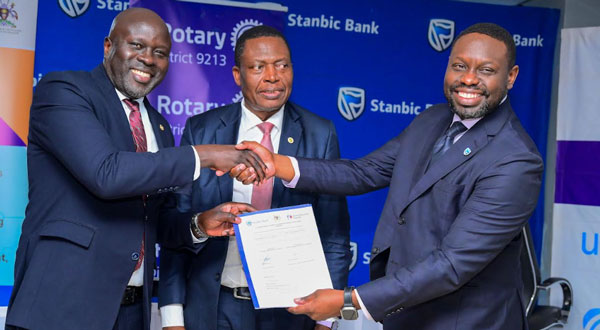
It is this reality that a new sh600 million partnership between Stanbic Bank Uganda and Rotary Mama Toto Care Uganda seeks to address, with an emphasis on strengthening existing public health facilities and reducing preventable maternal and newborn deaths.
Speaking at the signing ceremony held at Stanbic Bank’s Learning and Development Centre in Kampala, Stanbic Bank Executive Director Paul Muganwa said maternal health is not just a health issue, but a national economic priority.
“Uganda has set itself an ambitious goal of growing its economy to USD 500 billion by 2040. We cannot achieve that vision if women, who are the backbone of our families, communities and future workforce, continue to face preventable risks during childbirth,” Muganwa said.
He noted that every preventable maternal death represents not only a personal tragedy but also a loss of human capital and national productivity.
“We cannot talk meaningfully about inclusive growth while mothers continue to risk their lives simply by bringing forth the next generation. A healthy mother is the cornerstone of a productive workforce and a prosperous nation,” he added.
Muganwa said the partnership is part of Stanbic Bank’s Positive Impact Agenda, which focuses on empowering women, youth and farmers through financial inclusion, enterprise development, climate resilience, infrastructure development and corporate social investment.
Rotary District 9213
Rotary District 9213 Governor Dr Gerald Obai described the partnership as a demonstration of the power of collaboration in addressing one of Uganda’s most pressing public health challenges.
“This partnership shows what is possible when organisations come together around a shared purpose. Maternal mortality is not a challenge that government or Rotary can solve alone. It requires businesses, communities and development partners working together to save lives,” Dr Obai said.
He said Rotary’s Mama Toto Care programme continues to strengthen health systems by supporting healthcare workers, equipping facilities and mobilising communities to improve maternal and child health outcomes.
Speaking on behalf of Rotary Mama Toto Care Uganda, Magezi Ndamira said the partnership is the culmination of a journey that began in 2022, citing the programme stands with every woman of reproductive age, from expectant mothers travelling long distances to health facilities to healthcare workers who need the right skills and equipment to save lives.
“We stand with the mother who begins labour many kilometres from a health facility. We stand with the mother who arrives hoping there is equipment and skilled healthcare workers to help her deliver safely. We also stand with the midwife, the nurse and the doctor who want to save lives but need the right tools to do so,” he said.
Ndamira emphasised that every mother deserves dignity and every newborn deserves a chance at life, regardless of where they live or how much they earn.
“The value of this investment will not be measured by the amount of money committed. It will be measured by the mothers whose lives are saved, the newborns who survive and the families that go home together.”
Strengthening government health facilities
Ndamira explained that the Mama Toto Care model works through existing public health facilities rather than creating parallel systems.
The programme focuses on four pillars: training and re-skilling healthcare workers, providing essential maternal and newborn equipment, strengthening community awareness on antenatal care and safe delivery, and improving referral systems and quality of care.
“We strengthen government health facilities and equip healthcare workers who are already serving within the Ministry of Health. Our guiding principle is simple: where is the greatest need, and where can our intervention make the biggest difference?” he said.
Stanbic Bank Manager for Corporate Social Investment Diana Ondoga said the partnership directly contributes to Sustainable Development Goal 3 on Good Health and Well-being and SDG 17 on Partnerships for the Goals.
She noted that while Uganda has recorded significant progress in reducing maternal mortality, achieving global targets will require accelerated collaboration across sectors.
Dr Charles Olaro, Director General of Health Services at the Ministry of Health, welcomed the partnership, saying maternal health requires a whole-of-society approach.
“Maternal health is not the responsibility of the Ministry of Health alone. It requires government, the private sector, communities and development partners working together to remove barriers that prevent women from accessing quality care,” Olaro said.
He said partnerships such as the Stanbic-Rotary initiative complement government investments in strengthening health systems, improving healthcare infrastructure and increasing access to skilled maternal care.
The three-year partnership will support health facility upgrades, training of frontline health workers, implementation of an adopt-a-health-centre model and community mobilisation to encourage safe motherhood practices.