The Independent Uganda: You get the Truth we Pay the Price


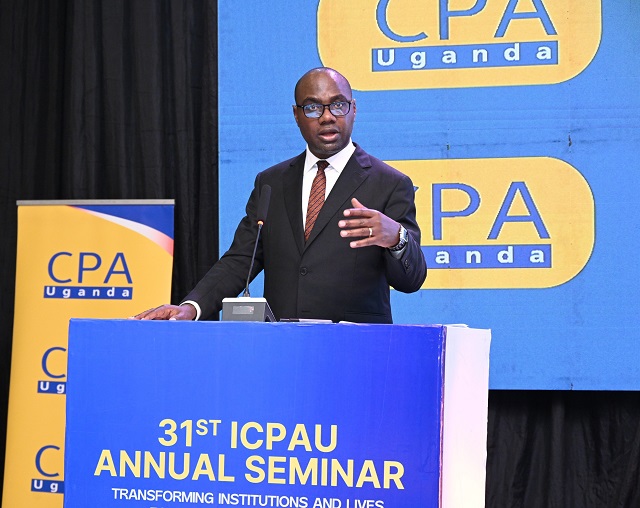
Kampala, Uganda | JULIUS BUSINGE | Henry Musasizi, the minister of finance planning and economic development has challenged accountants to move beyond traditional financial reporting and become strategic partners in safeguarding public resources, strengthening fiscal discipline and improving economic decision- making.
Musasizi said accountants have a critical responsibility to ensure public funds are efficiently managed and translated into tangible development outcomes, warning that weak financial information and poor accountability can undermine government programmes and economic growth.
He made the remarks while officiating as Chief Guest at the 31st Annual Seminar of the Institute of Certified Public Accountants of Uganda (ICPAU), held in Entebbe on Sept.2, under the theme, “Transforming Institutions and Lives for Sustainable Growth.”
Musasizi said evidence-based decision-making is essential for accelerating economic development, supporting sustainable business growth and avoiding costly policy and investment mistakes.
“Evidence-based decision making is fundamental to accelerating economic development, promoting sustainable business growth and avoiding costly policy and investment mistakes,” he said.
He noted that accountants are central to generating, analysing and validating much of the financial evidence used by governments, businesses and institutions to make critical decisions.
He therefore urged professionals to move beyond simply recording and reporting transactions and instead provide insights that can improve decisions, strengthen accountability and enhance institutional performance.
“Accountants are strategic partners in ensuring prudent fiscal management, effective public service delivery, and sustainable economic development,” Musasizi said.
In the public sector, he said reliable financial information enables government to monitor revenue and expenditure, safeguard public assets, manage liabilities and determine whether public resources are producing the intended development outcomes.
Protect public funds
Musasizi highlighted the role of accountants throughout the national budget cycle, from planning and preparation to execution, control, accountability and reporting.
He said accountants should help government track public resources in real time, monitor cash flows and expenditure limits, and identify financial commitments before payments are made.
Such measures, he said, are important in preventing the accumulation of domestic arrears and containing large fiscal deficits.
The minister also urged accountants to embrace emerging technologies, including digital financial management systems, blockchain and artificial intelligence, which he said are changing how financial information is generated, managed and used.
His call comes as the accountancy profession faces growing demands for transparency, stronger institutional governance and faster adoption of digital technologies.
Ethics amid AI
ICPAU President CPA David Timothy Ediomu challenged accountants to rethink their role as technology, evolving business models, economic uncertainty and financial crime reshape the profession.
Ediomu said professional competence must be accompanied by integrity, ethical leadership, continuous learning and attention to the overall well-being of practitioners.
He argued that accountants cannot effectively transform institutions if they neglect their own health and personal development.
“We cannot transform institutions if we neglect our health,” Ediomu said, stressing that sustainable organisations require healthy and capable professionals.
He also warned that although artificial intelligence can automate routine tasks and identify complex financial patterns, it cannot replace the human responsibility to make ethical decisions.
“Technology can make us faster. Integrity is what makes us trustworthy,” he said.
The three-day seminar, which attracted nearly 2,000 physical and virtual participants, also focused on emerging international standards, including the International Standard on Auditing for Audits of Financial Statements for Less Complex Entities, sustainability disclosures under IFRS S1 and S2, and new global internal audit standards.
Ediomu urged accountants to measure the success of the seminar not by the number of Continuing Professional Development hours earned, but by the practical changes they implement in their organisations and communities.
Meanwhile, ICPAU Chief Executive Officer CPA Derrick Nkajja said the theme speaks directly to the responsibility and opportunity before the accountancy profession today.
“We operate in an environment characterised by rapid technological change, evolving business models, economic uncertainty, heightened expectations for transparency and accountability, and increasing demand for sustainable and inclusive growth,” he said.
He added that professional accountant’s contribution must therefore extend beyond the traditional roles of financial reporting, compliance and stewardship because the professionals are uniquely positioned to shape decisions, strengthen institutions, safeguard trust, allocate resources responsibly and influence the quality of lives and communities they serve.
The annual seminar offers an opportunity to participants to reflect on how accountants can transform the institutions in which they work and, equally importantly, how professional knowledge, ethical leadership, and personal influence can transform lives.