The Independent Uganda: You get the Truth we Pay the Price


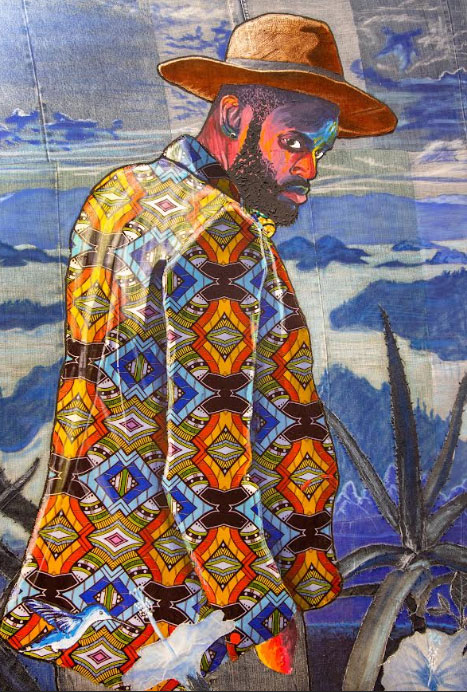
The artist works with Kitengi fabric, Denim and bark cloth to instigate conversations on the subject of African identity and the politics of decolonization of Africa.
ARTS | Dominic Muwanguzi | A self-portrait of the artist, Matt Kayem, dressed in a jacket made from Dutch wax (Kitengi fabric) and a bark cloth hat sitting on his head against a sky blue backdrop, and cutting that pose of someone who has been suddenly distracted from his garden stroll by a stranger, in this scenario, the hummingbird below the painting that is depicted flying to perch on the nectar in the vegetation, provides a window to the theme of the exhibition, In a Blue World. The solo exhibition with multidisciplinary artworks that interrogate the subject of colonial and postcolonial dominance – represented by the denim material from which the images are suspended – and how such influences the people of the Black continent is inspired by the artist’s familiar themes of Pan-Africanism and Decolonization. The material the artist works with, including Kitengi fabric, denim and bark cloth, acts as tropes, representing dominance, hybridity and cultural memory, leading to a conflagration of emotions and debate in his art .
The artist confronts the delicate subject of cultural identity, focusing on three critical components of identity: who we were, who we are and who we are becoming. Through the process of figuratively unearthing the continent’s complex realities, the artist is able to construct powerful visual narratives in his work. The self-portrait titled, The Discourteous Stranger in My Backyard, is a metaphorical representation of the inconveniences brought on African people by western political and social systems. These systems like capitalism contribute to the compromise on the African identity but also can be blamed for poor governance and the perennial plundering of the continent’s natural resources. Nonetheless, on some occasions these strangers like the hummingbird depicted in the painting, miss out on those valuable elements in these communities because they possess dismal knowledge of African cultural heritage. “There’re some of those valuable aspects of our cultural heritage these people cannot steal from us because of the limited knowledge they have about the continent,” says the artist. Bark cloth certainly is one of those treasures that are often overlooked because of its complex meaning to the identity of a number of communities across the continent. Historically, the organic material is the oldest fabric used by the Buganda of central Uganda and can be traced in other communities in Zambia like among the Bemba people and parts of Ghana. Its universal presence gives it an identity as a symbol of unification and a powerful metaphor for commonality among the different communities of the continent.
While the artist tackles the subject of intrusion and cultural collision through his art, he also casts a sharp gaze on the subject of identity shame that influences many Africans to hide their heritage. In the installation, The Need For a Bigger Bed (The Beauty Under It), the artist presents a single-sized blue metallic bed with cultural artefacts hidden beneath it. The playful title of this installation offers a glimpse into the shame some Africans harbour about their cultural identity. The need for a bigger bed, in the context of this body of work, is intended to hide those elements of African identity, like the gourds, pots, smoking pipe and masks, that many consider as primitive and satanic. Incidentally, the artist has gained a reputation within the art community and his neighbourhood for always boldly wearing cultural symbols like bronze ornaments, bark cloth and Kitengi fabrics as a statement to his identity: first as a Muganda of Buganda origin, and also as an African with strong ties to his cultural heritage. Notably, Kayem’s fusion of art and fashion speaks to his deliberate attempt to construct powerful visual narratives through the two art forms intended for his diverse audiences. Equally, this coalescence critically symbolizes the inherent desire for expression through art and fashion by the people of the continent. Traditionally, Africans used their attires to communicate their identity and also as a symbol of social status among the community. However, this practice has since been eroded with the introduction of Western fashion trends that have no cultural relevance to the people of the continent.
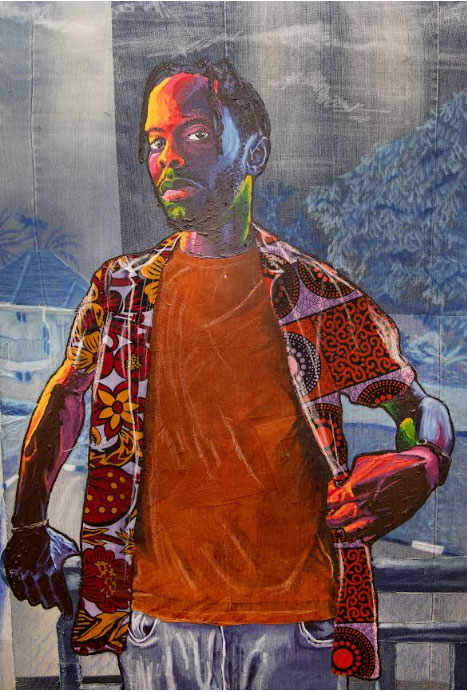
The fraught relationship between Africa and the West discussed in this body of work is silently punctuated by a tone of adaptability and negotiation, particularly represented by the Kitengi fabric. The Kitengi a common garment attached to the continent, is ironically an imported fabric from Indonesia but traces its origin to the west, in the Dutch factories. The exportation of the material to the African continent and how Africans have succeeded in adopting it and making it a staple feature of their fashion suggest the aspect of adaptability that is essential in the continent’s going forward, in spite its troubled past. This stance in the artist’s body of work that seemingly mocks western dominance and represents African identity as the perfect deal, is critical in muting propagandist sentiments that may be speculated in this work by some critics. Previous critiques of the activities of the West on the continent have been greeted with sharp criticism by some Western scholars who allege such a narrative of colonialism has been long exhausted and borders on playing victimhood in an era where Africans should be embracing reconciliation and co-existence. By drawing on the writings of African scholars in his work and working with imagery that is directly connected to his heritage, the artist is able to avert such prejudices in his work. Hence, In a Blue World becomes a platform to reflect and evaluate the direction Africa and its people should take in this age of a globalized identity.
****
The exhibition is open at Frame Space next to Afriart gallery on 7th Street, Industrial Area, Kampala.